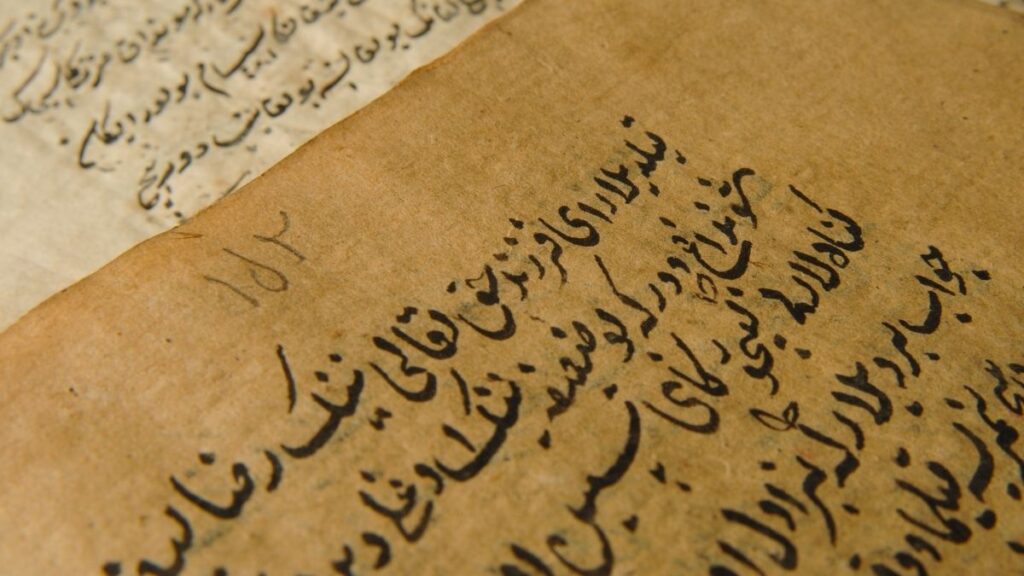
The Book al-Muqtasid in Commentary of al-Īḍāḥ

بسم الله الرحمن الرحيم
Some of my excellent students—those committed to knowledge, eager to grasp deeper meanings, and drawn to what lies beyond the outward surface of grammatical studies—said to me: “O our teacher, we often hear you praise the book al-Muqtasid by ʿAbd al-Qāhir al-Jurjānī (d. 471 AH), and you commend it in a manner that seems to us to elevate it above other works, placing it in a rank we are not accustomed to see any book of grammar attain. Would you kindly write a short article describing this book comprehensively, clarifying what makes it worthy of such admiration, and uncovering the qualities that give it such a distinguished status and make it deserving of deeper study? For you, our teacher, are a man who believes in contemplation, who does not speak without reflection, and does not pass judgment without thorough investigation. If you then make a definitive pronouncement on a book, it is our duty to consider your words carefully, and to seek the underlying cause and motivation from you—perhaps we will come to perceive what we had not perceived, and understand what we had not understood.”
I replied to them—and I am not among those who withhold from their students what they believe or consider, nor one who hides from them the pleasures of thought he has tasted or the intricacies of a discipline he has discovered: Yes, I have indeed praised al-Muqtasid, and my praise of it does not arise from partiality, nor from the kind of exaggeration that entraps one taken by a great name or the reputation of a renowned scholar. Rather, my praise springs from a mind that has thoroughly explored books, travelled the pathways of grammar, and wandered the valleys of eloquence—until, when it paused at the works of ʿAbd al-Qāhir and read this particular book, it found itself before an extraordinary intellect and a form of thought unaccustomed among the ranks of authored works.
How easy it is for a person to describe a book as noble, useful, or great. But how difficult it is to prove that statement, to establish evidence for it, and to express it through an analysis that convinces the reader and communicates the truth of the matter. Therefore, I do not consider ʿAbd al-Qāhir al-Jurjānī a man one can bypass in the history of Arabic grammar and rhetoric. Rather, I see none who devoted himself sincerely to these sciences except that he came to a halt before him and his works, and came away with ample provisions and unending amazement.
As for al-Muqtasid, it is a just witness to the genius of ʿAbd al-Qāhir—not because it is his longest book, nor because it is richest in material, but because it is a mature distillation, written after a long course of intellectual experience. It came after he authored al-Mughni, a commentary on al-Īḍāḥ by Abū ʿAlī al-Fārisī, a book that encompassed the minutiae of grammar, but indulged in such detail as to burden learners. ʿAbd al-Qāhir soon recognised that excessive elaboration might repel the student, and that expansion might obstruct understanding. Thus, he chose to summarise—not in a way that weakens, but in a way that refines and brings closer—and so came al-Muqtasid.
It is not, as some assume, a mere summary of al-Mughni in abbreviated form, but a different book entirely, a new face of his thought. In it, ʿAbd al-Qāhir rebuilt the science upon a foundation that eases comprehension and fosters appreciation, without compromising precision or demeaning meaning. He himself made his intention clear when he wrote:
“You expressed your desire—may God support you—to truly study the book al-Īḍāḥ and attain its meanings and subtleties. You mentioned that what I had written in the book known as al-Mughni is not within the reach of everyone to benefit from, due to the multitude of issues and length of its sections… So you resolved that I should dictate to you a medium-length book that would lead the reader to the aims of al-Īḍāḥ…
I shall mention, by the help of God, what removes the obscurity of difficulty and shines light upon meaning, without exceeding what is essential to its objectives, or to its necessary branches and principles.”
This, in itself, is a pinnacle of scholarly etiquette—attainable only by one who values the reader’s intellect, respects his time and effort, and aims to benefit rather than boast. Al-Muqtasid thus became a book that blends teaching with contemplation, precision with ease, and depth with clarity.
One who skims the book casually is not like one who lingers over it and penetrates its depths. For whoever is patient with it and explores its inner layers soon sees the influence of logic—not just superficially, but in its method and objective. ʿAbd al-Qāhir was clearly among those who did not reject Aristotelian logic when it entered the Islamic sciences, nor did he submit to it blindly. Rather, he received it with a critical intellect, refined it, and re-employed it in service of the Arabic language, presenting it in a form suited to Arabic taste and the distinctiveness of Islamic rhetoric.
Therefore, in al-Muqtasid, we find something unfamiliar in earlier grammatical works: definitions built upon logical ḥadd (limits), accounting for genus and differentia, and formulated with precision that leaves no room for ambiguity. Its structure is built on categorisation, exclusion, opposition, and analogy—akin to the methods of logicians—not for ornament, but to make the subject intelligible and accessible to the mind in a clear conceptual form.
When ʿAbd al-Qāhir presented examples, he did not merely recycle inherited quotations. Rather, he knew how to craft original examples, as though he were testing the language himself. He cited pre-Islamic poetry, referenced the Qurʾān, and occasionally drew on examples from Persian or Hindi—evidence of his wide intellectual horizons, vast knowledge, and his zeal to benefit from whatever was available to him.
His logic was not dry, nor his thought rigid. Rather, it pulsed with life, illuminated with clarity, and addressed both intuition and reason. Thus, al-Muqtasid never lost its Arabic spirit. It remained faithful to Arab aesthetic in expression and sincere in its service to clarity of speech. In it, we witness how logic becomes a path to eloquence, not a hindrance to it; how rational reflection becomes a prelude to understanding, not a barrier to appreciation.
This book, in my view, was a cradle for the theory of naẓm (composition) that would later appear in Dalāʾil al-iʿjāz, which established ʿAbd al-Qāhir as an imām in rhetoric, as he already was in grammar. In al-Muqtasid, we see thought still in formation; we see the seed that would one day flourish. We see the idea that words are not understood in isolation, but only in their context; that grammatical inflection is not a mere phonetic device, but a signifier of meaning and indicator of structure.
This view, though familiar to us today, was in his time a departure from the norm and a rebellion against a methodology that sought meaning in isolated words, not in integrated contexts. For ʿAbd al-Qāhir, a word has no weight by itself—it gains meaning only through its placement and intended function. This was a profound renewal in grammatical theory in his age.
And it is not hidden from the discerning that this vision was, as the Westerners say, germinal—in seed form. It later unfolded fully in Dalāʾil al-iʿjāz, until it became a comprehensive theory to which all rhetorical insight could be referred, by which the eloquence of speech, the miraculousness of the Qurʾān, and the splendour of poetry could be explained.
People are drawn to Dalāʾil al-iʿjāz and Asrār al-balāghah for their brilliance and originality. Yet al-Muqtasid was no less influential, even if this influence was hidden to some. It was among the early foundations for building grammar upon solid rational principles.
It had the distinction of advancing many ideas that grammarians would discuss centuries later—from de Saussure, who saw meaning as context-dependent, to John Locke, who distinguished between inherent and communicative meaning, to Chomsky, who considered structure a gateway to the deep architecture of language.
Was ʿAbd al-Qāhir then ahead of them all? Or is it that Arab intellect, when clear and unhindered, can perceive what hasty minds fail to see? I believe that ʿAbd al-Qāhir was not a mere follower, but a pioneer—not a transmitter, but an innovator. He looked at language with an independent, original eye, and from it emerged a thought that has only become more radiant with time.
I do not claim that al-Muqtasid is the most voluminous of his works, nor the most renowned. But I say it is the most mature in thought, the most sincere in spirit, and the most refined in its union of grammar, logic, and rhetoric. In it, reason is disciplined, taste is sound, and language becomes an instrument of thought—and thought, a path to clarity of expression.
When I read al-Mughni, I find detailed knowledge. When I read Dalāʾil al-iʿjāz, I find dazzling rhetoric. But when I read al-Muqtasid, I find reason and taste working together to produce a unique book—one that teaches as it inspires, that explains as it provokes reflection. And I see between its lines a man who never left Jurjān, yet expanded the horizons of Arabic beyond all precedent.
That, my brothers, is a glimpse into al-Muqtasid, and into the mind of ʿAbd al-Qāhir al-Jurjānī. And how much more lies therein for one who knows how to read—and how to see.
Original source: