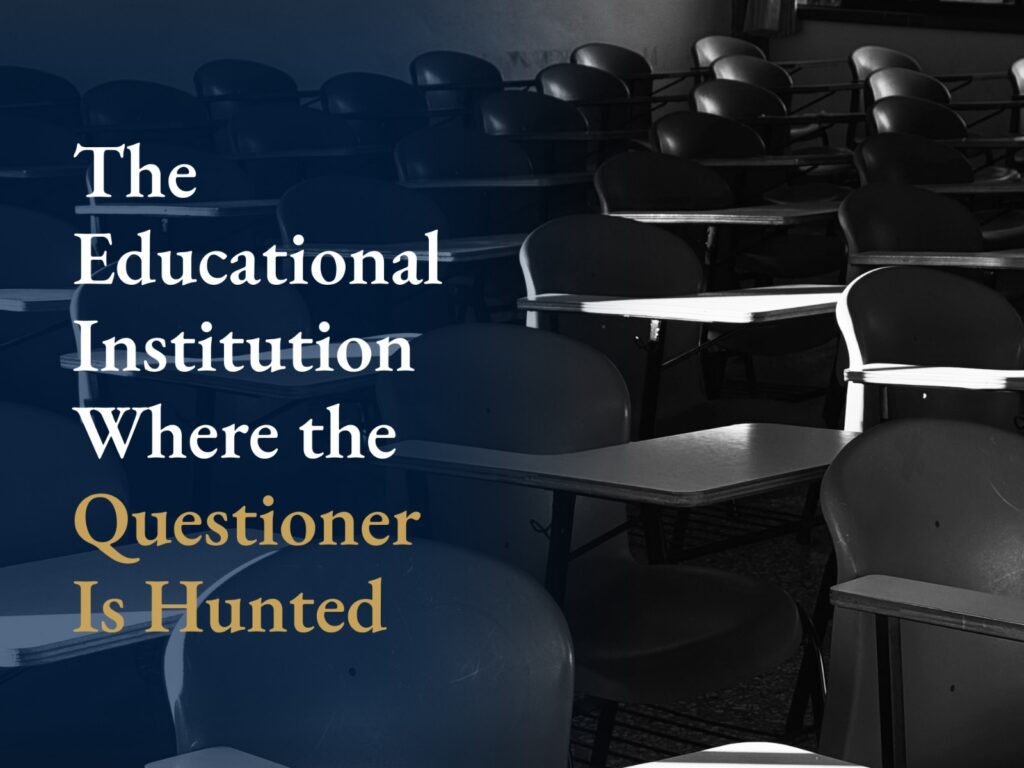
The Educational Institution Where the Questioner Is Hunted
The relationship between education and questioning is much like that between a lamp and its light. If a lamp exists but gives no light, one begins to wonder whether it has been placed there merely for display. Likewise, if there are no questions in an educational institution, one fears that education itself may have been reduced to buildings, certificates, and ceremonies.
Ever since my student days, I have suffered from a bad habit: I ask questions. Because of this habit, I have at times been considered intelligent, at times foolish, at times insolent, and at times simply too idle. Yet wherever I have stepped into an educational institution, I have observed at least one thing: when a question was asked, people would begin searching for an answer.
The universal history of the question
In the madrasas of the East, the universities of the West, ancient academies, modern research centres, small colleges, and vast educational cities, the same principle prevailed. Sometimes the teacher supplied the answer; sometimes a book did; sometimes a laboratory, a library, or years of research. At times the answer arrived immediately; at other times generations passed while the question remained alive.
The entire journey of human civilisation is, in reality, a long procession of questions.
Some restless soul once asked: What exactly is fire, that it consumes wood yet never grows fat itself?
Someone troubled by disease asked: Why do these creatures called germs seem so hostile to us?
Another, staring at the heavens throughout the night, wondered: Do the stars merely shine, or do they actually serve some purpose?
Someone else dared to ask: Is the Earth truly stationary, or are we all travelling constantly without even realising it?
These questions never allowed humanity to sit still. In pursuit of answers, people ventured into laboratories, descended into the depths of the oceans, climbed mountain peaks, and eventually reached the Moon. Indeed, it was through following such questions that humanity emerged from caves, entered laboratories, and then journeyed from laboratories to the Moon.
Science, in essence, is the autobiography of questions.
I had always assumed that at least one thing was common to all educational institutions in the world: if someone asked a question, people would seek an answer. But whenever a person begins to regard a principle as universal, Providence quickly arranges a correction.
An encounter with Mount Qaf
Thus, on one occasion, I happened to visit an island in the legendary Mount Qaf.
The island seemed to be the permanent headquarters of beauty itself. Its landscapes appeared as though a painter had stolen scenes from Paradise and pasted them onto the earth. The trees swayed not with the wind but with elegance. The flowers did not merely spread fragrance; they seemed to broadcast poetry.
The men were so handsome that mirrors appeared to adjust their shine after looking at them, and the women so enchanting that the Moon itself seemed compelled to reconsider its beauty. I thought: if beauty here is of such a standard, what must learning be like?
So I made my way to the island’s most famous educational institution. The building dazzled my eyes. It seemed as though the architects of the Taj Mahal, the Red Fort, the Alhambra, and Samarkand had all collaborated on a single project. The walls bore such intricate decorations that one might forget to seek knowledge and spend the day staring at the ceilings. The domes rose so high that clouds appeared to collide with them and then apologise.
At the entrance stood a marble plaque inscribed in golden letters:
“The House for the Acquisition of Exalted Perfections.”
The name alone impressed me. I entered.
The teachers were dressed in splendid garments. Their turbans were so lofty that some shorter teachers seemed to consist more of turban than person. Their beards possessed such dignity that one might imagine all wisdom had gathered there and nowhere else.
I sat in on a class. The respected teacher arrived. At once, the students straightened themselves as though military regulations had suddenly been imposed upon the human body. The lesson began. The teacher spoke, and the students listened. The teacher spoke, and the students listened. The teacher spoke, and the students listened.
The process continued with such silence and obedience that for a moment I wondered whether I was in a classroom or in a factory producing nodding heads rather than ideas. Eventually the lesson ended.
A fortress of fear
My old illness awoke once more. Politely, I raised my hand and asked a question. What followed was extraordinary. It was as though lightning had struck the room.
One student dropped his pen in panic. Another involuntarily exclaimed, “Astaghfirullah!” A third stared at me as though I were not a human being but the representative of some extinct species. The teacher’s eyes widened. His expression resembled that of a man who opens a cupboard and discovers a lion inside.
For several moments there was such silence that, had a pin fallen, disciplinary action might have been taken against it as well. I whispered to the student sitting beside me:
“Is everything all right?”
He glanced around nervously and replied: “You don’t seem to be from here.”
“No,” I said.
“That explains why you asked a question.”
I looked at him in astonishment. “What’s wrong with that?”
“You do not know? Asking questions in this institution is a crime.”
Assuming he was joking, I laughed. He did not. I stopped laughing.
“A crime?”
“Yes. A serious crime.”
“But why?”
“Because questions create doubts. Doubts create thought. Thought creates inquiry. Inquiry endangers old certainties. Therefore, the question is arrested at the very beginning.”
I said: “But throughout the world, people search for answers to questions.”
“That,” he replied, “is precisely what makes our institution unique. Everywhere else, when someone asks a question, people search for the answer. Here, when someone asks a question, people search for the questioner.”
“What happens to him then?”
The student shivered. “If you knew, your hair would stand on end.”
I insisted. He continued:
“First, his intentions are examined. Then his associations. Then his friends. Then his teachers. Then his old notebooks. If the question still survives all that, a committee is formed to investigate why the question arose in the first place.”
“And the answer?” I asked.
He looked at me in bewilderment. “The answer?” He pronounced the word answer as though I had mentioned the name of some extinct animal.
At that moment, a commotion erupted outside. People were running. Someone shouted: “The Director is coming! Find the questioner!”
The entire institution sprang into action. Those who moments before had appeared to be servants of knowledge now resembled a hunting party.
Looking through the window, I saw a long procession approaching. At the front was the administrator, followed by assistants, then guards, and among them the Director himself, whose face bore the determination of a man searching not for an answer but for a dangerous criminal.
The measure of a civilization
At that instant I realised that this was not a fortress of knowledge but a fortress of fear. Books were present, but curiosity was absent. Teachers were present, but dialogue was absent. Buildings were present, but thought was absent. And when thought disappears, educational institutions gradually become museums: places where knowledge itself no longer lives and only its statues remain.
How I disappeared from that place afterwards remains a secret known only to me and the winds of Mount Qaf. Yet I returned with one conclusion.
The greatness of civilisations is not measured by the height of their towers but by how they treat those who ask questions.
Where questions are welcomed, knowledge is born. Where questions are tolerated, research emerges. Where questions are encouraged, science advances. And where questioners are hunted, only fear flourishes.
In the embrace of fear, obedient people may be produced, but not inventors; eloquent speakers may be produced, but not thinkers; buildings may be erected, but civilisations cannot be built.
For the entire history of knowledge begins with a question mark, and any institution that fears questions is, in reality, afraid of knowledge itself.