The limits of religious debate

Shaykh Akram Nadwi
Muhaddith & Islamic Scholar
The limits of religious debate
By: Dr Mohammad Akram Nadwi
Oxford
23/12/2025
Religious debate has long been employed as a means of defending doctrines, contesting rival claims, and articulating theological positions. From classical disputations in antiquity to contemporary public debates and interfaith forums, debate is often assumed to function as a pathway to religious truth or even to personal belief. Such assumptions, however, rest on a misunderstanding of what debate, as an intellectual practice, is capable of achieving. This essay argues that religious debate is fundamentally limited in scope. It advances two central claims: first, that debate establishes the superiority of one argument over another without proving the truth of the religious position defended; and second, that debate produces competition rather than faith. Recognising these limits is essential for a more accurate and responsible evaluation of religious debate.
Argumentative superiority and the question of truth:
The primary function of a religious debate is to compare the strength of competing arguments. Debate operates within a clearly defined methodological framework governed by logical coherence, rhetorical effectiveness, evidential support, and adherence to agreed rules of engagement. When a debate concludes with one position being judged superior, what has been demonstrated is the effectiveness of that argument within the confines of this framework.
This outcome must not be confused with the establishment of religious truth. Religious claims often concern metaphysical realities, such as the nature of the divine, revelation, or salvation, that lie beyond the reach of empirical verification or purely logical proof. As a result, no debate can conclusively determine the truth or falsity of such claims. A successful argument indicates persuasive power, not ontological certainty.
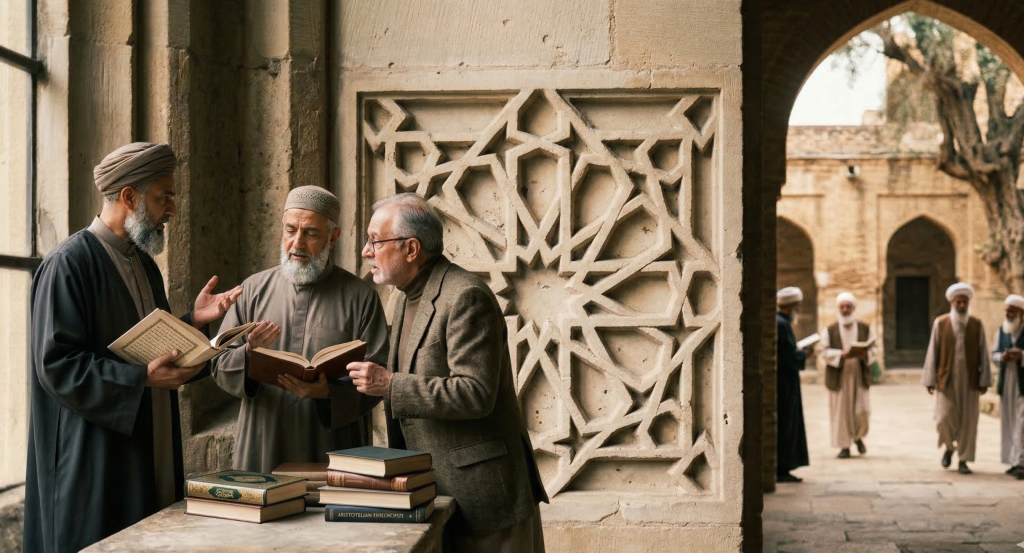
Historical examples illustrate this distinction clearly. Medieval theological disputations frequently involved scholars defending their respective religious traditions through shared philosophical resources, particularly Aristotelian logic. A participant who prevailed in such a debate did so largely because of mastery of a common intellectual language and method. The victory did not, however, compel acceptance of the underlying religious claims by those who rejected the philosophical premises themselves. The outcome thus reflected methodological proficiency rather than universal truth.
An analogy with competitive sport further clarifies this point. When one football team defeats another, the result demonstrates superior performance on a particular occasion, given specific conditions and rules. It does not establish any broader or absolute claim beyond that context. Similarly, winning a religious debate demonstrates argumentative competence, not the truth of the religion being defended. To infer truth from victory is to conflate rhetorical success with metaphysical reality.
Competition and the absence of faith formation:
The second defining feature of religious debate concerns its consequences. Debate is, by its very nature, adversarial. It presupposes opposing positions and frames intellectual engagement as a contest in which each side seeks to outperform the other. This competitive structure shapes both the behaviour of participants and the expectations of audiences.
Faith, however, is not the product of competition. Religious belief typically involves trust, commitment, moral orientation, and often personal or communal transformation. These elements cannot be generated through argument alone. While debate may challenge assumptions or stimulate reflection, it rarely produces genuine belief or conversion. At most, it may result in intellectual acknowledgement of a strong argument, which falls short of faith.
Contemporary public debates provide clear evidence of this limitation. Debates between representatives of different religions, or between religious believers and atheists, are widely circulated and vigorously discussed. Yet they seldom lead to conversion. Instead, audiences tend to interpret outcomes in ways that confirm pre-existing convictions. Debates thus function primarily as performances for supporters rather than as instruments of persuasion for opponents.
Moreover, debate discourages the vulnerability and openness typically associated with faith formation. Participants enter debates with firmly established commitments and strategic objectives. To concede belief would undermine the very premise of debate as a contest. Consequently, debate often reinforces identity boundaries and entrenches positions rather than fostering spiritual transformation.
Conclusion:
Religious debate performs a specific and limited role within intellectual and theological discourse. It demonstrates the relative strength of arguments without establishing the truth of the religious claims they defend. Like a sporting contest, it measures performance rather than essence. Furthermore, debate produces competition rather than faith, clarifying differences without creating belief. A clear understanding of these limits does not diminish the value of religious debate; rather, it situates it appropriately. When debate is recognised as a tool for clarification rather than conversion, it can contribute meaningfully to intellectual engagement without being burdened by expectations it cannot fulfil.