You Can Build the Taj Mahal, but Not the Kaʿbah
It was a Friday — the blessed moment of the fourteenth of Ṣafar, 1447 AH — when our feet touched the soil of Jeddah, and it was inscribed upon the Preserved Tablet of time that a caravan was setting out towards its true homeland. Before the hour was complete, the caravan’s direction turned towards Makkah.
O friends! This was not a road upon which ordinary caravans pass, burdened with their goods and provisions. This was a highway in which every grain of sand shimmered with the flame of supplication, every breeze was infused with the fragrance of remembrance, every turning was strewn with pearls of tears, and every gust carried the melody of hope. This was not a passage of mere sand and stone; it was the radiant ṣirāṭ of heart and faith, along which the story of earth and sky travels side by side, and the tale of heart and Lord whispers from one to the other.
What is life? A clamour of crowds, a caravan without direction, a flood of heedlessness in which a person loses his own identity. Then destiny stretches out a hand, grasps your shoulder, and places you upon a path that leads straight to that House — the House of God — which calls only to Him. I looked out from the window: the desert glistened like gold under the sun, the sands curved and bent, yet I felt neither the scorch of heat nor the thirst of dryness, for we were sealed within an air-conditioned vehicle. My heart asked: is this not the land where the footsteps of Ibrāhīm عليه السلام once pressed? Is this not the very sand beneath which the foundations of the Bayt Allāh were raised? Is this not the atmosphere in which the Noble Messenger ﷺ performed ṭawāf, strode between Ṣafā and Marwah, witnessed the descent of revelation, and moistened his lips with the Zamzam of supplication?
This road, O traveller, is a silent herald, announcing: you are near to a Presence unlike any other — a nearness that illumines the mirror within, so that a person comes to know why he has come and to where he is going.
I remembered: in all my past journeys to Makkah, each journey was a new world — a world whose sky matched no other sky, whose earth joined with no other earth, and whose air blew from no other air. Each time I returned, my heart carried a treasure — a treasure which neither the letter of speech could preserve nor the tip of a pen could confine. And in my simplicity, I would imagine that now I had attained the final secret, that I had drunk the cup which silences all questions and quenches all thirsts. Yet the next journey would arrive, shattering my assumption: it would be vaster in expanse, deeper in meaning, greater in impact — opening a door I had never even imagined, revealing a secret that did not erase the earlier ones but rather increased and brightened them. Every visit is a book; and when you finish it, you realise that it was merely the preface, and that the true chapters are still to come.
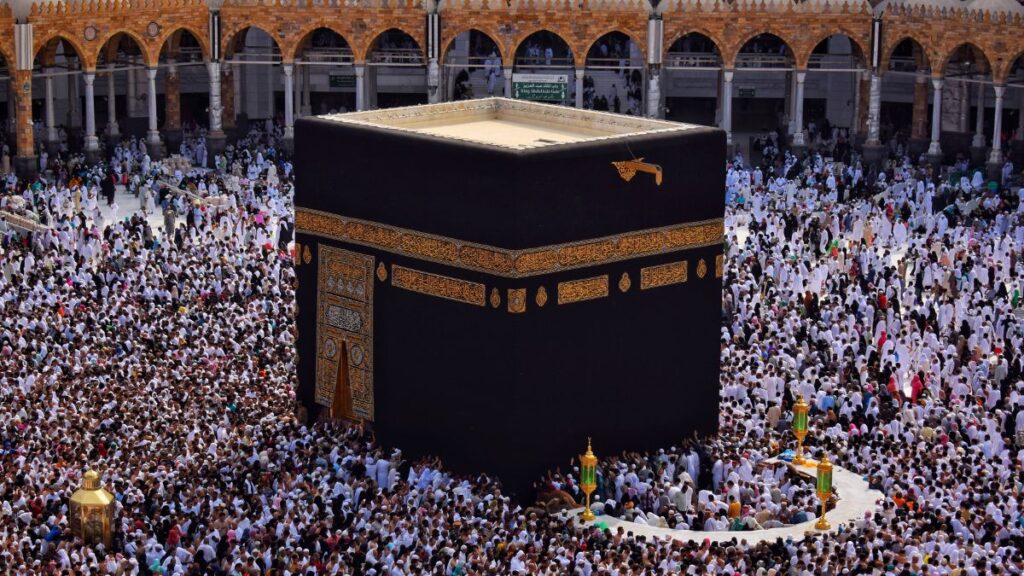
After the Friday prayer, precisely at half-past two, we set out for ʿumrah. When we reached midway, the minarets of the Ḥaram rose upon the horizon like pillars of light, lifting from the earth and disappearing into the canopy of the sky. My heart trembled — was it weeping, was it joy, was it wonder? I wished that my heart might reach inside before my feet did, that I might cling to the Black Stone, that before removing my shoes I might gather all the radiance.
The believer’s distance from the Bayt Allāh — that sacred House which God has made a canopy of mercy and the tranquillity of hearts — is in truth like turning away from the treasure of one’s very being. Such distance is not only a loss and diminishment in the path and practice of guidance; it breeds corruption and disorder in heart and soul. Whoever does not turn towards God is astray from his true destination; and whoever withdraws from His refuge is lost in darkness.
O dwellers of East and West! If the full moon of Badr were to set, perhaps you could fashion another moon. If the sun of dawn delayed its rising, perhaps you could produce another sun. But tell me — can you build a House like the House of Ibrāhīm? Go, build the Taj Mahal — not one but a hundred — one in every land, one in every city; yet know that they will all be lifeless tombs. That is your reality. You, and all mankind and jinn, indeed all creation together, could never build that Kaʿbah — the very axis of life for the people of earth, upon which rests the foundation of human existence, whose blessings spread to every direction, and whose beneficence encompasses centuries.
O Lord of the pure and sacred House! By the grace of that House, grant me a new life. Illuminate my restless heart with the radiant light of Ibrāhīm’s faith, adorn it with the ever-burning lamp of certainty, so that in Your presence I may be humbled with devotion, and filled with love and steadfastness in my prostration.
I returned from ṭawāf — but my heart remained there, where the light is, where the minarets are, where the tranquillity is that never ends. Indeed, beholding the symbols of God shatters the locks of heedlessness. Alas for my desires! The more I restrain them, the more they grow. O Allāh! By Your mercy grant me mastery over them, and grant me the company of the righteous.
Original source: