Women in Islamic Scholarship: A Historical Perspective

Preface
, United Kingdom
All praise is due to Allah, the Lord of all worlds. We praise Him, seek His help and forgiveness, believe in Him, and rely upon Him. May peace and blessings be upon our master, Muhammad, the Seal of the Prophets, his family, companions, and all those who follow them in righteousness until the Day of Judgment.
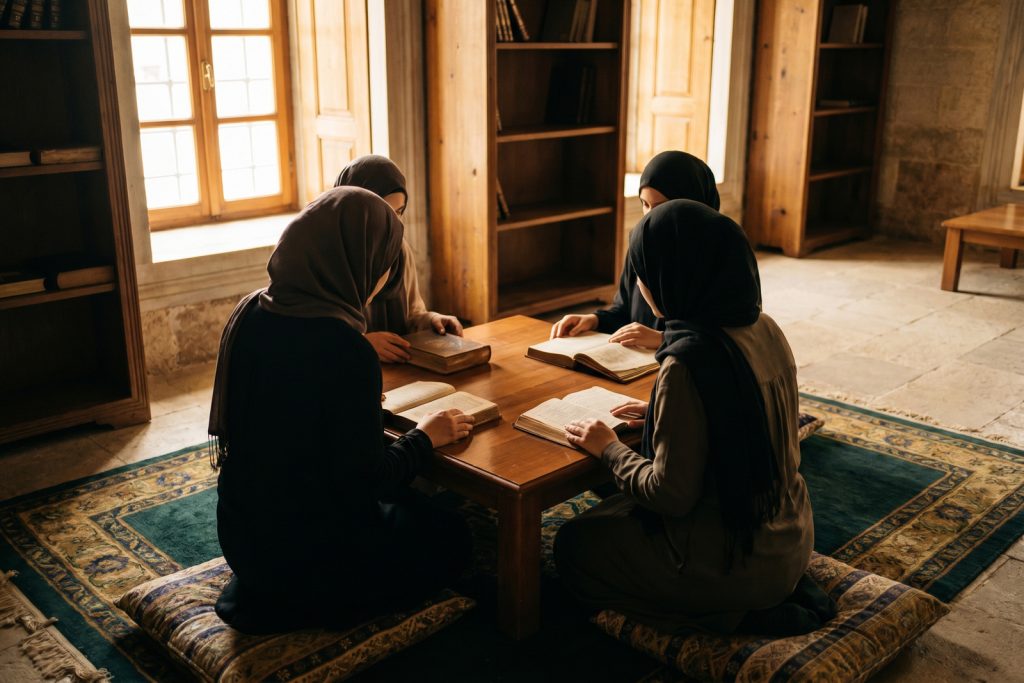
A thorough and unbiased study of the intellectual history of Islamic civilization clearly reveals that the role of women in shaping the intellectual, spiritual, and scholarly fabric of the Muslim Ummah has never been marginal, temporary, or incidental. Rather, they have been a vibrant, effective, and permanent element of this grand civilizational process. The Holy Qur’an addresses both men and women equally in matters of knowledge, understanding of religion, piety, moral responsibility, and religious consciousness. During the Prophetic era, this Qur’anic principle manifested in such a way that women not only actively participated in acquiring religious knowledge but also made significant contributions in the fields of Hadith narration, jurisprudence, issuing legal opinions, teaching, ijtihad, community training, and scholarly discussions.
However, as the process of documenting Islamic history became confined to formal, class-based, and institutional frameworks, the scholarly contributions of women gradually receded into the background. Particularly in sciences like jurisprudence and legal opinion, which later became predominantly male domains, women’s genuine participation was either underrepresented or portrayed as partial, exceptional, and ineffective. Yet, historical sources, biographical dictionaries, classes, jurisprudential traditions, and scholarly credentials provide clear evidence that women’s participation in Islamic scholarly tradition was not only present but, in certain periods, they held positions of leadership and guidance in issuing legal opinions, teaching, deriving rulings, and scholarly guidance.
Therefore, it is indeed commendable that my close friend, long-time companion, esteemed researcher, and writer, Dr. Muhammad Razi-ul-Islam Nadwi, has made a serious, beneficial, and scholarly effort to revive this forgotten scholarly tradition through his work “Tadhkirah al-Faqihāt.” In my view, this book is not merely a collection of biographical accounts but an important endeavor in the scholarly rediscovery and civilizational revival of a neglected aspect of Islamic jurisprudential history. Its significance is further enhanced by the fact that in the Urdu language, such comprehensive, coherent, scholarly, and documentary work on this subject is rare.
Dr. Razi-ul-Islam Nadwi is counted among the distinguished scholars of the subcontinent who have played a quiet yet highly effective role in the fields of contemporary Islamic thought, jurisprudence, legal opinion, da’wah, social reform, and scholarly awakening. He is not merely a prolific author but a representative of a living intellectual and reformist tradition. His scholarly persona combines Nadwi scholarly taste, da’wah consciousness, reformist thought, scholarly seriousness, and intellectual moderation in such a harmonious manner that his writings not only serve as a repository of information but also expand the intellectual horizons of the reader. His numerous books on Islamic sciences, intellectual debates, women’s issues, biography, social reform, and da’wah topics are published and regarded with trust, benefit, and esteem in serious scholarly circles. His writings are marked by scholarly integrity, balance, moderation, purposefulness, and da’wah insight, which are rare qualities in the present age.
To understand his personality and intellectual temperament, it is also necessary to mention the righteous and religious family whose reformist tradition played a fundamental role in shaping his intellectual and moral identity. His late father was among the sincere reformists who, in an environment where customs, innovations, and non-Islamic social behaviors were deeply entrenched, quietly yet effectively strove for the awakening of true religious consciousness and the propagation of Islamic beliefs. His life was not limited to individual piety or personal worship but was characterized by the service of da’wah, social reform, and Islamic symbols. This is why he made the construction of a mosque his investment for the Hereafter in the last days of his life. Indeed, families founded on sincerity, da’wah, service to humanity, and reform of the Ummah give rise to such blessed traditions of knowledge and action that continue to influence generation after generation. Dr. Razi-ul-Islam Nadwi’s scholarly, da’wah, and reformist personality seems to be a natural extension of this righteous environment.
In the subcontinent, Jamaat-e-Islami has played a historical role in creating religious consciousness among the modern educated class, combating intellectual and ideological deviations, and presenting Islam as a living civilizational, intellectual, and moral force. The impact of this reformist and da’wah environment is clearly evident in the intellectual formation of Dr. Razi-ul-Islam Nadwi. The purposefulness, scholarly seriousness, moderation, humility, and religious consciousness found in him are not merely the products of educational institutions but the fruit of a living reformist tradition. The scholarly atmosphere of Nadwatul Ulama instilled in him a scholarly taste, research insight, and a deep connection with Arabic and Islamic sciences, while his association with the da’wah and reformist movement gave his knowledge purpose, direction, and practical significance. This is why his writings not only contain scholarly information but also reflect the concerns for the intellectual, moral, and civilizational issues of the Ummah.
Personally, I have had a particular scholarly affinity with this subject. My work “Al-Wafa bi Asma al-Nisa” was primarily an effort to compile the scholarly contributions of those Muslim women who played a prominent role in the preservation, dissemination, and teaching of Hadith and Prophetic sciences. During this work, it repeatedly became evident that the scope of women’s contributions in the Islamic scholarly tradition was not limited to Hadith narration but extended significantly and comprehensively to jurisprudence, legal opinion, principles of jurisprudence, teaching, derivation, and scholarly discussions. Therefore, I consider “Tadhkirah al-Faqihāt” an important extension and completion of this scholarly series. Dr. Razi-ul-Islam Nadwi has organized this subject with commendable diligence, pursuit, historical awareness, scholarly integrity, and research thoroughness.
A notable feature of this book is that the author has not confined himself to well-known and widely discussed personalities but has also endeavored to uncover and bring to light those women from various centuries, regions, scholarly centers, and jurisprudential schools whose mention is less common in general scholarly discussions. This forcefully brings to the fore the reality that women’s jurisprudential contributions were not exceptional or accidental phenomena but a natural and indispensable part of the scholarly structure and jurisprudential tradition of Islamic civilization.
This book is also of great importance in another respect as it brings balance to our contemporary scholarly and intellectual debates. In the present age, there are two extremes regarding women’s religious education and jurisprudential participation: on one side are those circles that attempt to prove the Islamic tradition as limited, static, and inactive concerning women’s scholarly roles, and on the other side are those trends that, under the pressure of modern intellectual influences, present a reinterpretation of Islamic history devoid of historical balance. This book, distinct from both extremes, presents a balanced and credible narrative based on pure scholarly, historical, and documentary foundations. It provides strong evidence that women’s scholarly role in the Islamic tradition was neither merely symbolic nor temporary but an effective and active part of the scholarly continuity and jurisprudential tradition.
While reading the book, one intensely feels that the Muslim Ummah has forgotten a significant portion of its scholarly memory. Until Islamic intellectual history is read with all its classes, scholarly centers, and influential elements, a complete and balanced picture cannot emerge. Ignoring women’s scholarly contributions is tantamount to reading the intellectual history of Islamic civilization in an incomplete and flawed manner. Dr. Razi-ul-Islam Nadwi’s work is a serious, scholarly, and commendable effort to rectify this incompleteness.
I am confident that “Tadhkirah al-Faqihāt” will not only prove beneficial for scholars, university students, and madrasa students but will also provide a strong foundation for future research. Especially for the new generation of Muslim female students, this book will serve as living evidence that the Islamic scholarly tradition has always offered them breadth, possibility, role models, and historical precedents. If this book results in the creation of a new atmosphere of serious scholarly training, specialization, and research interest among women in jurisprudence and Islamic sciences, it will undoubtedly be a great scholarly ongoing charity for its author.
I extend heartfelt congratulations to my dear friend Dr. Muhammad Razi-ul-Islam Nadwi for this invaluable scholarly service and pray that Allah Almighty grants acceptance to this work, makes it beneficial for the Ummah, and bestows further expansion, blessing, acceptance, and impact on the author’s scholarly, intellectual, and da’wah services.
And my success is not but through Allah. Upon Him I have relied, and to Him I return.
Muhammad Akram Nadwi,
17th Dhu al-Qi’dah 1447 AH