Tīmūr Lang – The Final Verdict
This was my third journey to Uzbekistan. The details of the first two trips have been recorded in my Arabic book Riḥlat Ūzbakistān. This third visit took place in May–June 2025, accompanied by nearly one hundred students of Al-Salam Institute. Praise be to Allah, I maintained the habit of writing a daily journal throughout the trip. The travelogue was written in Arabic, but selected reflections have also been shared from time to time in Urdu for the interest of readers.
On this trip, we had two tour guides: one was called Alugh Beg and the other Raḥmatullāh. Both were Muslim residents of Tashkent, each around forty years of age. Alugh Beg was the main guide, and Raḥmatullāh his assistant. Both were gentle-natured, sympathetic, patient, and sincere. Alugh Beg loves Islam and Muslims but is somewhat distant in practice, whereas Raḥmatullāh is a practicing Muslim.
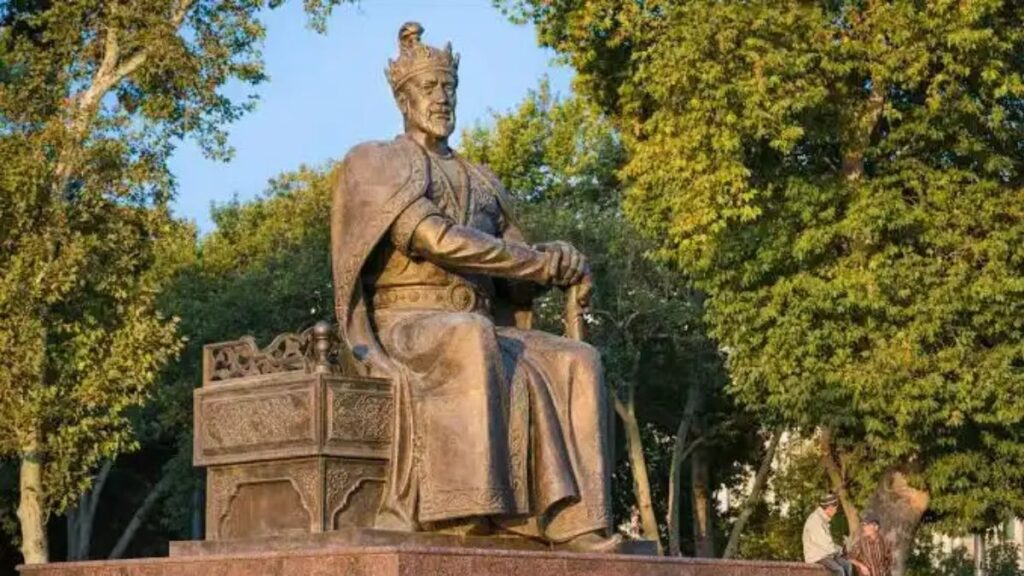
The hero of strength and resolve whose name is mentioned in every gathering in Uzbekistan, and whose memory is alive on every tongue, is Tīmūr Lang. His reverence in the hearts of Uzbeks can be gauged from the numerous monuments and sites associated with him throughout Samarkand and other cities of Uzbekistan.
Alugh Beg praised Tīmūr Lang, mapped out his conquests, and narrated his exploits. Among our group were many Arabs who did not appreciate such praise. Arabs consider Tīmūr Lang a successor to Chingīz Khān and Hulāgū Khān. The devastation he caused in Egypt, Syria, and Iraq is well documented in the annals of history. Iqbāl, in one place, pairs Tīmūr with Chingīz Khān:
> Royalty breeds madness in its trail,
God’s scalpels are Tīmūr or Chingīz.
ʿAlī Sardār Jāfarī writes:
> Chingīz, Nādir, and Tīmūr passed this way,
Carrying blood-soaked torches in hand.
One of the students asked me about the view of Tīmūr in India. I replied that Tīmūr Lang ransacked Delhi just as he devastated other parts of the Muslim world. Therefore, he is certainly not viewed favourably in India. However, because the Mughal rulers of India claimed descent from Tīmūr, and because India remains forever indebted to the Mughals for their services, many people see Tīmūr merely as a determined and courageous invader and the founder of an empire.
The greatness hidden in this line of Iqbāl is evident:
> The zeal called ḥamiyyah departed from the house of Tīmūr.
In another place, Iqbāl says:
> The surge of Tīmūr’s action was all-encompassing;
Before a flood, what value is high or low ground?
The father of Urdu, Maulvī ʿAbd al-Ḥaqq, writes in the preface to Intikhāb-e-Mīr:
> “Delhi at that time had a special place in history. It was the soul of India and the capital of the Mughal Empire, yet it was the target of calamities from all sides. Her state was like a woman who, though not widowed, suffered more than widows. The descendants of determined men like Tīmūr and Bābur sat lifelessly upon their globally famed throne, like portraits without spirit.”
I added that Tīmūr Lang plundered the world, but he built up his own land. The development that cities like Samarkand saw during his time explains why its residents may still love him – and it is not surprising.
When Tīmūr heard of Ḥāfiẓ Shīrāzī’s couplet:
> If that Turk of Shīrāz takes my heart in hand,
I’d give away Samarkand and Bukhārā for her mole.
He was furious and said: “The cities I built by conquering the entire world, this poet is offering them away for a black mole of his beloved!” But Ḥāfiẓ’s verse was mere poetry – he did not own even an inch of Samarkand or Bukhārā, so how could he give them away?
When the debate around Tīmūr intensified, our companions turned to Raḥmatullāh and asked for his view. True to his nature and sense of fairness, he replied:
“When someone praises Tīmūr, others begin to criticise him. And when someone denounces him, there are always those who rush to defend him. I too could say something, but this debate will not end with my words. Let Tīmūr’s case be left to Allah. On the Day of Judgement, His verdict will be the final one – and whatever the Most Just of Judges decides, everyone will acknowledge it as justice.”
We did laugh at Raḥmatullāh’s remark, but that laughter quickly turned to seriousness. The debate did not resume after that.
How many matters do we debate day and night, through which bitterness increases and no resolution is reached in the end? Why not, then, take Raḥmatullāh’s advice and leave our differences to be resolved on the Day of Reckoning?
Original source:
View the original Telegram post.