Lost Souls in a Tumultuous Era

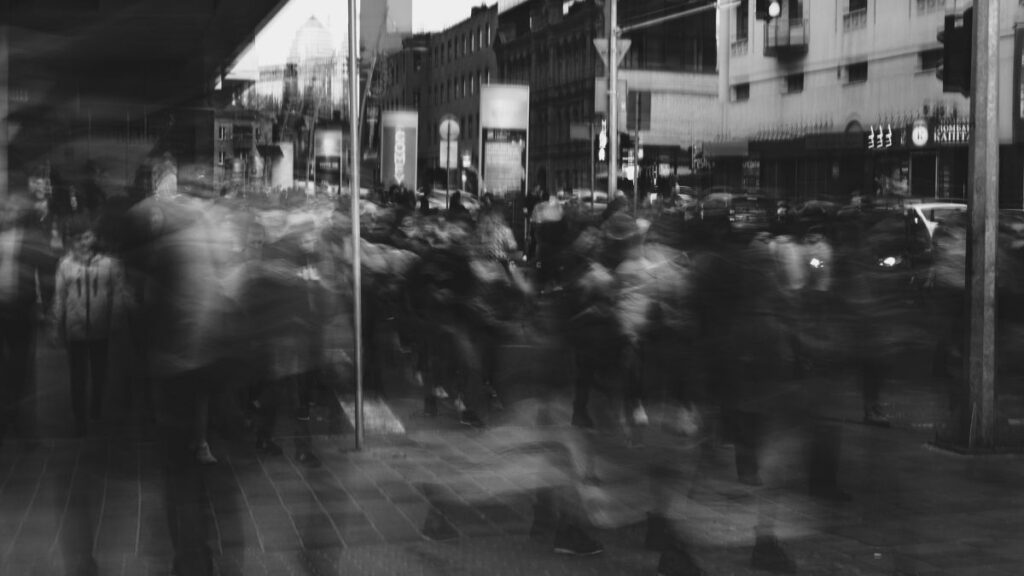
In this era, humanity is inundated with sounds unheard by its ancestors for centuries: the clamor of metal in motion, the hum of machines at work, and the bustling noise of cities, pulsating with life as if a single restless entity. Yet, amidst this cacophony, seldom does one listen to the subtle voice dwelling within—the voice of the soul in moments of clarity or silent sorrow, shared with none.
Today, countless faces pass before our eyes—on streets, screens, and in mirrors of glass and light. Yet this multitude of faces has only distanced us from understanding our own, as if the modern human has forgotten their original visage, or it has become a faded reflection in a misty mirror.
Surrounded by so much light, it seems as though night has vanished forever, and the world has become an eternal day, unacquainted with dusk. However, this profusion of light has not dispelled the darkness within; rather, it may have deepened and concealed it. Not every light reveals, nor does every brightness illuminate the heart. How often does external brilliance grow while the heart within becomes more desolate and solitary, buried in an unending silence?
The clamor of life has intensified to the point where silence itself has become an alien thing, feared not for its pain but for the truths it unveils, which noise once concealed. People flee from solitude as they do from confronting themselves. When alone, they hear a faint, sorrowful voice within, persistent and sincere, despite attempts to silence it with worldly distractions.
I wonder: Is what we perceive as progress truly advancement, as people claim, or is it a transformation that has only deepened human bewilderment and misery?
Humanity has managed to bridge distances, bringing the far near and making the entire earth seem like a small room where sound and image travel in an instant. Yet, with all this, it has not drawn a single sincere step closer to itself. Perhaps, as knowledge of the external world increases, alienation from the internal world deepens, and as hands fill with what is termed achievement, the heart grows emptier, unfulfilled.
We live in an era seemingly ignorant of pause; everything rushes forward, as if time itself has lost its ancient tranquility, now racing restlessly. People hurry, machines accelerate, thoughts hasten, even rest has become a brief stop on the long journey of haste. No longer does one find in their day a moment to pause and reflect at sunset or listen to the rain tapping on windows, like an ancient message from heaven to earth.
It is as if this era has decreed that humanity be deprived of moments of stillness, of those minutes when the ancients would sit with themselves as with a true friend, neither feared nor avoided. Even night, once a time for calm and reflection, has become an extension of day, differing only in the color of the sky; the noise persists, and anxiety remains.
I believe the gravest affliction of this age is not the physical exhaustion or the rapid pace of life, but the strange emptiness that has befallen the soul. One may possess things unimaginable before, yet within lies a vast emptiness, like an endless desert, as if this external fullness has only widened the internal void.
People laugh often, but sometimes their laughter signifies not joy, but a social habit devoid of spirit. They speak at length, yet their words may not spring from the heart, but from a memory crowded with sounds, no longer discerning which are genuine and which fleeting.
In past times, humanity knew less, yet perhaps was closer to itself, more at peace, and purer in feeling. They gazed at the sky and saw not just a material void, but a meaning beyond sight. Night was not merely the absence of the sun, but another presence of tranquility. The home was a place of human warmth, not just walls sheltering the body.
The modern human, however, has surrounded themselves with devices and means, living as if within a world of tools, not a world of meanings. Life is measured by possessions, not by being, by outward success, not by inner depth.
I fear that people have gradually lost their sense of the intrinsic value of humanity itself; a person is now valued by wealth or fame, not by purity or truth. Forgotten is the truth that a human is not a machine, nor a number to be calculated, but a soul seeking its meaning in existence.
The Essence of Humanity Beyond Materialism
I do not advocate for the rejection of civilization, for such an attitude lacks wisdom and reason. However, I assert that if a person were to possess the entire world yet lose their own self, they have indeed lost everything. What value does this external abundance hold if the heart is devoid of tranquility? And what worth is this external light if the soul is engulfed in its own darkness?
Today, souls appear lost—not because they have lost their way, but because they have forgotten that they ever had a path. They seek peace amidst noise, meaning in abundance, and tranquility in haste, only to find more anxiety.
If a person were to grant themselves a moment of honesty, away from all this chaos, they would hear a different voice, unlike the sounds of the world—a faint yet profound voice, as if an ancient call from the depths of the soul, urging them to remember themselves and return to the simplicity of the original meaning.
Perhaps, in the end, a person does not need the multitude of things they believe they cannot live without. Perhaps their greatest need is not for more, but for the pure and simple; for a heart at peace, a soul unafraid of silence, and a moment of truth where they feel they have not strayed far from themselves.
Humanity will continue to draw closer in distance yet drift apart in meaning until one day it realizes that civilization is not in the abundance of what we possess, but in the depth of what we feel. A person truly becomes human when they listen to their heart as attentively as they listen to the world, in a balance where the inner is not lost to the outer, nor the outer to the inner.
Translation note: This article was translated by AI. View the original Telegram post.