Journey to Turkey (25)
(25)
We set out for Istanbul at dawn, at a time when the night still clung to the edges of the sky like an old man holding onto his last memories. The city was waking slowly, like a woman exhausted by a sleepless night, roused by a distant sound, unsure if it was the call of life or the echo of a dream that had passed. The roads were damp with the morning dew, and the cars moved quietly, as if afraid to awaken the silence prematurely.
Our driver for this journey was Brother Saifullah, a man of Turkmen origin. He was not like those who carry their homelands only in their passports; he carried it in his voice, his accent, and his longing, in his remarkable way of moving from one conversation to another, like a bird hopping effortlessly between branches. He had lived in Turkey for a long time, becoming familiar with its lands and cities, and had married a Pakistani woman, as if his life was mapped out from the plains of Central Asia to the mountains of Anatolia and the valleys of Punjab.
He was a young man with a pleasant spirit and quick wit, possessing a charming lightness that made the journey seem shorter. His conversation was not mere stories; it was like a caravan passing through the soul, laden with images of lands, people, scents, and sounds. He spoke to me about the Turkmen, about the scattered villages in Turkmenistan like beads of a rosary spilled on a sandy carpet, about Turkey where the scent of the sea mingles with the call of the minarets, about Afghanistan resembling a wounded man refusing to fall, about Syria which, despite its trials, retains a whiff of historical fragrance, and about Pakistan where the markets are crowded with colors, noise, spices, and faces.
He spoke of these lands not as a tourist speaks of places, but as a son speaks of family members; aware of their flaws yet loving them still, complaining about them with a smile. Listening to him, I felt that the Islamic world, despite its vast distances, was but a large house with many rooms, different languages, but one roof, one sorrow, and one longing.
He mentioned his wife residing in Pakistan, and his voice softened slightly, like a string touched by an unseen hand. Laughing, he said, “I long for biryani like a stranger longs for the scent of home.” I laughed, but I realized that a person’s deepest yearnings might hide in the simplest things; in a familiar dish, a known scent, or a cup of tea once shared with a loved one. Memories often conceal themselves in small things, like stars hiding behind the mist.
What impressed me about this young man was his beautiful recitation of the Quran, articulating the letters with calmness and reverence. The road to Istanbul stretched before us like a ribbon of memories laid upon the earth. We passed small villages like dream stations, green hills flowed in the horizon like waves, and trees lined the road like silent soldiers guarding the morning. The sun rose gradually, its light spreading over the plains like ink on a white page.
We arrived at Al-Kawthariyya School at nine in the morning. The school stood in a quiet reminiscent of old scholarly corners, like a small island of dignity in a turbulent world. It is named after our great teacher, the scholar Imam Muhammad Zahid al-Kawthari, a man who lived for knowledge as others live for life, wielding his pen like a sword to defend the heritage of the Ummah, his name becoming a high minaret guiding seekers of truth and research.
Al-Kawthariyya is dedicated to teaching girls Arabic and Islamic sciences, but it is not a school in the cold sense of the word; it carries an educational spirit embodied in its structure.
We were warmly received by Mrs. Faizan, the head of the institute, with genuine warmth, not the performed kind. She showed me around the school facilities, where students and teachers moved with composed serenity, as if knowledge had cast a veil of dignity over their souls. The faces were modestly veiled, without affectation or pretense, but with a modesty akin to a subtle fragrance; unseen yet felt in everything.
Walking through the school corridors, I felt that the Arabic language, despite the weariness of years, still had the power to unite hearts as a mother gathers her children around a single table. I saw books of grammar, exegesis, and hadith, and heard Arabic words spoken by non-Arabic tongues, filling me with hope, for when a language travels far and finds love in exile, it is like a tree uprooted from its land yet determined to bloom anew.
The students sat with me for a bilingual discussion in Arabic and English, asking about the pursuit of knowledge, reading, and building an academic self. Their questions reflected intelligence and good upbringing, for a good question is as valuable as a good answer; often, the question is a mirror of the mind and spirit.
We then had a light breakfast, rich in affection. Often, affection is a subtle nourishment that fills the soul more than bread does.
Afterward, I delivered a talk about my book “Al-Wafa bi Asma al-Nisa.” I did not want it to be merely a presentation of a book, but a reflection on the Islamic memory that has often wronged women by forgetting them. I spoke about female scholars, narrators, and writers, about names overshadowed by those of men, like light hidden behind walls, and the need to restore these bright pages of our history.
The students listened with interest, and I felt as if the words were falling into their hearts like rain on thirsty ground. The questions that followed the lecture were eager and sincere in their quest for knowledge, not mere passing curiosity.
The teachers of Al-Kawthariyya spoke to me about our teacher, Imam Abu al-Hasan al-Nadwi, may Allah have mercy on him, and the presence of his books in the Levant, how his words still flow among people like rivers in parched land. They mentioned his book “What the World Lost by the Decline of Muslims,” as if they were not mentioning a book but an alarm bell still ringing in the conscience of the Ummah. They spoke of “The Path to Medina” and his book on the Prophet’s biography, elaborating on its impact on souls.
We returned to Kocaeli around two in the afternoon, with the sun at its zenith and the day fully adorned. We did not linger long before heading to the Kocaeli Conference Center, where a conference organized by the Islamic Organization for Freedom and Rights was held.
The hall was grand and spacious, bustling with faces from various directions, making it seem as if the entire Islamic world had condensed itself into that hall; some came from the East carrying the concerns of minorities, others from the West bearing the wounds of identity, and others from distant lands with different languages but hearts that knew the same pain.
Dr. Bülent Şenay from the Faculty of Theology at Uludağ University in Bursa delivered the opening speech, blending the language of politics with the language of thought, like a river meeting the sea at its mouth.
Then Mufti Ibrahim Shasho from Aleppo spoke with the fervor of a believer carrying the burden of his Ummah in his chest. His voice rose at times and calmed at others, like waves that surge and then return to calm. He spoke about the Quran and Sunnah’s stance on minorities, the brotherhood of Islam that knows no geographical boundaries, saying that Muslims, though divided by lands, are like one body; if one part suffers, the whole body responds with sleeplessness and fever. He mentioned the book “What the World Lost by the Decline of Muslims,” praising it greatly, and discussed the challenges of language and identity, the danger threatening new generations when uprooted from their roots like a tree from its soil.
Dr. Abdul Razak Ahmad from Malaysia spoke about democracy and minority rights, his speech calm and composed, like a man holding a small lamp in a dense night; it does not dispel all the darkness but guides people along the way. Then Mr. Blount Yıldırım gave his speech, igniting the hall with takbeer, as if the audience found in his voice something that awakened a dormant spirit within them.
The speeches and discussions continued on Muslim minorities and their geopolitical issues, with ideas intersecting in the hall like roads in a crowded city, yet a shared sorrow united them all.
We walked to the “Al-Maida” restaurant on the shore of the Sea of Marmara, like a balcony cast between water and sky, where soft voices drifted and the scent of the sea mingled with the aroma of food, making it seem as if the place was made for companionship, with the night itself joining us at the table, silent and attentive, not interrupting conversation nor spoiling contemplation.
The sea before us was calm, like a mystic after his supplication, barely stirring except for a gentle ripple akin to the breathing of a contented sleeper. The distant lights broke upon the water’s surface, appearing at times like threads of molten gold, and at others like stars that descended from the sky and lost their way back. Watching these reflections, I felt that cities, no matter how noisy by day, rest at night upon the water, as a person finally rests upon the pillow of memory.
We dined as the evening spread its deep blue cloak over the place, neither the darkness that frightens the soul nor the light that dispels the secrets of the night, but a color in between, as if nature wished to leave the spirit something to ponder and the eye something to soothe. The sea breeze passed gently, like a mother’s tender hand wiping the fatigue from her child’s brow after a long day.
We dined in a light-hearted calm, interrupted by a conversation here, a laugh there, and a passing comment that lightened the spirits burdened by the seriousness of conferences and lengthy discussions. How remarkable is man! He spends the day discussing the world’s concerns and the issues of nations, yet in the evening, a warm loaf, good company, and a sea breeze suffice to reveal another, less noisy, more merciful face of life.
The food was served to us in succession, but the pleasure of the company was more immediate to the soul than the pleasure of the meal; for no matter how good the food, it does not reach the heart as true companionship does. I observed the faces around me, each bearing a story, each eye hiding behind it a long journey, an exile, or a postponed wish.
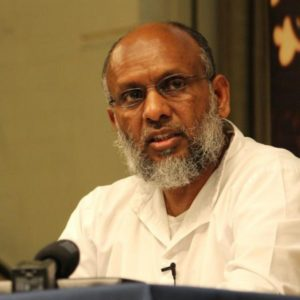
I met Professor Muhammad Bashir Haddad, the former director at the International Islamic Fiqh Academy and former professor at King Abdulaziz University, who had returned to Aleppo after an exile of forty-five years. His face bore the features of those returning from long exiles; those who return to their homelands carrying entire lifetimes of toil and memories.
We talked at length about Aleppo, Jeddah, Arabic poetry, Persian poetry, their shared and differing characteristics, and about the scholars we met along the way, who were then scattered like autumn leaves by the winds. His conversation reminded me that no matter how far a person strays from their homeland, they remain attached to it like a root to the earth; the absence may be long, but the longing remains in the depths like embers beneath the ashes.
We returned to the hotel just before ten at night. The body was weary, but the spirit remained awake, filled with images of people, voices, faces, and words. As I prepared for sleep, I felt that this day was not just one day, but a long river of scenes and meanings, carrying us from a road to a school, from a school to a conference, from a conference to the sea, and from the sea to an endless memory.
Translation note: This article was translated by AI. View the original Telegram post.