Bosnia Journey 2026 — Day 6
Bismillahir-Rahmanir-Rahim
We took our breakfast at the hotel restaurant slowly and in peace. The sun had begun to spread its gentle rays over Mostar, entering softly through the windows, as though it were waking the place quietly and without any violence. Some of the people in the restaurant sat in silence, contemplating their new day, while others spoke in low voices, and the scent of coffee and warm bread rose around us, putting something of companionship and peace into the soul. We sat at our table and ate with the calm of a traveller who has grown used to journeying. He does not linger long in any one place, yet he never stops reflecting on what he sees of people’s lives and of the country itself.
After breakfast I turned to some of my work. I reviewed what I had written over the previous days, replied to letters that had accumulated, and put in order the arrangements for the next stage of the journey. The traveller sometimes imagines that travel is a break from work, but in truth it is a movement from one kind of work to another, and from one kind of tiredness to another. The only difference is that the tiredness of travel is eased by the constant renewal of scenes and the changing of faces and places.
The Road to Sarajevo
We left the hotel in Mostar at half past nine in the morning and set out for Sarajevo. The road stretched between mountains and rivers in a quiet beauty that settled something of serenity into the soul. The bus made its way up and down the slopes, while small villages and scattered houses appeared on the hillsides before us, and rivers ran between the rocks like threads of silver moving through a wide green robe.
Our silence in the bus did not last long. My companions began to ask me about a range of matters connected with family life and marriage, the rulings of divorce and the waiting period, and the finer questions of fiqh that branch out from them. The conversation then moved on to matters of prayer, purification, and other things that people need in their daily life and worship. What struck me was that these questions, for all their number and variety, were not questions of debate or display. They were the questions of one who seeks peace, an enquirer who wishes to be guided to whatever is closest to the truth and gentlest upon people.
I answered them with what Allah had opened for me, drawing on what I had memorised of the jurists’ statements and their proofs, and trying to bring together precision of knowledge with the ease of the Shariah. For religion was not sent to torment people or to place them in hardship, but as guidance, mercy, and a setting-right of life. Some of them would follow one answer with another question, and so our conversations branched out further, until the bus on the road turned into a small gathering of knowledge, in which travel mingled with reflection, and beautiful scenery with calm juristic enquiry.
I could see the joy on the students’ faces as they listened to the answers, not merely because they had received rulings, but because they felt that when knowledge is joined to gentleness and sincerity, the heart opens to it and the soul finds rest in it. Perhaps the greatest thing that gives a teacher’s soul satisfaction is to see the effect of his words in the minds of those who listen, and to feel that knowledge is still able to bring people together in a time when the causes of division and disturbance have so multiplied.
The Tunnel of Hope
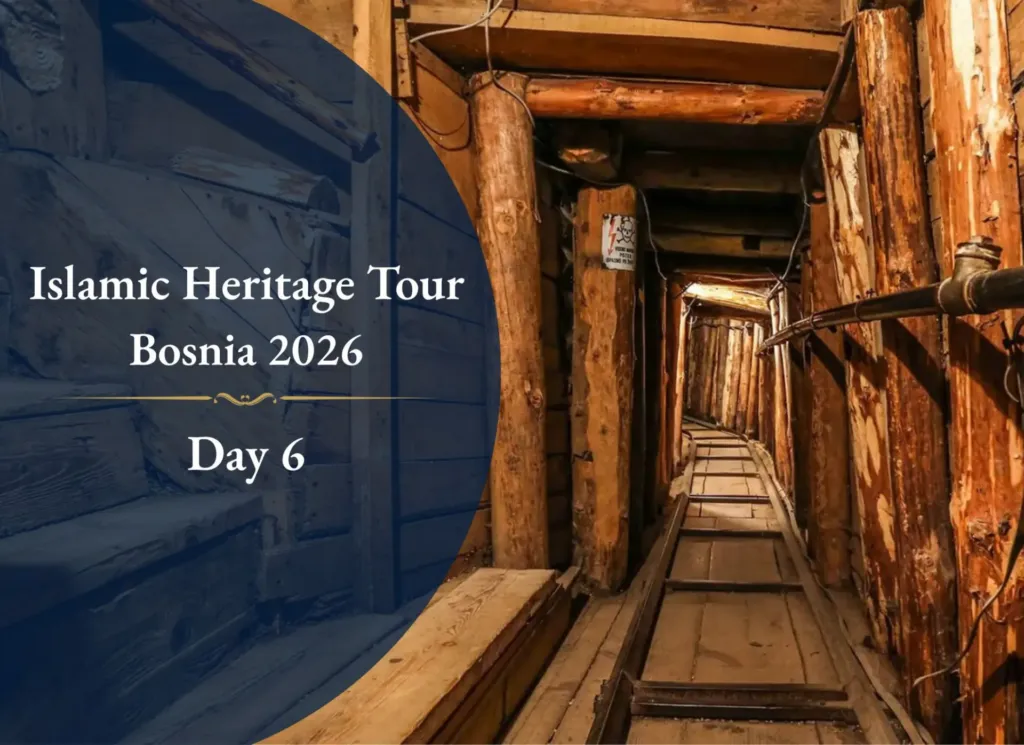
The bus went on making its way towards Sarajevo, while the conversation carried on at times and paused at others. The mountains around us stood quiet and majestic, as though they too were listening to our talk of religion and life. In time we stepped down near the Tunnel of Hope, close to Sarajevo airport. At first glance it seems no more than a small, modest building, but as soon as you hear its story you realise that you are standing before a bleeding page of modern history, written in suffering, patience, and a will that would not break.
With us was a retired officer of the Bosnian army, his beard now grown white and his frame bowed by the years, though his voice still carried something of the heat of fighters who had lived through war and looked death in the face. He stood and spoke to us at length about the days of the siege, and about Sarajevo when every passage into it had been closed, so that it became a city besieged between the mountains and the fires, connected to the outside world only through an airport held by UN forces. When people wished to leave, or to bring in a little food and medicine, they were forced to cross the airstrip on foot, running, under the eyes of snipers who watched every movement from the surrounding positions, so that death there was not some chance event but was present in every step and every glance.
Then he told us of the courageous decision the Bosnian army had taken once every route was cut off, to dig a tunnel beneath the airport that would connect the besieged city with the outside world. The digging began from a small, modest house belonging to the Kolar family, in a quiet neighbourhood where no one imagined that beneath its ground a lifeline for an entire city would be born. The work on the tunnel began from two sides: from Dobrinja and from Butmir, while shells fell around them, groundwater held up the diggers, and sniper fire surrounded them on every side. Despite all this, the work went on for months until the tunnel was completed in the summer of 1993.
Translation note: This article was translated by AI. View the original Telegram post.