Do Not Call Him a Nameless Deceased
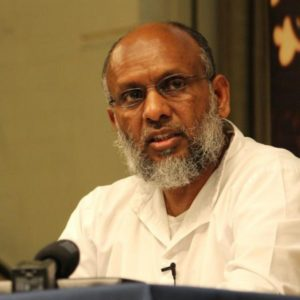

Dr. Mohammed Akram Nadwi
Written
—
“When I died, I became disgraced—why did I not drown in a river?
Neither was there a funeral, nor any grave in sight.”
I offered the Dhuhr prayer in my local mosque (Central Mosque). Typically, I rush to leave the mosque right after the Imam concludes the prayer, as though sitting on burning coal. However, today, for some reason, I stepped back and started my Sunnah prayers. After the prayers, the Imam announced a funeral prayer. I wondered to myself, “When someone passes away, the mosque usually fills up. Today, it’s just a few worshippers. Is it for a stranger?” The Imam’s voice reached me as he announced the deceased’s name: Muhammad Tikriti.
The name sounded familiar, but I thought perhaps I hadn’t heard it clearly. Then the Imam mentioned the deceased’s wife’s name: Linda Tikriti. My heart began to race, and memories spanning more than three decades began to flash before me. This happened just yesterday, Tuesday, the 16th of Jumada al-Akhirah, 1446 AH.
I quickly finished my Sunnah prayers. The junior Imam was engaged in a conversation with a young man. Interrupting them, I asked, “Mawlana! Whose funeral is this?” He replied, “Ask this young man; he and his companion arranged the funeral.”
The young man was someone I recognized. I inquired about the deceased.
“Such simplicity! They are unaware.
Arriving at the body, they ask, ‘What happened?’”
He replied, “This is the funeral of an unknown deceased. We brought him from a care home. He had been living there alone for quite some time.” I asked, “Does he have any family?” He said, “No.” I then asked, “Did his wife come?” He replied, “No, perhaps she will be at the cemetery.”
My vision darkened. There was no one from his family, no one from his homeland, and no one from who knew him. Nor had anyone come from outside. How lonely this deceased is! How indifferent is this funeral to the crowd!
“In your city, not everyone lends a shoulder to the deceased.
In our village, even the smallest roof is lifted by all together.”
Overwhelmed with emotion, I prayed the funeral prayer for my old friend in grief. The day passed, but my heart remained unsettled. This morning, I tried to work on the Qur’an’s commentary for a while, but memories of the departed kept haunting me:
“Today, I cried a lot.
Perhaps you wept too.
Nasir, your departed one,
Must still come to your mind.”
I hadn’t planned to write anything, but I felt that perhaps putting my thoughts into words might ease my sorrow.
When I arrived in in January 1991, I worked alongside many men and women. Among them was Linda Tikriti, a white English woman who had embraced Islam a few years earlier. She observed full hijab, lived modestly, and prayed on time. She didn’t interact much with men, but she became familiar with me. Her Arabic was good, and we often conversed in Arabic or English. She sometimes assisted me with tasks and consulted me on religious matters, respecting my scholarly background and accepting my advice as final.
One day, she introduced me to her husband, Muhammad Wajih Tikriti, and this acquaintance blossomed into a lasting friendship.
Muhammad Tikriti was originally from the city of Latakia in Syria. Like many Syrians who fled the tyranny of Hafez al-Assad, he had emigrated. His family originally hailed from Tikrit in Iraq. From Latakia, he had moved to and married Linda Tikriti.
We met periodically, mostly discussing issues of Arabic grammar and literature. He had published a study on Imam Ibn Malik’s famous treatise regarding the masculine use of “قريب” in the verse, “إِنَّ رَحْمَتَ اللَّهِ قَرِيبٌ مِّنَ الْمُحْسِنِينَ.” He gave me a copy, and I wrote a review that he greatly appreciated.
In the summers, we sometimes held gatherings in open spaces, where families would bring barbecues and roasted meats. Tikriti Sahib was always the heart of these gatherings. During one such event, he told me that he was responsible for the Arabic language examinations conducted by Cambridge University across various countries. He graded the exam papers and needed an assistant for this academic task, which also offered a reasonable remuneration.
As a newcomer to England at the time with fewer commitments, I accepted his offer, gaining a valuable new experience. This academic collaboration deepened our friendship.
Tikriti Sahib’s wife, Linda, would prepare tea or coffee with a graceful demeanor reminiscent of an Eastern hostess. Alongside, she would serve delightful Syrian sweets. Our discussions ranged from Syrian political conditions to linguistic and literary topics, lasting for hours.
Over the years, the Cambridge exams gained fame, and student interest multiplied. Consequently, more examiners were appointed, and our meetings shifted to hotels in or . Tikriti Sahib chaired these meetings with a kind and brotherly approach, consulting everyone and never imposing his opinions.
On one occasion, he pressured me to take over his position as the chief examiner. Although he repeated his offer, I firmly declined, explaining that I participated only because of him. If someone else replaced him, I would step away. He eventually relented.
After parting ways with the examinations, I barely met him once or twice. During the COVID era and afterward, we lost contact. I attempted to call him, leaving messages, but received no response. Occupied with my own commitments, I didn’t make efforts to meet him, though his memory would occasionally cross my mind.
“Your memory visited my heart like an unexpected meeting.”
Recently, as the revolution in Syria toppled the Assad regime, I thought of Tikriti Sahib and imagined his joy. I even considered celebrating this freedom with him.
I did not know that meeting him was no longer possible. By Allah’s decree, I prayed his funeral prayer. Later, I informed our old acquaintances of his passing. Each person expressed shock at the sudden news. Someone mentioned that his family had moved out of . I hope to find their contact to at least offer my condolences.
This is the story of someone who was perhaps my closest friend here at one time. His passing has closed a chapter of my life in , and with it, an era of profound academic and literary discussions has ended.
May Allah have mercy on him and grant him a vast abode in Paradise.
Original source: View the original Telegram post.