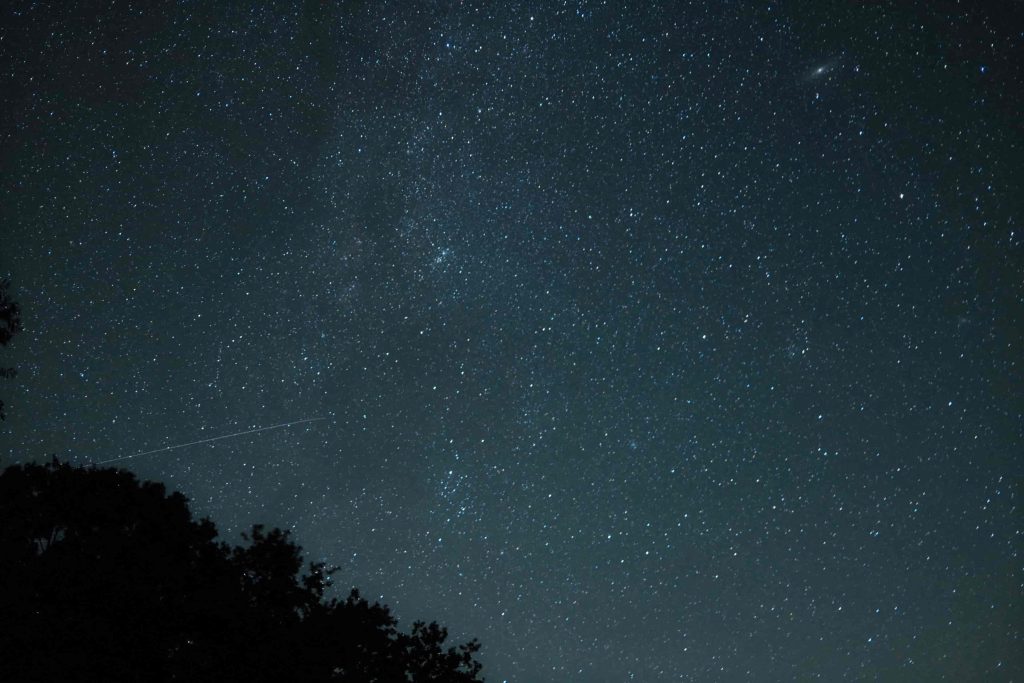
It is our considered opinion that many Urdu idioms are, in fact, fundamentally flawed. One such expression is: “counting the stars all night.” One wonders which man of wit and wisdom coined it, and which ill-starred humourist then assigned its meaning! Most likely, some night-watching simpleton, unable to sleep, first reshaped the geography of his bed by turning from side to side, then wearied of staring at the ceiling, lifted his gaze to the heavens and began to number the stars. From that very day star-counting, instead of remaining an innocent and delightful occupation, was made a symbol of sleeplessness, restlessness, anxiety and the deprivation of slumber, as though counting the stars were a crime and staying awake its punishment!
We have ever objected to this idiom. What, after all, is wrong in counting the stars? Is it not a beautiful pretext for conversing with the vastness of the sky? Is it not akin to turning the pages of the silent book of the universe? And is sitting in the assembly of the stars and enumerating them any less than a blessing? Alas, this idiom has transformed a virtue into a vice and an engaging pastime into an ailment.
There must be, besides ourselves, many sensible folk who passed their childhood nights beneath the open sky. What a time that was! No ceaseless whir of fans, no artificial coolness of air-conditioners, no blue glow of mobile phones, no purposeless spectacle of social media. The earth served as our bed, the sky as our roof, and the cool breeze, becoming the hand of Providence, stroked our faces with affection. We rejoiced in the fresh gusts of air, felt the gentle touch of night’s darkness, and lost our gaze in the immensity of the heavens.
We would scrutinise uncle Moon for long hours, observe the gathering of stars around him, count each star and reflect upon their movement. Whenever a star shot across the sky, it seemed as though a pearl had slipped from the brow of heaven towards the earth. At times, beholding a cluster, we imagined that these stars too had assembled in a gathering much like our own. While numbering them our eyelids would grow heavy, and sleep would draw us into its embrace without our even noticing.
In our understanding, then, counting the stars does not mean keeping awake all night; rather, it is an invitation to sleep, a preparation for dreams, and a surrendering of oneself to the bosom of nature. The starlight was a lamp to our eyes, and their spectacle sharpened our powers of observation. We hold that looking at the sky broadens vision, grants flight to thought, and delivers a person from the narrow world of his own existence into the boundless expanses of the cosmos.
Yet modern man, in the name of progress, has entirely altered his priorities. He no longer counts the stars; he swipes his fingers across a mobile screen. Where once there was a galaxy of stars in the sky, there is now a galaxy of apps in the hand. Previously one conversed with the moon; now one speaks on WhatsApp with innumerable people whom one never felt the need to meet. Formerly the eyes would lose themselves in the vastness of the heavens; now they have been confined to a few inches of screen.
It is a strange irony that man, depriving his eyes of the most beautiful scene created by Allah, has become captive to an artificial light. The night passes while gazing at the mobile, the eyes grow weary, thoughts scatter, and on waking the next morning one feels heavy-hearted. All day long there is complaint of fatigue, irritability and insomnia. Despite this, we clasp the mobile to our chests as though it were not a beloved but an oxygen cylinder without which life itself were impossible!
In our view, should a board for the correction of Urdu idioms ever be established, this idiom ought to be the first to be amended. In place of “counting the stars all night” let “looking at the mobile all night” become current, for the true cause of sleeplessness is not the stars but the mobile; it is not the vastness of the sky that steals our sleep, but the brightness of the screen. And if perchance someone is indeed found counting the stars the whole night, he should be regarded, not as sleepless, restless or troubled, but as a fortunate soul who has spent at least a few hours in the company of nature.
Today, all of a sudden, those childhood nights return to mind, especially the summer nights after coming to Nadwa, when we used to sleep upon the roof of Athar Hostel. Bedding would be spread upon the roof, the sky in all its splendour lay before us, and we would converse with the moon, arrange the assembly of the stars, and while counting them drift into another world altogether. At times we tried to identify a particular star; at times a debate would arise concerning a star’s change of position; and at times we would gaze silently at the sky. Those nights were not mere nights; they were a chapter of our life containing simplicity, leisure, imagination and tranquillity.
Now those roofs come to mind, that open sky, that uncle Moon, and that carefree spirit whose price perhaps the earnings of an entire lifetime cannot pay. We now possess innumerable sources of light, yet have no leisure to look at the sky; thousands of means of communication, yet no opportunity to talk to the moon; an ocean of information, yet no thirst for reflection.
I wonder: was the idiom at fault, or have we ourselves changed the very meaning of life? A society that deems the star-counter sleepless and the mobile-watcher busy—whither is it heading?
Would that, along with the correction of this Urdu idiom, the routines of our lives might also be set right. May we once again count the stars all night, so that at least our nights be illumined, even though there be no mobile in our hands!