The Myth of the Enigmatic Bird ‘Anqa’
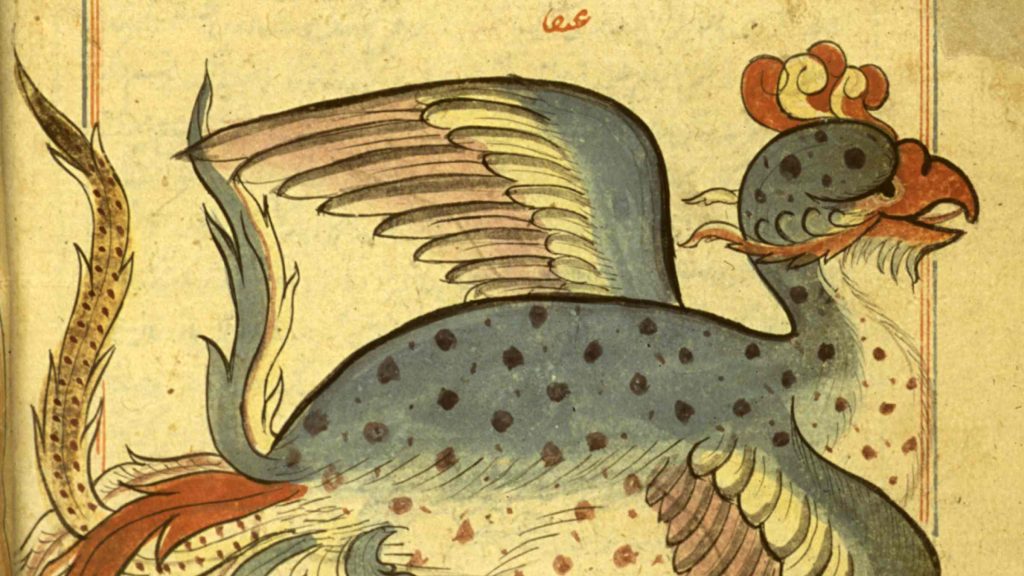
They say that the ʿanqāʾ is a talismanic bird of Arab legend, wondrous in form, its feathers shot through with gold. The species is counted as feminine, perhaps because all the qualities of beauty, grace and rarity have been gathered for her alone. It is related that she keeps herself hidden beneath the dust of ages, that only once in centuries does she appear to some fortunate soul, and then she is lost again in the vastness of the horizon. Certain narrators claim that her dwelling is at that place where the sun sets; it is as though the ʿanqāʾ belongs to that company of beings whose address is known to all yet the road to reach them is known to none.
We have read much, heard much, and seen many people convinced of her existence, yet to this day we have met no one who has beheld her. Essays abound on the beauty and elegance of the ʿanqāʾ; tales of her flight are on every tongue; men of letters have worn down their pens describing the gleam of her golden wings, yet no one possesses her picture. It is as though the ʿanqāʾ were no bird at all, but a governmental project whose inauguration has been celebrated many times though its completion has never come to pass.
Nevertheless, we have arrived at a disclosure concerning the ʿanqāʾ which we regard as the fruit of our investigation: when a human being dies, he becomes an ʿanqāʾ.
This claim may at first seem strange, yet it contains as much truth as the belief in the ʿanqāʾ herself. The only difference is that the ʿanqāʾ has never been seen, whereas around us we constantly observe her counterparts.
So long as a human lives, he is but an ordinary person. One may meet him, disagree with him, point out his errors, interrupt his speech and, on occasion, even ask to borrow money from him. He is for us a being of flesh and blood whose virtues are visible and whose faults are visible too. But the moment he departs this world, there settles upon his personality a gilded aura of sanctity such that even his slightest remark becomes a precious saying. His flaws are buried with the shroud, while his merits emerge from the grave and glitter in the heavens.
Yesterday the very words that displeased us, to-day we regard each sentence of his as a jewel of wisdom. The counsels from which we once sought escape, our ears now yearn to hear but one of them. The phone calls that irked us, we now preserve his number in our mobiles, gazing at it for long moments. In life he was a mere engagement; in death he becomes a keepsake. It is not death that transforms the man; it transforms our commentary upon him.
We can speak for hours about our deceased relatives, teachers and friends. We can discuss in detail their temperaments, habits, thoughts, achievements and shortcomings, narrating their stories with such precision as though we had but just taken tea with them. We can recite odes in praise of their virtues, shed tears in their memory, and lay flowers upon their photographs. Yet we cannot meet them. We may speak about them, speak for them, even speak on their behalf, but we cannot speak to them. This, indeed, is the very mark of becoming an ʿanqāʾ!
In this matter the devotional taste of our society is truly remarkable. To value the living runs counter to our disposition. We cannot make time to visit a living teacher, but we will sacrifice half a day to attend his condolence gathering. In a sage’s lifetime we find no leisure to listen to him, yet after his passing we constitute a committee to publish a volume of his aphorisms. While a friend is alive, taking his call is burdensome, yet upon his death we compose on social media such lengthy tributes that, were the departed able to read them, he might request to die once more!
Our love, too, is peculiar; it finds little attraction in the living, but its passion for the departed is wondrous. As long as someone lives, we perform a post-mortem on his personality; once he dies, we begin to sculpt his statue. In life we label his words exaggeration; in death we declare those same words philosophy. It seems the graveyard among us is the greatest institute of character-building, where every person’s faults are confiscated at the point of entry and his virtues are returned along with the certificate of graduation.
Perhaps for this reason the existence of the ʿanqāʾ has ever remained a riddle. We roam searching for her, yet she is already present in our homes, in our families, in our schools and in our memories. Every father who remained commonplace in the eyes of his children until his voice fell silent for ever is an ʿanqāʾ. Every mother whose love was understood only after her separation is an ʿanqāʾ. Every teacher whose worth became known to his pupils only after his departure is an ʿanqāʾ. And every friend whose seemingly idle moments together turned, in his absence, into life’s most precious hours is an ʿanqāʾ.
We know much about the ʿanqāʾ, yet we cannot see her. Likewise, we can say everything regarding our deceased, yet we cannot reach them. They live on in our conversations, breathe within our memories, and become the theme of our gatherings, yet they lie beyond our grasp. Their existence is now like a book we may read again and again, but from which no new page can be opened.
It is another intriguing human contradiction that we are always hunting for rarities while failing to recognise the worth of what is already in our possession. We dig mountains in search of diamonds, yet kick away the stone in our hand. We fix our gaze upon distant stars, whilst remaining oblivious to the flame of the lamp at home. We journey through legendary valleys in pursuit of the ʿanqāʾ, yet cannot take two steps to value the person sitting beside us.
Perhaps the real enchantment of the ʿanqāʾ lies not in her golden wings but in our heedlessness. She is not rare because she is nowhere to be found; rather, because so long as she is with us, we do not recognise her. Her abode is not in some far-flung place, but in that recess of our past where, once the sun has set, it never rises again.
To search for the ʿanqāʾ we need neither to sift the deserts of Arabia nor to reach the place where the sun sinks. We need only cast a glance around ourselves. We must look at our living relations, friends, elders and teachers; listen to them, spend time with them, and cherish their presence—before they too become ʿanqāʾ for us, leaving us with nothing but their tales to recount.
For, at the end of all our research, this is the conclusion: the ʿanqāʾ is no bird; it is the form a human being takes after his death. In life he is within our reach; after death he is within our discourse. In life we overlook him; after death we declare him rare.
And that is why we can say with full assurance: The ʿanqāʾ is no ʿanqāʾ; she is our very own whom we failed to recognise while she yet lived!