School of Thought Never Let Me Go

It is with some difficulty that I attempt to express what lies within my heart. My thoughts, observations, and experiences are of the kind that not everyone will find agreeable. There’s a hesitation in me, a concern that my words may be misunderstood or provoke disapproval and criticism. Still, I have resolved to speak the truth I have seen and known, whether or not others accept it.
In this journey, whatever misgivings, obstacles, or voices of opposition may arise, I choose to heed the call of my conscience. I find strength in a verse from the renowned Persian poet ʿUrfī:
ʿUrfī, do not fear the noise of rivals;
The barking of dogs never decreases the provision given by God.
When I arrived in England, I felt a surge of joy. I believed I was entering a world outwardly developed, where I would be free from the chains of ritual and tradition, and liberated from the narrow confines of sectarianism and ideological partisanship. Part of my contentment stemmed from the contrast with India, where anyone who sincerely seeks to practice the pure religion of God is treated as a stranger—alienated, isolated, and discriminated against. Wherever he goes, he is deemed an outsider. In mosques, he is treated coldly; in madrasas, he is swiftly shown the door.
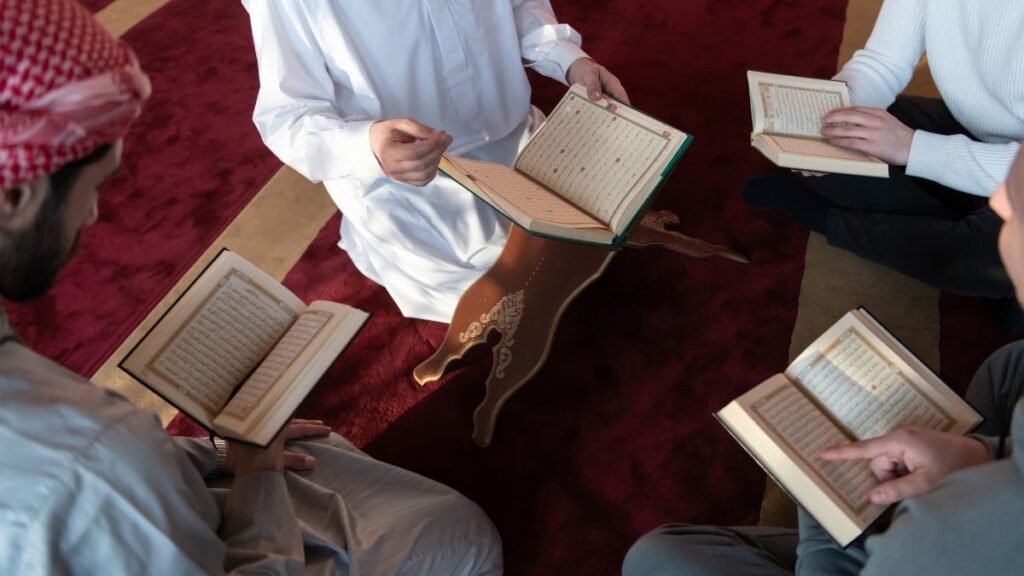
It was a blessing and privilege for me that I stayed in a hostel at Oxford University, where a few other Muslim students resided. I would lead prayers for them, teach them the Qur’an, and introduce them to the foundational teachings of Islam. In this clean, untainted environment—free from the constraints of sect or school of thought—I tasted a spiritual joy and serenity that is beyond description. There was no coercion of any mullah, nor the fear of a spiritual master. Prayer was for God alone, and reading the Qur’an was solely for His pleasure.
I had assumed that Europeans were rational people who judged everything based on reason and evidence. That here, every act was evaluated by the scale of intellect. In contrast, India, I believed, was a regressive society where the greatest authority was tradition, sect, and allegiance to one’s school. But this illusion did not last long. Very soon, the veil was lifted, and I realised that the West, too, is bound by the same sectarian chains that shackle Eastern civilisations. The only difference lies in form and expression.
A common Western practice is to eat with the left hand. I, however, always ate with my right hand, because in our religion, this act is a prophetic tradition and a source of blessing. An Englishman once asked me why I didn’t eat with my left hand. I replied, “Using the right hand is part of our religion—it is the Sunnah of the Prophets.” He asked, “What about those who are born left-handed?” I said, “Most of your society is right-handed, yet you still follow the left-hand custom. Why shouldn’t those naturally inclined to the left practise eating with the right hand?” He had no reply. But the truth is this: a school of thought is one that refuses to bow before reason. I remained firm in eating with my right hand. In the eyes of Westerners, my appearance was no different than someone entering an Indian madrasa in trousers or a dhoti—strange and out of place.
On one occasion, a group of university faculty and students went on a visit to a church in another city. I was the only Muslim in the group, and, as usual, I was wearing a cap. A church official approached me and said that wearing a cap was considered inappropriate there, and I should remove it to enter. I respectfully replied, “In our tradition, covering the head is a sign of respect.” He replied, “In our tradition, being bareheaded is a sign of reverence.” At that moment, I thought to myself: in our mosques, insistence is placed on wearing a cap, while here, pressure is put on removing it. In both cases, what we see is tradition, school, or sect in different guises—diverse manifestations of the same phenomenon, present in every society.
A similar incident occurred in Greece, where I was working on my laptop inside a church. A church official came and politely requested that I shut it down. I ignored him. He returned later and said, “If we did this in a Muslim mosque, how would you feel?” I replied, “It would not bother us in the least.” I pointed out to him that no signs in the church prohibited the use of laptops. He responded that it was an unwritten rule. He walked away angrily, while I continued my work.
From all these observations and experiences, I concluded that every society—whether Eastern or Western—is bound by some tradition, school of thought, or ideological framework. Man is enslaved to his self-made ways, even if he claims to be free. A Chinese sage once said: “It doesn’t matter whether a cat is black or white—what matters is whether it catches mice.” The same holds true for sects—whether they belong to white people or people of colour, their shared trait is the same: both are equally successful in sidelining reason and religion.
The cage itself causes me no pain, O hunter—
It is the constant uproar in my wings that unsettles me.
The freedom I had hoped for in the West turned out to be a mirage. The truth is that a sect is wherever reason is silenced. Wherever a person goes, if he sincerely wishes to practise the pure religion, he will remain a stranger. Yet estrangement from society has always been the hallmark of the Prophets’ followers—and it is precisely this estrangement from which they draw their strength:
Day and night, my being shakes in the act of building.
Original source: