Comparison Between Shah Waliullah Dehlavi and Mawlana Abdul Hamid al-Farahi

Introduction
Sayyid Usman Khan, a PhD student from New Jersey, USA, wrote to me:
“Assalamu ‘Alaikum, Mawlana! I hope you are well. A question came to mind: Could you write an article about the similarities and differences between Shah Waliullah and Mawlana al-Farahi, particularly concerning the Qur’an? Such an article would be extremely beneficial for me. Jazakum Allahu Khayran.”
Response
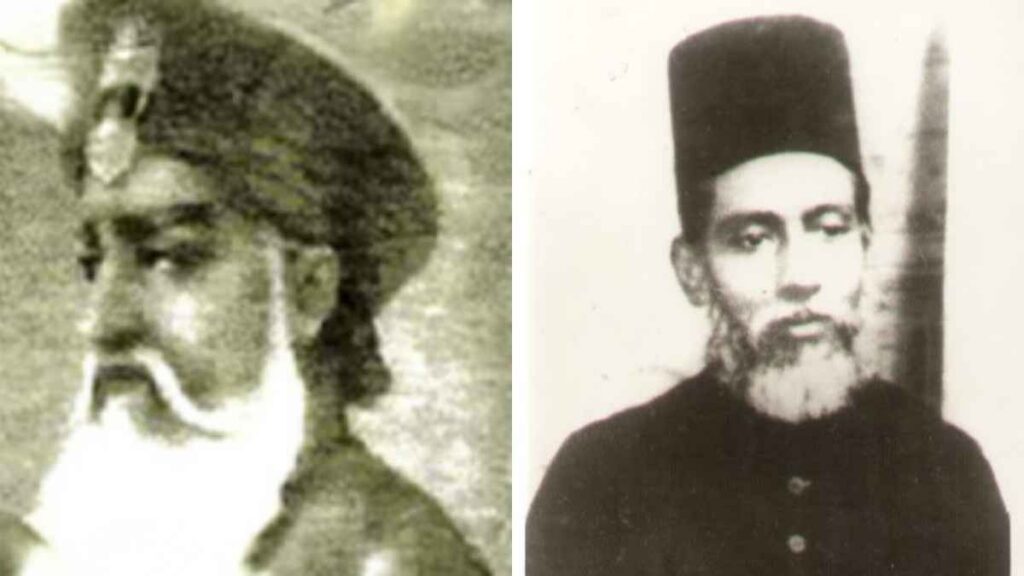
In my response, I will focus on the main aspects related to the Qur’an. Before proceeding, I would like to note that Shah Waliullah Dehlavi (1114–1176 AH) and Mawlana Abdul Hamid al-Farahi (1280–1349 AH), may Allah have mercy on them, were among the great scholars of ijtihad and deep investigation. They were far removed from imitation and blind following, as is evident from their writings. This served as the foundation for their views and research.
Their Approach to the Qur’an
Shah Waliullah’s Perspective:
Shah Waliullah emphasized returning to the Qur’an with reflection, holding onto it, and deriving principles from it. He followed the way of the righteous predecessors, including the Companions and their followers. He stated:
“The first generation received the Qur’an directly from the Prophet ﷺ, and the second generation received it from the first, and so on until it reached this humble servant, who had his share of its recitation, understanding, and reflection.” (Al-Fawz al-Kabir, p. 27)
He further noted:
“When Allah opened a door of understanding His Book to me, I thought to record beneficial insights for my brethren. I hope that just comprehending these principles will open a vast pathway for students to understand the meanings of the Qur’an. If they spent their entire lives studying books of tafsir or reading them with commentators, they would not obtain such structured and consistent principles.” (Al-Fawz al-Kabir, pp. 27-28)
Mawlana Farahi’s Perspective:
Mawlana al-Farahi devoted his life to reflecting upon the Qur’an, uncovering its meanings, and delving into its intricacies. In the introduction to Nizam al-Qur’an, he wrote:
“I examined books of tafsir thoroughly, but found them like a mirage in the desert—an illusion for the thirsty. They neither quenched my thirst nor cooled my heart; rather, they increased my anguish and filled my liver with fire.”
He continued:
“I turned to the Qur’an for deep reflection and exploration of its vast meanings, abandoning people’s interpretations. It was while I contemplated its verses that its structure became apparent to me, shining brightly like the morning light. The veil was lifted from my heart, and my vision became clear.”
On Asbab al-Nuzul (Reasons for Revelation)
Shah Waliullah critiqued the prevalent approach to asbab al-nuzul:
“Most commentators connected every verse related to rulings or disputes with a story reported as its reason for revelation, believing it to be the actual reason. However, the truth is that the Qur’an was revealed to refine human souls, remove false beliefs, and eliminate corrupt actions.”
(Al-Fawz al-Kabir, p. 31)
Similarly, al-Farahi wrote:
“The concept of ‘reason for revelation,’ as popularly understood, is merely the context of human affairs addressed by the Qur’an. Every surah has a primary focus, and its reasons for revelation should be sought within the surah itself.”
(Fatiha Nizam al-Qur’an, p. 25)
On Naskh (Abrogation)
Shah Waliullah explained:
“The early scholars used the term naskh in its linguistic sense—removal—rather than the later technical definition by jurists. For them, naskh referred to clarifying the end of a ruling, specifying generalities, or correcting pre-Islamic customs. This broader interpretation of naskh led them to identify hundreds of abrogated verses. However, based on careful investigation, only a few verses—five according to my view—are truly abrogated in the Qur’anic sense.” (Al-Fawz al-Kabir, pp. 83-84)
Farahi wrote a treatise, Al-Rusukh fi Ma’rifat al-Nasikh wa al-Mansukh, in which he discussed areas where abrogation applies:
1. Gradual actions meant to prepare individuals for higher purposes.
2. Innovations and false practices eliminated by subsequent revelation.
3. Pure trials, like the change of qiblah, to test the believers’ sincerity.
On Nizam (Structure) of the Qur’an
Shah Waliullah did not perceive a systematic structure in the Qur’an, comparing its revelation to royal decrees addressing various situations.
(Al-Fawz al-Kabir, pp. 139-140)
In contrast, Farahi’s groundbreaking contribution was uncovering the coherence and interconnectedness of the Qur’an. He argued:
“The Qur’an is a unified whole, with each surah connected to the one preceding and following it. This interconnectedness allows the Qur’an to be understood as one coherent discourse.”
Farahi emphasized that discovering this nizam not only deepens understanding but also resolves interpretative differences and clarifies ambiguous meanings.
Conclusion
Both Shah Waliullah and Mawlana al-Farahi were reformers deeply committed to the Qur’an. While Shah Waliullah focused on practical principles for understanding and deriving rulings, Farahi sought to uncover the Qur’an’s structural harmony. Their unique contributions enrich the tradition of Qur’anic studies and continue to inspire scholars today.
Original source: