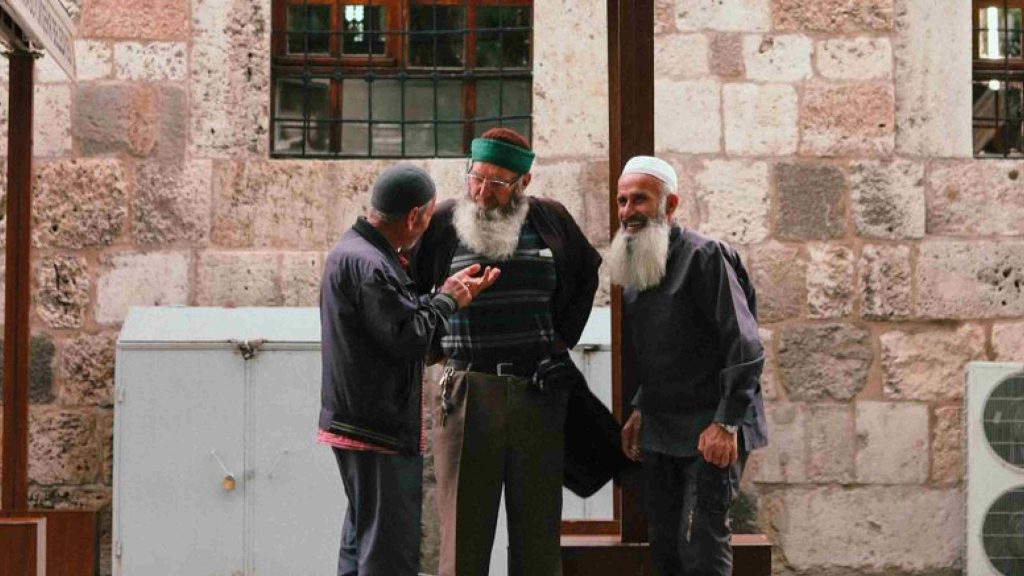
Guidance on Conducting with Others

It is mentioned in the book Tanbīh al-ghāfilīn by al-Samarqandī:
Yaḥyā ibn Muʿādh said:
“Let the portion of a believer from you be three:
If you cannot benefit him, do not harm him;
if you cannot gladden him, do not grieve him;
and if you cannot praise him, do not blame him.”
My companion, refraining from harming people is an act of ʿibādah.
If you are unable to speak the truth, do not clap for falsehood.
If you cannot keep pace with the charitable in their giving, do not belittle them.
If you yourself are among the givers, never mock the poor and the discreetly needy who can find nothing to give.
If you are incapable of competing in noble character, do not disparage its possessors.
If Allāh has honoured you with obedience, then do not grow arrogant or boastful over the drowning sinners, the lost and pitiable ones who ache because they are not among the obedient.
It is ignominy enough for you that you neither do good nor choose what is right, and that you assail the righteous.
And in the noble ḥadīth: “It suffices a man, as evil, that he should despise his Muslim brother.”
Disclaimer: This article was translated by AI. Original post: https://t.me/DrAkramNadwi/9376
, , , ,
The Essence of a Student
Bi-smi llāhi l-Raḥmāni l-Raḥīm
You have asked me for a description of the child nurtured by toil
8/6/2026
A student of Nadwat al-‘Ulamā’ asked me: “Mawlānā! Who is a ṭālib al-‘ilm?” I fell into contemplation. There are questions whose answers first require silence and reflection; only then may speech begin. Thereafter I said:
You have asked me to portray that delicate creation whom a few phrases cannot contain. You have sought the portrait of one reared by labour. You wish to be introduced to that being who opened his eyes in the household of effort, who was nurtured in the lap of struggle, whose toys in childhood were questions, whose companions in youth were books, and whose associate, even in old age, remains wonder and inquiry.
The ṭālib al-‘ilm is not a mere word but a state; not a name but a journey. Many people read books, yet not every reader becomes a seeker of knowledge. Just as every person who lifts a hammer is not thereby a builder, nor everyone who dabbles in colour a painter, so he who gathers a few volumes does not necessarily become a student. To be a student is, in truth, the title of an inner condition: a hunger of the heart that bread cannot satisfy, a thirst of the mind that water cannot quench, a restlessness of the soul that pillows and cushions cannot soothe.
Most people in the world search for a destination, yet the student is among those rare souls who love the journey more than the arrival. An ordinary person, once he has secured an answer, feels content; when the student finds one answer, ten new questions are born within him. For others the answer is the end; for him it is the beginning. People suppose knowledge to be the storing of information; he considers knowledge the widening of wonder. The more his ‘ilm increases, the more keenly he senses the vastness of his own ignorance. A child may mistake a pond for the sea, but one who truly reaches the ocean discovers that beyond the horizon there is nothing but water upon water.
Hence a peculiar humility settles in the temperament of the student. The clearest sign of the ignorant is their certainty, whereas the clearest sign of the learned is their hesitation and conjecture. The ignorant carry a response to every question; the student, after every response, engenders a fresh question. The mind of the ignorant resembles a sealed chamber where no breeze may enter, whilst the mind of the student is like an open valley where winds arrive from every direction and new seasons are born.
You asked: Who is the student? Then listen! The student is the one who has learnt to wage war against time. The people of the world consult the clock; the student consults pages. Others count days and months; he counts stages of reading and understanding. His nights are not the nights of ordinary men. When the streets fall silent, when lamps are extinguished, when weary bodies surrender to their beds, his world comes alive. A book lies open before him, a pen rests in his hand, and a single question knocks incessantly at the door of his mind.
He grows indifferent to the distinction between night and day. The sun is, of course, a source of light for him, yet the sun of comprehension may rise for him at midnight. How often has it occurred that a student spent an entire night pondering a single sentence, and at dawn that solitary sentence transformed the entire perspective of his life!
The relation between the student and hardship is equally curious. People regard comfort as a blessing; he regards comfort as a trial. People search for soft beds; he is the traveller of rough paths. His likeness is that of a mountain spring carving its course by striking again and again against the rocks. Were it to wait for gentle terrain it might never reach the sea. Likewise the student knows that the shaping of character does not take place amid ease. Steel is forged by fire, the sword is tempered by blows, and a human being is fashioned by enduring toil.
The student is a companion of both ease and pain. Common people flee from wounds; he learns from them. What wounds do to others, balms do to him; he fears that an abundance of comfort might lull his inner quest to sleep. People chase after pleasures, yet the student often beholds the signs of his greatest triumphs upon the brow of sorrow, for the delight contained in solving a single problem outweighs a hundred entertainments, and the rapture of grasping one reality cannot be granted by a thousand cushions of luxury.
Nevertheless, there is a bright-hued aspect to this portrait. Though the student is serious, within his seriousness a subtle humour is concealed. Events occur in his world at which even the angels would smile. At times he searches for his spectacles while they rest upon his nose. At times he hunts for his pen while it is tucked behind his ear. On occasion he overturns the entire room looking for a book only to discover that the book was in his hand. Sometimes he brews tea, sits to read one page, raises his head and finds the tea cold while the thoughts in his mind still boil. Sometimes he forgets the name of a friend, yet remembers word for word a quotation from an author who lived five centuries ago. It appears that memory, too, discriminates in favour of the student: it turns ordinary matters away from the threshold, but grants scholarly questions permanent residence.
Yet beyond all these attributes the true hallmark of the student is his love of ḥaqīqah. People generally favour statements that endorse their own views, whereas the student seeks statements that endorse reality, even if they contradict his opinions. He is not an advocate of his personal judgement; he is a servant of truth. He cherishes an unwelcome truth more dearly than a beloved error. This very quality distinguishes him from ordinary people.
Then a time arrives when he realises that the purpose of knowledge was not merely to know, but to become. The true task of books is not to stuff the mind but to refine the human being. If reading does not sow humility within a person, if knowledge does not engender mercy in his heart, if understanding does not widen his temperament, then that is not ‘ilm but only a heap of data. Information accumulates in the memory; knowledge permeates the personality.
Therefore, if today someone were again to ask me, “Who is the student?” I would answer the same: the student is the one who opened his eyes in the house of labour, was nurtured in the lap of quest, came of age under the shade of patience, and searches for his path by the light of the lamp of wonder. He is not the owner of answers but the trustee of questions. He is not a warehouse of information but a caravan of seeking. He is a traveller who, even upon reaching a destination, does not end his journey, for he knows that in the world of knowledge behind every horizon another horizon awaits.
And perhaps for this very reason no definition of the student can be fashioned. Definitions pertain to things that have been completed, whereas the student ever remains upon the path of completion. He is not a book whose last page exists; he is a tale that writes a new chapter every day. He is not a drop but a river, and the greatness of the river lies not in where it has arrived but in that it flows without cease.
Dr Muḥammad Akram Nadwī
Disclaimer: This article was translated by AI. Original post: https://t.me/DrAkramNadwi/9379