Reflections on a Memorable Visit to Nadwatul Ulama
Special Acknowledgment
During the brief period from April 4 to April 9, 2026, my stay at Nadwatul Ulama, though short in duration, was abundant in blessings and immensely refreshing for the heart and mind. The time was fleeting, yet its effects were enduring; the stay was limited, but the benefits were vast. My companion, Zaid, and I derived immense pleasure and benefit from this journey, not merely due to apparent reasons, but because of the warmth, unblemished kindness, and special attentions of the people of Nadwa. These factors transformed this brief stay into an everlasting memory, elevating a few days to the stature of an entire era.
Though the days of our stay were limited, the breadth of enjoyment was boundless; time was short, but the delight was infinite. As the poet says:
“Love knows no bounds of imagination, longing knows no bounds of sight,
Whatever I desire, I desire without limits or bounds.”
The truth is that sincerity has no other name than sincerity itself, and its reward cannot be anything but sincerity. What emanates from the heart finds its way into another heart. This is why what we gained from this journey was not due to formalities or apparent causes, but rather the result of the truthfulness of hearts, the purity of intentions, and the spontaneity of relationships—a blessing felt more than expressed, and one that lingers long in memory.
It is evident that individually thanking each benefactor is neither easy nor does it do justice, and there is a greater concern that some noble souls may inadvertently be overlooked. Nevertheless, despite this hesitation, it seems necessary to mention a few distinguished individuals whose kindness imparted a special color, a unique pleasure, and profound significance to this journey, without whom this narrative would remain incomplete.
Maulana Muhammad Wasiq Nadwi, counted among the eminent teachers of Arabic literature at Nadwa, has always facilitated my travels and smoothed the paths. He is entrusted with the editorship of the Arabic daily “Al-Ra’id,” and it can rightly be said that he is a strong link and a living connection between Nadwa and me, a connection imbued with the warmth of a heartfelt relationship rather than mere formality. His prose combines simplicity with gravity, and his style blends elegance with dignity. Intellectually, he follows in the footsteps of the esteemed teacher Maulana Syed Muhammad Wazih Rashid Nadwi, and the benefit he has derived from him is a rare fortune. Compiling and publishing various articles is also among his significant scholarly contributions, which is not merely editing but the preservation of an intellectual heritage. His intellectual harmony with Syed Jafar Masood Hasni has always been evident, reflecting a subtle affinity.
For a long time, I believed that perhaps my contemporaries and colleagues had benefited most from Maulana Wazih Sahib, but Wasiq Sahib dismantled the very foundation of this belief. As assumptions were successively shattered, it became increasingly apparent that in this world, nothing is absolute, and the realm of reality is always broader than conjecture.
Maulana Muhammad Khalid Bandwi is known as an accomplished and tasteful personality among the teachers of Arabic literature. I had the opportunity to meet him on numerous journeys. His command over the Arabic language is undisputed, and his writings reflect his refined taste and sound nature. His contributions under the title “Bara’im al-Iman” are regularly published in the journal “Al-Ra’id.” During this journey, I had the chance to tour various places with him, and it was repeatedly felt that the same meticulousness and aesthetic sense with which he wields his pen, he also applies to the affairs of life, as if his life itself is a well-crafted piece of writing. His companionship is both endearing and subtly attractive, effortlessly drawing the heart towards him.
His association with “Bandwi” sometimes invites a mild objection from us, and what kind of scholar would he be if he didn’t have objections and queries at every turn? We are fully convinced that whoever becomes a Nadwi, in essence, becomes a Lakhnawi, and then transcends all affiliations. After all, consider, if one draws swords and breaks goblets in Lucknow, what else could they be but a Lakhnawi?
Maulana Abdul Rahim Nadwi, a teacher of Tafsir and literature at Darul Uloom, held two sessions with us during this journey, which are a source of joy for the learned. We had the opportunity to discuss intricate topics such as Hadith, the principles of Hadith, and the causes of Hadith, and this discussion was not merely a question and answer session but an intellectual exercise and a means of intellectual training. His questions revealed depth of thought and insight, and his conversation was marked by courtesy and seriousness, with a distinct scholarly dignity that is the hallmark of the learned.
Upon arriving in many Indians are astonished at how educated this country is, where even children speak fluent English, as if they were born graduates. Similarly, Arabs experience this at Nadwa, where everyone converses in Arabic, not only in casual conversation but also in expressing views on the most intricate scholarly, Hadith, and jurisprudential issues. Moreover, they maintain a distance from sectarian narrowness and possess the capacity to respect diverse opinions and thoughts simultaneously, a quality that broadens knowledge and saves hearts from narrowness.
When divine grace descended upon Nadwa, it was no ordinary moment but a special hour of destiny:
“The beauty of the eternal distribution was being shared,
Your stretch of hand took it.”
Someone once asked me why the aging that has befallen other institutions has not come upon Nadwa. At that time, I couldn’t provide a satisfactory answer, but now I think perhaps the reason is that everywhere else, time is the ruler, while Nadwa is among the few institutions that have taken control of time itself. Time subdues those who are content with following it, but it cannot harm those who stay ahead of it. The day Nadwa becomes yesterday instead of tomorrow, it will become a museum piece, and living institutions do not become museums as long as they resolve to remain alive.
During this journey, I developed a close acquaintance with Maulana Saud Al-Azmi. In one aspect, he is also my compatriot. After graduating from Nadwa, he pursued further education at Jawaharlal Nehru University. He is currently involved in trade and serves as a special correspondent for the esteemed magazine “Al-Mujtama” published from Kuwait. His affinity for the Arabic language is natural, his thought is balanced, and his temperament is serious, possessing a balanced and cultured personality in ethical qualities. The truth is that this beautiful blend of trade and literature is among the rarities of the age, and few are those who can manage two different worlds simultaneously.
Maulana Abu Muhammad Amir Nadwi, associated with the affiliated schools department, is among my students. He belongs to a respectable and cultured family of Lucknow. He has a considerable command of the English language, and his speech is marked by fluency and confidence. He has also resided in America for some time and has been involved in teaching English at Nadwa. During this journey, I had the opportunity to meet him multiple times. He is noble-hearted, good-natured, and a true representative of Lucknow’s culture, embodying a pleasant blend of old culture and the new world.
In the current era, observing the young teachers of Nadwa brings peace to the heart, as the beautiful blend of knowledge and literature that has been the hallmark of this institution still remains, and Nadwa continues to uphold its ancient tradition of expansiveness, moderation, and broad-mindedness. These are the qualities that have made it not just an educational institution but a living center of knowledge and culture, a center whose spirit is still alive and whose lamp has not yet been extinguished.
May Allah Almighty grant acceptance to the efforts of these noble individuals and bestow further blessings upon their scholarly and practical services. Ameen.
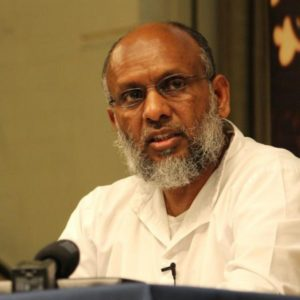
Dr. Mohammed Akram Nadwi
Translation note: This article was translated by AI. View the original Telegram post.