Visit to Bilgram: A Historical Reflection
In the City of Bilgram
On Tuesday, the seventh of April 2026, we visited the serene city of Bilgram, lying seventy kilometers west of Lucknow. Despite its proximity to the bustling metropolis, Bilgram has chosen the seclusion of scholars and the tranquility of ascetics, turning away from the clamor of the world to the whispers of memory, where remembrance is abundant with life.
Accompanying me on this journey were Zaid and Saud Al-A’zami Al-Nadwi. We departed from Lucknow on a clear morning, with the sun casting a gentle light upon the earth, neither awakening the heat nor stirring the dust. It was as if the sun itself knew we were heading to a city not visited like other cities, but rather, it is a pilgrimage to a place of historical significance and spiritual refuge.
The name Bilgram is not unfamiliar to those acquainted with the history of Islamic India, nor is it unknown to those who peruse the books of biographies and chronicles. This small city, grand in its impact, has produced scholars, poets, and righteous individuals unmatched by cities of greater size and renown. It is one of those rare places where it seems the earth has been chosen by Allah to be a vessel of knowledge, a sanctuary of wisdom, and a descent for the blessings of the pious.
Among its illustrious figures, whose names history echoes with admiration, is Sayyid Abdul Jalil Al-Balkrami (1071–1137 AH). A man whose image the mind struggles to encompass, for he mastered Arabic, Persian, Turkish, and Hindi. His mastery was not that of a mere learner or a rote memorizer, but a proficiency that bore poetry, eloquence, and granted him dominion over words in four tongues. He composed poetry in all these languages, as if each language had its own heart, tongue, and spirit that understood its secrets. Sayyid Ali Khan Al-Madani, author of “Salafah Al-Asr,” remarked, “I have not seen his equal in India,” a statement of such weight that it outweighs the biographies of many men. Due to his sound judgment, wise counsel, and the trust of Sultan Aurangzeb Alamgir in his intellect and integrity, he was entrusted with the position of chronicler and treasurer in the Sindh region, a role reserved for those endowed with intelligence, integrity, and capability.
From his descendants, who inherited his glory in knowledge and literature, was his grandson Ghulam Ali Azad bin Sayyid Nuh Al-Husayni Al-Balkrami (1116–1200 AH), author of “Subhat Al-Marjan Fi Athar Hindustan.” This book was not merely a collection of biographies or a list of names, but a vivid portrait of India in its scholarly era, a wide exhibition of its scholars, poets, and virtuous men. He gathered in it what was scattered in minds, preserving from oblivion what was nearly lost in the hustle of days.
Perhaps the most renowned son of Bilgram is Sayyid Murtada Al-Zabidi (1145–1205 AH), the eminent scholar whose name is linked with one of the most significant works in the service of the Arabic language: “Taj Al-Arus Fi Sharh Al-Qamus.” This book, when mentioned, brings to mind vast erudition, the patience of scholars, and the tenacity in research and exploration. His other work, “Ithaf Al-Sadah Al-Muttaqin Bi Sharh Ihya Ulum Al-Din,” is further testament that he was not merely a linguist but an ocean of jurisprudence, hadith, and Sufism, where sciences converged like rivers into the sea.
In its past eras, Bilgram was predominantly Muslim, with its mosques, schools, and spiritual retreats bearing witness in every corner. However, as is the nature of time, circumstances have changed, and faces have altered, with Muslims now comprising only forty percent of its population. Yet, the city still retains its ancient fragrance, and its air carries something of the scent of the centuries inhabited by scholars and devotees.
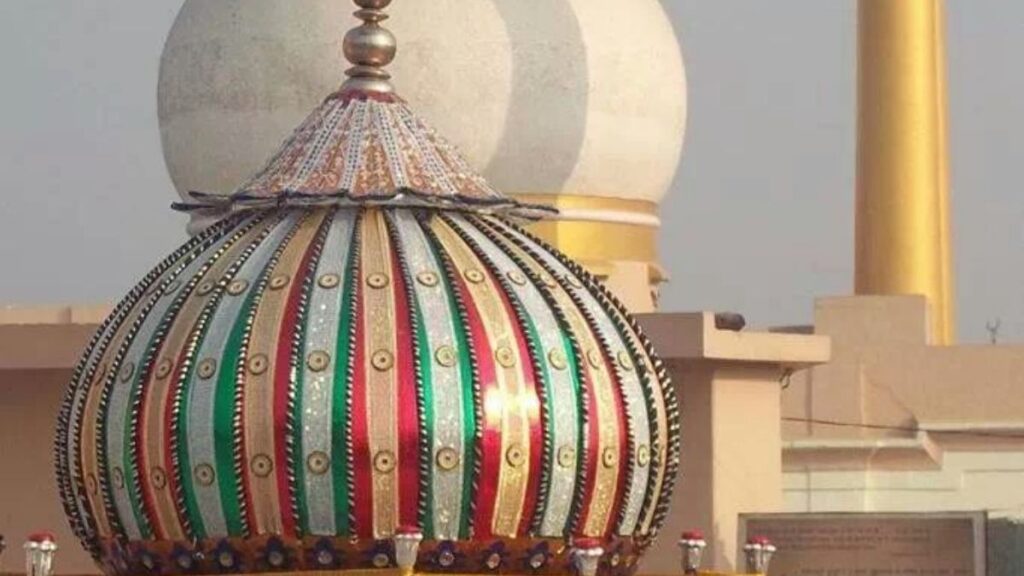
Upon our arrival, we first visited one of its schools, entering at noon and performing the combined and shortened Dhuhr and Asr prayers. The mosque was enveloped in a majestic silence, a silence that descends only upon places accustomed to prostration, where the walls have absorbed the whispers of supplication generation after generation. I narrated to some of the school’s teachers the Hadith Musalsal Bil-Awwaliyya and granted them a general authorization. We then left the school as the sun began to lean slightly towards the west, and we headed to the mosque and shrine of Mir Mubarak Al-Balkrami.
تاريخ الشيخ مبارك بن فخر الدين
Mir Mubarak, as described by the author of “Nuzhat al-Khawatir,” was the esteemed Sheikh, the scholar and hadith expert, Mubarak ibn Fakhruddin al-Husayni al-Wasti al-Balkrami. He was one of the practicing scholars and righteous servants of Allah. Born in the city of Balkram on the sixth of Sha’ban in the year 1033 AH, he began his studies under Sheikh Tayyib ibn Abdul Wahid al-Balkrami and other scholars of his town. He then traveled to Delhi, as ambitious seekers of knowledge journey to major capitals, and studied various books under Khawaja Abdullah ibn Abdul Baqi al-Naqshbandi al-Dehlawi. He learned hadith from Sheikh Nur al-Haq ibn Abdul Haq al-Bukhari and Sheikh Abu Rida ibn Ismail, the grandson of Sheikh Abdul Haq. He completed his studies on the seventh of Rajab in the year 1064 AH, then returned to his hometown, where he took up teaching. Many students learned from him, including Abdul Jalil ibn Ahmad al-Husayni al-Wasti and Tufail Muhammad ibn Shukrullah al-Husayni al-Atrulawi, among others who carried his knowledge to others.
This Sheikh, as the narratives describe him, was dignified and awe-inspiring, of high stature, gentle nature, noble character, and eloquent in discourse. He enjoined good and forbade evil, and no one dared commit wrongdoing in his presence—not out of fear of his power, but out of reverence for the light that emanated from him, making people see in him the example of a man whose heart was purified by knowledge and whose inner self was cleansed by worship.
He passed away on Monday, the tenth of Rabi’ al-Thani in the year 1115 AH, in the city of Balkram, where he was buried. His grave remains a place of visitation, as if his spirit continues to guard the place and welcome visitors in the silence of the saints.
Among the most remarkable stories about him is one that penetrates the heart like light through clear water, revealing the extent of his asceticism, meticulous piety, and the perceptiveness of his students in understanding the subtleties of his state. Once, while performing ablution, he fainted, and his student Mir Tufail Muhammad al-Balgrami rushed to his side, staying with him until he regained consciousness an hour later. When pressed for the reason behind his condition, the Sheikh eventually confessed that he had not tasted food for three days, yet he had not complained to anyone nor borrowed from anyone.
Upon hearing this, the student’s heart was moved with compassion and reverence, and he hurried home, returning with a table laden with various foods, placing it before his Sheikh. The Sheikh rejoiced, prayed for him, and then said: “If you find nothing in yourself, I will reveal a secret to you.” When given permission, he said: “When you left me, I felt you were going to bring food, and this is known among the Sufis as ‘food of the soul’s anticipation.’ While jurists permit its consumption, and the Sharia allows the consumption of carrion after three days of necessity, the poor do not consider the food of anticipation permissible.”
The student took the table back home, waited a while, and returned with the same food, saying to his Sheikh: “When I left you, did you feel I would return?” The Sheikh replied: “No.” The student said: “Then the food now comes without anticipation.” The Sheikh’s face lit up with joy at his student’s cleverness, and he said to him as he began to eat: “You possess a remarkable insight.”
We then left the mosque for the cemetery where most of Balkram’s scholars and elders are buried. The sun had begun to cast its final rays on the gravestones, making the place appear like a page from a distant time, folded by people but not by God. We walked among the graves in deep silence, broken only by the sound of footsteps on the soil, as if we were walking in the presence of history itself. The names engraved on the stones were names we had often read in the depths of books, now silent and still, saying nothing, yet stirring within us meanings that long speeches cannot convey.
There, we felt that although these men had departed from the world in body, they remain alive through their legacies, and that knowledge alone defeats death, granting humans a form of existence beyond their demise. We stood in long prayer for them, sensing in those moments that the supplication was not for them alone but for ourselves as well; for one who stands among the graves of scholars cannot help but ask Allah to join him with the ranks of the righteous.
We then left the cemetery as evening approached, and the minarets of Balkram began to fade into the dusk, as if dissolving into the sky. We departed the city, but it did not depart from us; something of it remained within us, akin to longing, reverence, and another feeling without a name, but it is that profound impression left by places filled with spirit, rich in memory, inhabited by the souls of men who do not die.
Translation note: This article was translated by AI. View the original Telegram post.