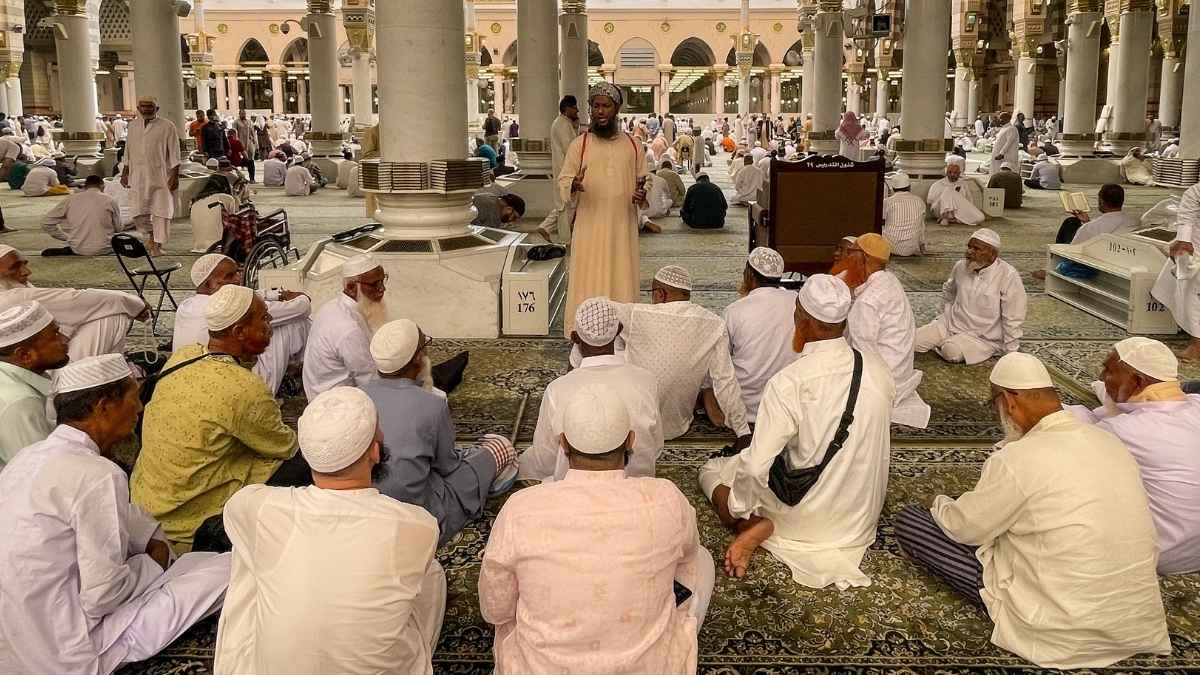
Many of my students are active in the fields of teaching and daʿwah among Muslims. Their efforts are bearing fruit, but they have also expressed a recurring difficulty which causes them some concern: certain people attempt to entangle them by stirring up talk of sectarianism and blind attachment to particular schools. How should they respond… Continue reading Pay Attention to Ninety-Nine Percent of Muslims
Journey to America (56)

We prayed Fajr in the mosque of Zaytuna College, perched high upon a lofty hill whose summit greets the first breaths of the morning breeze and is enveloped in a serenity befitting places of worship and knowledge. Thereafter, I returned to my work, turning over the examination papers of Al-Salam Institute, weighing them with due… Continue reading Journey to America (56)
Women’s Education
Among the many problems confronting Muslims today, one of the most critical is the question of “the status of women in Islam.” Serious effort to understand this issue in depth, and to seek a sound solution, is still lacking. When a problem arises, it is necessary to find its solution, for human nature, as created… Continue reading Women’s Education
The Golden Age of Letter Writing: Faint Memories of a Lost Civilisation

“I called you, but you did not pick up.” “I sent you a WhatsApp message, but you did not think it proper to reply.” “I rang you many times, but you remained silent throughout.” Such is the unbearable burden of our age, where the very means of communication that have made life easy have also… Continue reading The Golden Age of Letter Writing: Faint Memories of a Lost Civilisation
The Important Duty of the Time
In 1912, news spread that some Muslims of Shahjahanpur had apostatised. At that time, ʿAllāmah Shiblī was gravely ill. Upon hearing this news, he became restless — neither by day did he find rest, nor by night tranquillity. In whatever way possible he strove to reach that region. The authorities had placed a strict cordon… Continue reading The Important Duty of the Time
You are the Proof
All praise is due to You that we have known You. It is by Your favour alone that we have recognised You. How did we come to know You? How did we come to recognise You? It was by Your will that we came to know You, and by Your decree that we came to… Continue reading You are the Proof
We Do Not Know Laylā

The story of Laylā and Majnūn has, since ancient times, been recognised in Eastern literature as a celebrated and authoritative tale of love. For centuries this narrative has captivated the imagination of the people of the East, becoming a symbol of love, fidelity and sacrifice. Yet the question remains: do we truly know Laylā? Was… Continue reading We Do Not Know Laylā
Religion, Opinion and Madhhab
Islam is not merely a religious system or a set of rituals and acts of worship. Rather, it is an all-encompassing, divinely revealed way of life that, by the light of revelation, provides human beings with guidance in every aspect of their individual, social and spiritual existence. Its foundation is the Qurʾān, the direct speech… Continue reading Religion, Opinion and Madhhab
The Explanation of a Report from Abū al-Dardāʾ (رضي الله عنه)
This query was received from a sincere and pious teacher: “Al-salāmu ʿalaykum. In Ṣaḥīḥ al-Bukhārī there is a statement of Abū al-Dardāʾ (raḍiya Allāhu ʿanhu): وقال ابو الدرداء فی المری ذبح الخمر النينان والشمس. Could you please explain this? Does fish annul the effect of wine, thereby rendering it lawful?” The prohibition of khamr (wine)… Continue reading The Explanation of a Report from Abū al-Dardāʾ (رضي الله عنه)
Was It Obligatory upon the Prophet ﷺ to Follow Abū Bakr al-Ṣiddīq (ر.ض)?
Last time the respected Muftī Ṣāḥib had visited me, he had posed a question: “Tell me, which aspect of intelligence do you most admire?” When I answered, he became so upset and agitated that I did not expect he would forget his anger so swiftly. Muftī Ṣāḥib is indeed sincere and pious, but when seized… Continue reading Was It Obligatory upon the Prophet ﷺ to Follow Abū Bakr al-Ṣiddīq (ر.ض)?