Nurturing Writing Instinct and Intellectual Awareness in the Students of Nadwat al-ʿUlamāʾ


The Arabic language, ever since its light first shone upon the land of India, was never merely an instrument for speech or writing. It has always been something deeper, more profound in impact, and higher in status in the hearts of its people. It was—and still remains—a living inheritance, passed down as one would pass down beliefs, history, and cherished memories. It has been an ever-open window through which they looked upon the Arab world, illuminating them with the light of thought, the brilliance of literature, and the echo of Islamic civilisation.
When Dār al-ʿUlūm Nadwat al-ʿUlamāʾ was founded in Lucknow, it was fully conscious of this truth. It was never among those institutions that separated the teaching of a language from the life of that language. From its inception, it understood that Arabic is not taught like dry rules are taught, nor instilled like memorised rhymes for children. Rather, it is to be planted in hearts, infused into souls, cultivated like a refined sense, nurtured taste, and disciplined thought, so that the student does not merely speak it, but lives by it, thinks in it, senses its beauty, and savours its subtleties.
Hence, Nadwat al-ʿUlamāʾ did not confine itself to lessons and lectures, nor did it limit itself to what was delivered in closed halls. Instead, it made newspapers and magazines a living tongue speaking on behalf of its students, a platform for them to voice what they had learned, a field where they could test their talents and measure their abilities, emulating the people of Arabic lands—not as strangers to its language, but as its own children, even if their mother tongues and environments were different.
In this way, Arabic at Nadwat al-ʿUlamāʾ emerged from the bounds of silent books and entered the students’ lives as a living, speaking presence—dialoguing with them like a mother with her child, gently coaxing them like the first letters they learn to pronounce. When they mastered expressing themselves and grew accustomed to its beauty, they became part of it, and it became part of them, inseparable from their minds and ever-present in their hearts.
The newspaper Al-Rāʾid, issued by Nadwat al-ʿUlamāʾ upon its founding, was never a mere printed and distributed sheet. It was part of a profound educational project, designed to produce generations of writers, speakers, and translators who would not be content with merely learning Arabic in theory, but would live it, practise it, and write in it as its native speakers do in the Arab world.
It is remarkable that this newspaper, born in the heart of India, became in the eyes of many Arab observers a cultural platform reflecting the image of Indian Muslims, conveying their voices, concerns, and thoughts to the Arab world. It even introduced Nadwat al-ʿUlamāʾ’s students to Arab readers not as foreigners to their language, but as contributors to its craft.
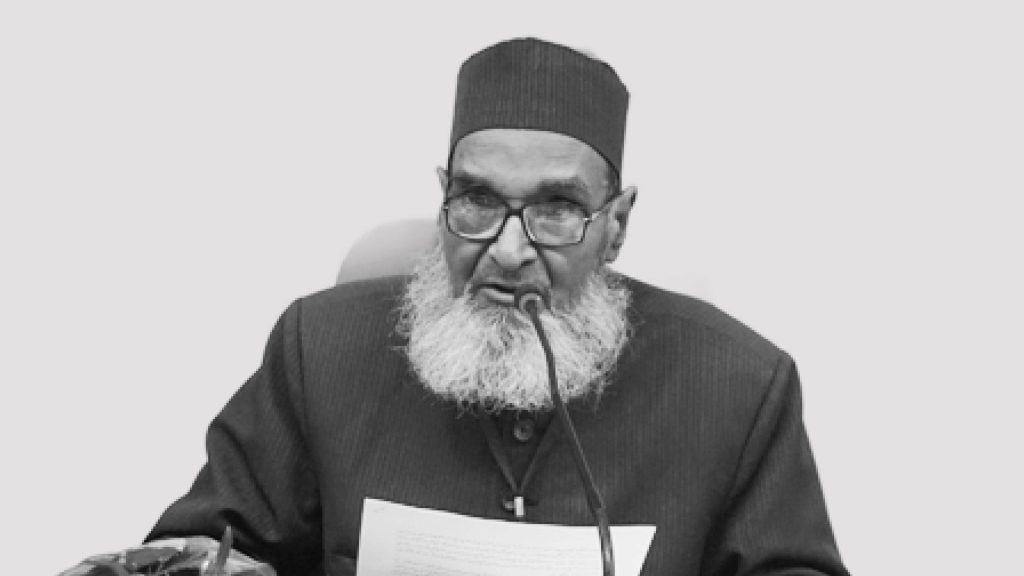
One day, as I browsed the archive of old issues of the magazine on the official website of Dār al-ʿUlūm Nadwat al-ʿUlamāʾ, I found myself reminiscing about those days when we were students in its courtyards, penning our first attempts at writing Arabic, translating from Urdu and English into it, as if learning to cast ourselves into the sea of this grand language—sometimes erring, sometimes succeeding. Yet our teacher, Ustādh al-Sayyid Muhammad Wāziḥ Rashīd al-Nadwī, may Allah have mercy on him, would hold our hands, teaching us how to swim, how to dive into its depths proficiently, and how to emerge with what delights the reader’s taste, convinces the critic’s mind, and satisfies the writer’s soul.
This noble teacher was a man whom Allah endowed with deep knowledge, broad culture, noble character, and far-sightedness. Arabic had settled in his soul like a lover in the heart of the beloved, so that he could scarcely distinguish between his personal life, educational work, and passion for the language.
At the time, he was the editor-in-chief of Al-Rāʾid, yet he did not limit himself to managing and overseeing its content. He transformed it into an educational laboratory, training students in translation and writing, correcting their work, discussing it with them, refining and polishing it without erasing their personalities or discouraging their spirits. He would honour the outstanding ones by publishing their pieces, making them feel that they had advanced a step forward, that their language had transcended study notebooks to reach pages read by others, minds that follow, and critics who evaluate.
It is unsurprising for one who trained in Arabic journalism, read the works of its leading writers, and followed its newspapers and magazines closely, to excel in choosing titles, mastering article composition, and teaching his students how to make a headline attractive without being misleading, how to craft a piece smooth yet not trivial, and how to render translations faithful in meaning, elegant in expression, and close in style to what Arabs themselves write. His method of correction was an art in itself: he would not rewrite the text from start to finish, erasing the student’s identity, but instead preserved its structure, applying just the refinement needed to reveal it like a piece of beauty—polished to perfection and adjusted with precision—without making its author feel it was no longer his own.
He was also a gentle man, noble in character, never mocking, nor harsh, treating students’ mistakes as a teacher does a child’s first steps: encouraging, guiding, correcting, and repeating patiently until the student mastered writing, so that Arabic on his tongue and pen became easier than for many whose environment was Arabic by birth.
By Allah’s grace, this effort bore fruit: from his hands and the pages of Al-Rāʾid emerged a group of writers and intellectuals who proved to the Arab world that India is not distant from Arabic, and that its children, when well-taught and placed in the right educational environment, can write it, excel in it, and participate in the ummah’s issues—not with stammering foreign tongues, but with clear, correct, elevated language.
No reader of Al-Rāʾid’s golden-era issues can fail to notice the clear progress in students’ writings, the development of their styles, the broadening of their horizons, and their growing awareness of Muslims’ concerns in India and the world. The newspaper thus went beyond reporting only their news; it presented them to the Arab world as part of its causes, a voice among its voices, helping to close a longstanding gap in Arab media concerning the presence of Muslims in the Indian subcontinent.
Ustādh Wāziḥ Rashīd al-Nadwī, may Allah have mercy on him, grasped that teaching language cannot be separated from cultivating thought, and that both are inseparable from instilling principles and values. He was keen to make Arabic a tool for knowledge, a platform for opinion, and a means of civilisational communication—not merely a language learned to be memorised for an exam and then forgotten.
If I may express the impact of this experience on my life, and the lives of many of my colleagues, I can confidently say that it nurtured not only linguistic ability, but also intellectual awareness, allowing us to enter the Arab world not merely as listeners, but as participants—realising, through what we learned and wrote, the old hope of Nadwat al-ʿUlamāʾ’s pioneers: that Arabic in India be living and eloquent, and that its children find a place in the heart of the ummah, its culture, and civilisation.
Would that other educational institutions, in India and beyond, reflect on this experience, draw lessons from it, and realise that language education, when coupled with practical training, moral guidance, and human respect, becomes a project of revival—producing capable generations, committed intellectuals, and writers skilled in speech as they are in deed.
None of this would have been possible without the spirit carried by Ustādh al-Nadwī in his heart, which he made a light for his path and his students’ path—many of whom still write in Arabic today, think in it, and contribute to its renaissance as if they were born to Arabic itself, not merely taught it.
Original source: