In the Name of Allah, the Most Gracious, the Most Merciful
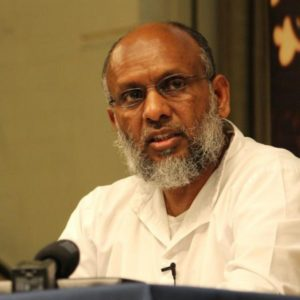
Shaykh Akram Nadwi
Muhaddith & Islamic Scholar

In the Name of Allah, the Most Gracious, the Most Merciful
Is There a Grammatical Mistake in the Qur’an?
By: Dr. Muhammad Akram Nadwi
Oxford, UK
Question:
Respected Maulana Rida ul-Haq, Principal of Jamiat Al-Huda in Nottingham, may Allah preserve him, has a daughter, Ustadha Safiyya Zaid, who is an accomplished scholar, a specialist in Arabic language and Hadith, and also one of my students. She has received authorization in Hadith from many scholars. She posed the following question:
What does it mean that the Prophet (PBUH) was “Ummi”? Was there any error made by the Prophet (PBUH) in writing the Qur’an? Is there any grammatical mistake in the Qur’an? Is there a mistake in the Qur’an’s script? Why is “ليكوناً من الصاغرين” in Surah Yusuf (12:32) and “لنسفعاً بالناصية” in Surah Al-`Alaq (96:15) written with a noon that resembles an alif?
Answer:
Your questions are significant, and to address their importance, I will answer each question under a subheading to ensure clarity and eliminate any misunderstandings.
What does it mean that the Prophet (PBUH) was “Ummi”?
We won’t delve into the etymology of the word Ummi here, as detailed research can be found in books of linguistics and tafsir. Instead, we will focus on its meaning as understood from the Qur’an.
The Jews had been receiving divine scriptures one after another, which they used to read and write. Compared to other nations, the Jews were more literate. However, among them, there were some who could neither read nor write, and the Qur’an refers to them as “Ummi” – “And among them are unlettered ones who do not know the Scripture except in wishful thinking” (Surah Al-Baqarah 2:78). In contrast, most Arabs were illiterate, hence as a nation, they were generally referred to as Ummiyoon (unlettered).
The term Ummi is not the opposite of Alim (scholar), but rather of Qari/katib (reader/writer). The opposite of Alim is Jahil (ignorant). Therefore, a person could be Ummi (illiterate) and still be a scholar. In Islamic history, we find examples of many blind scholars who couldn’t read or write, such as Qatadah bin Di’ama (d. 117 AH), who was regarded as a master in Hadith, Tafsir, Fiqh, and history despite being Ummi.
Similarly, the Prophet (PBUH) could neither read nor write, like most Arabs at that time, which is why he was referred to as Ummi. Allah deliberately kept the Prophet (PBUH) unlettered so that no one could accuse him of fabricating the Qur’an. “You (O Muhammad) were not reciting any Scripture before this, nor were you writing it with your right hand, otherwise the falsifiers would have doubted” (Surah Al-Ankabut 29:48). This is akin to the wisdom behind Maryam (AS) being unmarried, so no one could doubt the miraculous birth of Isa (AS).
Despite being Ummi, the Prophet (PBUH) reached the highest level of knowledge and wisdom, and his sayings and actions are proof of this. It is also nothing short of a miracle that the Qur’an, revealed to an Ummi Prophet, surpassed all other divine books. As the poet Sa’di said:
The unlettered one who corrected the Qur’an,
Wiped clean the libraries of seven nations.
Was there any error made by the Prophet (PBUH) in writing the Qur’an?
The preservation of the Qur’an has been unparalleled, unlike any other divine or non-divine book. The Qur’an is preserved in the heavens and was delivered to the Prophet (PBUH) through Jibreel (AS), who revealed verses as needed. The Prophet (PBUH) memorized them and recited them in prayers, according to divine order. Trusted companions wrote down these verses under his supervision. Some companions even kept their own copies of the written verses.
The process of writing down the Qur’an was carried out by several companions, but mainly by Zayd ibn Thabit (RA). During the time of Abu Bakr (RA), Zayd was entrusted with compiling the Qur’an into one book, and no disagreement about its script was reported. This led to a unified version of the Qur’an.