In the name of Allah, the Most Beneficent, the Most Merciful
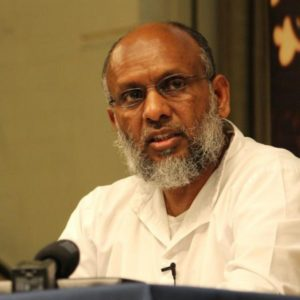
Shaykh Akram Nadwi
Muhaddith & Islamic Scholar

In the name of Allah, the Most Beneficent, the Most Merciful
*A Meeting with Maulana Muhammad Tariq Jameel*
By Dr Muhammad Akram Nadwi, Oxford
Translated by Syed Huzaifah Ali Nadwi, Cambridge
On Sunday, July 29th 2018, I had the chance to meet the very well-known speaker Maulana Muhammad Tariq Jameel in Wakefield (England) at the time of Dhuhr. Even though we had both wanted to meet each other for a long time it had yet to transpire. Yesterday, I was teaching a course on Tazkiyah (purification of the self) at the University of Leeds, organised by Zayd ul-Islam through Al-Buruj Press, and it was Zayd’s wish for me to meet him because he was in the area and the timing was also appropriate. As I was busy I thought that speaking to him on the phone would have sufficed, but one of Maulana’s hosts conveyed a message on his behalf indicating that he would like to meet me.
So, I, Zayd ul-Islam and our two accompanying friends visited the Maulana at around 2pm. Maulana warmly welcomed us, we combined Dhuhr and Asr prayers (because we were both travelling), drank tea, and it was a short meeting because I had to get back to the class at university. Maulana also assured me that he will visit Oxford the next time he makes a trip to the UK.
تمهارى جيسى ش باهت كو ڈهونڈتا تها دل
تمهارى شكل نه ديكهىى تهىى جس زمانه مين
The heart tries to find a resemblance similar to you
The era has not seen an appearance like yours
Maulana is not in need of an introduction or praise, but I will introduce him in order to show affection. There is no one comparable to Maulana in the work he’s doing with Dawah and Tabligh, and in how people are being changed through his efforts. He has many great qualities, including but not limited to the fact that he is from those individuals who have shown many people the way to the right path. But the quality which Maulana has, and I find myself most influenced by, is that he does not distinguish between groups and sects, and transcends them. Maulana takes every Muslim in good faith and sees the good aspects of every person, and that to me is the reason why I find Maulana to be so pious. For this reason, Maulana’s heart-warming speeches have brought many wrongdoers onto the straight path.
Maulana asked me about my connection with him. I said that this connection was shared desire for unity and the most important reason for this is that I also try to distance myself from prejudice, close-mindedness, bigotry and that I call towards the unity of the Muslims.
دل كو بهايا نه كوئى رنگ محبت كے سوا
The heart did not like any colours except the colour of love and affection
These invented (artificial) human differences cannot affect the pillars of this unity and it is the reason why Islam is universal. It is sad that we have destroyed this unity for many years, and we have become so immature by taking pride in this differentiation.
Talking about Pakistan’s politics, I said that Imran Khan is not a scholar nor a thinker, his background is cricket, and yet he does not have any other competition in politics, so his party has won the elections by a majority and soon he will become the Prime Minister of Pakistan. So why is it that none of our scholars and intellectuals, who have been active in politics for seventy years, gained an important position in the government? The reason for this is that people do not believe that the scholars are representatives of the nation’s religion, rather every scholar is regarded as being from a sect. If by chance they reach an agreement on a matter it is purely coincidental and soon their sectarian tendencies prevail. They are then deceived by these groups and stir up sectarianism.
Replying to this, Maulana said that the fact is that “I invite towards ‘togetherness,’” i.e. that Muslims should lessen the importance of their differences and become a united nation. In contemporary times, the one that carried out this effort in the subcontinent was the scholar Maulana Abul Hasan al-Nadwi (may Allah’s mercy be upon him). Maulana opposed sects and prejudice, and these characteristics are foun
d in his true successor, Maulana Rabey al-Hasani al-Nadwi. I have also seen this special concern in two other scholars: firstly, Maulana Saeed Ahmad Khan (may Allah’s mercy be on him) whom I visited in Madinah in a mosque named Masjid Nur and then had the honour to spend time with him in Nizamuddin. Maulana would not call towards a sect or group, rather he shared the concern and pain for all Muslims. When we would see Maulana, a voice would come out exclaiming:
مانند حرم پاك هے تو ميرى نظر مين
You resemble the blessed Haram in my eyes
The second figure who had a great impact on my life was Maulana Muhammad Umar Palanpuri (may Allah have his mercy on him), who I met frequently in Nizamuddin, Bangladesh, Lucknow, and many other places. I heard his talks on numerous occasions. Indeed, he was not sad on this account because of the Muslims but for humanity at large. This is the reason why we see a zeal in his speeches.
كيا جانے رهروان محبت كدهر گئے
روشن مگر هين راه ابد مين نشان كئى
What do the travellers know about affection?
There are many eternal marks that are glowing (in the path of eternity)
After these three scholars, Maulana Tariq Jameel is the true caller to this message of the Quran. His talks resemble the spirit of Bilal in terms of the call to prayer. And this is the reason why Muslims at large respond positively to his message and their attachment to him increases.
خيال وفكر كى شيشه گرى مين كچه بهىى نهين
يقين نه هو تو فقط آ گهىى مين كچه بهىى نهين
Thinking and imagination in glass blowing is nothing.
If there is no belief then there is no benefit in having knowledge.
The other quality of Maulana with which I find myself impressed by is his zeal and enthusiasm for the Quran. This is the reason why he called me a few years ago and we spoke about many interesting things, and then he asked me a question regarding a verse of the Quran. After this, we had a series of conversations where we discussed various verses of the Quran. During this conversation, I presented a short introduction to the erudite scholar of the Quran, Maulana Hameed Uddin Farahi (may Allah be pleased with him).
In today’s meeting, Maulana asked me how can the ummah be bought closer to the Quran? I gave a brief answer to him and emphasized that the reason for all the issues that the Muslims are facing is because of their detachment from the Quran, as people usually do not reflect or contemplate the Quran. Maulana then asked what the best method for the interpretation of the Quran would be and I gave an appropriate answer to it, explaining and illustrating this through many/various verses from the Quran.
The other reason for the connection with Maulana is that Maulana often reads my articles which I write in Arabic and Urdu, and sometimes writes words of approval too. In today’s meeting, Maulana repeated his admiration of these articles, which gave me confidence, while also asking me how I write such good Arabic while living in England.
This meeting with Maulana was short, but affection for him increased. The message of the meeting is that we should invite Muslims to attach themselves to the Quran and we should stop them from being separated into sects and groups: “and hold fast to the rope of Allah and do not be divided” (Quran 3:103). The believers in one God should be one, the believers of the one guidance should have the same root, and the nation of the last prophet should have the same role model.
May Allah make us remember the forgotten lesson of love and save us from sects and groups! Ameen.