Entering Masjid al-Haram while menstruating

Shaykh Akram Nadwi
Muhaddith & Islamic Scholar
Entering Masjid al-Haram while menstruating
By: Dr Mohammad Akram Nadwi
Oxford
15/12/2025
Question:
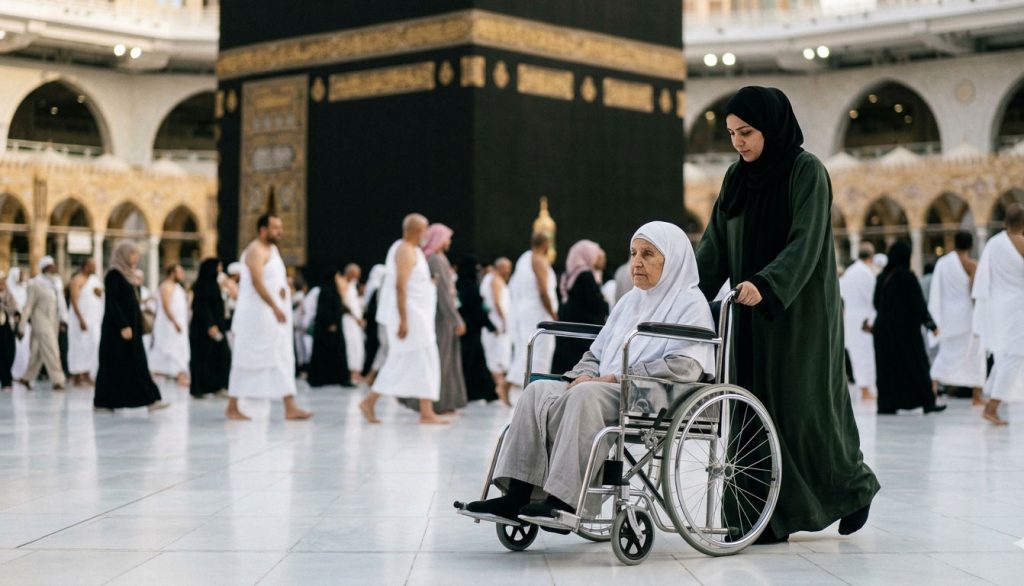
You mentioned that a menstruating woman may enter Masjid al-Haram in Makkah. Does this permission apply to all areas of the mosque? Additionally, if her only purpose for being there is to assist an elderly parent, is she allowed to remain with her mother while the mother performs ʿUmrah using a wheelchair or golf cart?
Answer:
According to the majority of classical scholars, including the Hanafis, Malikis, Hanbalis, and the relied-upon position of the Shafiʿi school, a woman in the state of menstruation is not permitted to enter or remain in a mosque, and this ruling applies to Masjid al-Haram as well. This view is based on their understanding of the Qur’anic verses concerning ritual impurity and on prophetic reports which they interpret as prohibiting staying in the mosque for those in a state of major ritual impurity. For this reason, the dominant and more precautionary legal position is that a menstruating woman should neither enter nor stay inside the mosque.
At the same time, a recognized minority of scholars held a different view. This opinion is attributed to the Ẓāhirī school, to al-Muzanī among the Shafiʿis, and was also supported by scholars such as Ibn al-Mundhir. They maintained that remaining in the mosque is permissible, arguing from the principle of original permissibility, namely that prohibition requires clear and explicit evidence, which they did not find to be established. They cited, among other proofs, the statement of the Prophet ﷺ, “The believer does not become impure,” narrated by al-Bukhari and Muslim, and also relied on a number of historical and contextual reports. These include the fact that Ahl al-Ṣuffah resided in the mosque, as well as reports indicating the presence of women in the mosque, such as the story of the woman who used to clean the mosque and the incident of dhāt al-wishāḥ. Along with other situational precedents, these reports were understood by them to indicate that both men and women remained in the mosque without explicit differentiation, and thus to support the permissibility of remaining in the mosque in the absence of a clear and specific prohibition.
Imam al-Nawawi رحمه الله, in his commentary on al-Muhadhdhab, mentions that al-Muzanī, Dāwūd, and Ibn al-Mundhir permitted remaining in the mosque absolutely, and he explains that their strongest reasoning is that the default ruling is permissibility and that no sound, explicit text establishes a clear prohibition.
When this juristic discussion is applied to Masjid al-Haram specifically, it should be emphasized that visiting Makkah is often a rare and deeply significant spiritual opportunity, especially for women who may not have the means or ability to return again. In light of this, some scholars consider it acceptable, in cases of genuine need or strong religious benefit, to act upon the minority opinion, while still maintaining respect for the sanctity of the mosque and avoiding unnecessary presence inside it. From a more cautious perspective, it is preferable for a menstruating woman to remain in areas such as Safa and Marwah, which many scholars consider to be outside the mosque proper, and from which the Kaʿbah can still be seen and remembered.
If, however, there is a real need for her to be inside Masjid al-Haram, such as assisting an elderly mother, father, maḥram, or female relative who is performing ʿUmrah using a wheelchair or golf cart and requires constant help, then entering the mosque for this limited and necessary purpose may be permitted according to the aforementioned minority opinion. In such a case, the intention is service and necessity rather than engaging in acts of worship that require ritual purity.
FOLLOW THE الشيخ محمد أكرم الندوي CHANNEL ON WHATSAPP:
https://WhatsApp.com/channel/0029VbAxp2qGpLHHqQ3LoY0w