Cucumbers in six months

Shaykh Akram Nadwi
Muhaddith & Islamic Scholar
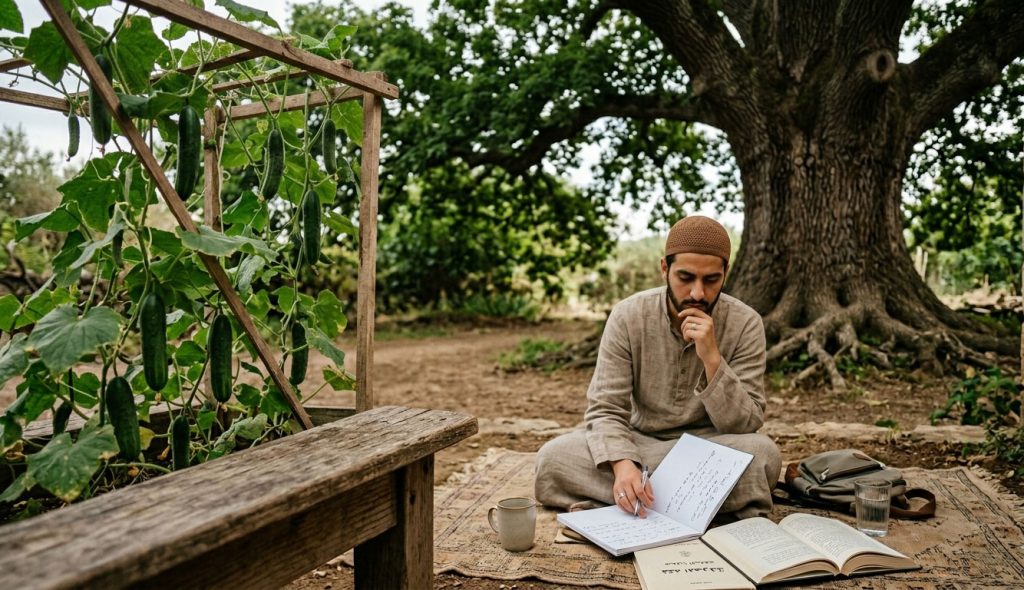
Cucumbers in six months
By: Dr Mohammad Akram Nadwi
Oxford
05/12/2025
In recent years, one encounters advertisements proclaiming, with the breezy boldness of a street magician, “Learn Arabic in six months!” The assurance is delivered so serenely that one almost begins to suspect that the long centuries of scholarship, pedagogy, and intellectual labour behind the language were merely the fussy hesitations of overcautious academics. Yet the truth stands firm and unmoved: in six months one may, indeed, coax a cucumber from the soil, straight, green, and blissfully unaware of the metaphysics of grammar, but one cannot grow an oak tree. And Arabic, with its millennial rings, its sprawling canopy, and its roots sunk deep into sacred and literary earth, is nothing if not an oak.
Those who offer rapid fluency imagine language to be a species of flat-pack furniture: open the box, follow the diagram, tighten a few screws, and behold, a brand-new tongue. But languages do not behave like obedient furniture. They do not submit to Allen keys. They are ancient animals: temperamental, dignified, shaped by epochs of usage, enriched by civilisations, and quite capable of refusing one’s company until approached with the proper mixture of humility and perseverance. To learn a language, to truly learn it, is to enter an apprenticeship older than your grandparents’ grandparents. And apprenticeships, like oak trees, require time, weather, patience, and the occasional humility-inducing stumble.
This impatience is not merely linguistic. It forms part of a broader social mood that treats time as an optional suggestion rather than a stubborn reality. Take, for instance, the hotelier near the sacred precinct of the Haram who assures the pilgrim, with a sweetness that would give a nightingale self-esteem issues, that his hotel is “just 500 metres from the sanctuary.” The number is crisp, the tone persuasive, the confidence unshakeable. Yet once the pilgrim sets out, he discovers that these 500 metres do not behave like metres at all. They stretch, shrink, writhe, and multiply according to elevator queues, wandering alleyways, and slopes that rise with the obstinacy of mountain goats. These metres belong less to physics than to metaphysics, a measurement system devised by the cheerful and the unreliable.
Consider, too, the debtor. “Two days,” he intones, seated upon the throne of untroubled certainty, as though time itself were his personal valet. Yet his two days flutter about like startled pigeons, alighting occasionally on a week, sometimes on a month, and every so often on a distant year. And when he finally reappears, he arrives with such disarming innocence that one wonders whether the debt was ever anything more than a charitable hallucination.
There is the home contractor who assures you, hand hovering near heart, that the kitchen renovation will be complete “by Friday.” This Friday is a legendary figure: a trickster deity of the calendar, elusive, migratory, lavishly fond of long holidays. It wanders across weeks, drops in on unexpected seasons, and occasionally slips quietly into the next year. When the project at last concludes, the results bear unmistakable traces of its pilgrimage: a drawer that opens only when serenaded, a countertop inclined gently towards philosophical meditation, and a patch of paint that appears to be pondering its own existence.
Then there is the cable technician who promises, with the unearned optimism of a motivational poster, to arrive within a “two-hour window.” This window, however, expands like a novel written without an editor. It embraces the morning, appropriates the afternoon, grows fond of the evening, and sometimes peers with curiosity into the following sunrise. The technician eventually appears, naturally—at the precise moment you have stepped into the shower or relinquished hope entirely.
What joins these small comic tragedies is a cultural habit of treating promises not as commitments but as decorative utterances, verbal confetti tossed into the air to make the present moment sparkle. Promises soothe; they do not necessarily bind.
It is in such a climate that the slogan “Learn Arabic in six months” finds its eager audience. It flatters the contemporary palate: swift results, minimal effort, the comforting illusion of mastery. But Arabic is unmoved by such flattery. Its grammar is precise, its semantics layered, its rhetoric intricate, and its literature vast. To learn it is not to memorise a vocabulary list; it is to enter a thousand-year symposium. One does not burst into such a gathering unprepared, announcing, “I’ve arrived!” One enters with patience, reverence, and the quiet willingness to be shaped.
Thus the cucumber remains the rightful emblem of the six-month plan, modest, wholesome, and uncomplicated by nuance. But Arabic, like the oak, demands slow ripening. Its branches bear heavy fruit; its roots pierce deep strata of revelation, poetry, jurisprudence, and philosophy. To claim mastery of it in half a year is not merely wishful, it is a misunderstanding of mastery itself.
In the end, the lesson is unmistakable: haste may grow vegetables, but not trees; marketing may sell courses, but not scholarship; promises may soothe the ear, but they cannot replace the long, steady labour through which real learning is earned. Arabic, like all profound knowledge, welcomes not the hurried tourist but the patient traveller. And only the patient traveller will ever stand in its shade.
FOLLOW THE الشيخ محمد أكرم الندوي CHANNEL ON WHATSAPP:
https://WhatsApp.com/channel/0029VbAxp2qGpLHHqQ3LoY0w