An Era of Nadwat al-Ulama Has Passed Away

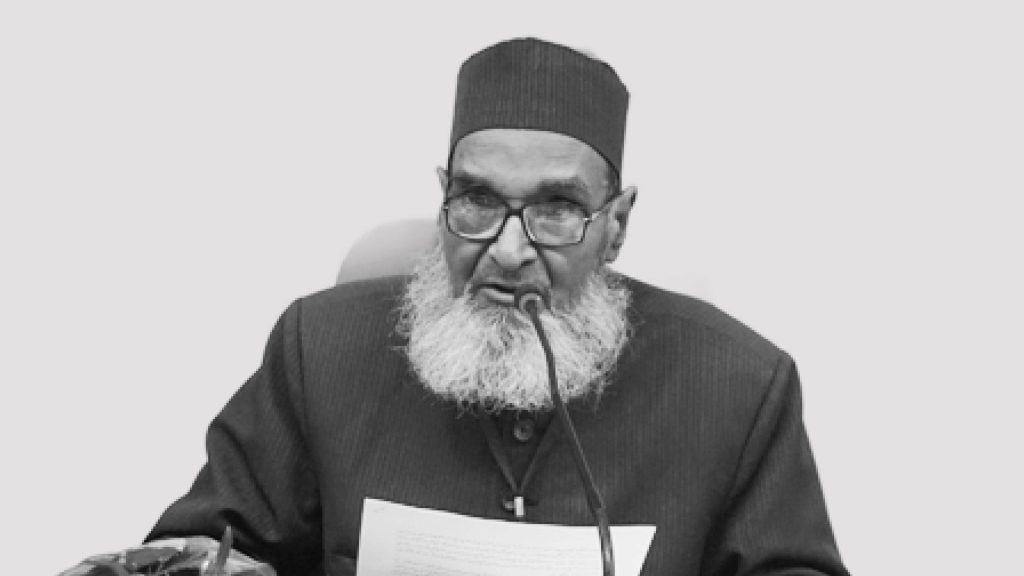
The finest flower in the whole garden,
Whose radiance illumines the colourful air,
Which never witnessed the tyranny of autumn,
Which spring nurtured with the blood of its own heart—
That single flower now rests within the flower-picker’s eye.
I joined Nadwat al-Ulama in 1978. When I heard the Friday sermon, I heard, for the first time, an extempore Arabic address of a kind I had never encountered before. There was neither a book before the preacher nor a written text; yet there was such fluency in his words, such thunder in his voice, and such force in his manner of expression that it felt as though a storm were passing before us in all its might—a storm before which even the hearts of rivers would tremble.
What lion has arrived that the battlefield itself is trembling?
On one side the battlefield trembles, and on the other the ancient sky itself shakes.
The emotional impact was so profound that the entire gathering sat utterly still and silent. Even if someone coughed, all that could be heard was the voice of the preacher. It seemed as though we were present in the ancient Arab marketplace of Ukaz, listening to one of Arabia’s celebrated orators displaying the finest arts of eloquence. This was my first encounter with my respected teacher, Maulana Saeedur Rahman Azmi Nadwi, may Allah have mercy on him.
The history of an institution is not preserved merely in its buildings, books, offices, and documents. Its true imprint is etched into the lives and services of those who remain associated with it for decades and contribute to its construction and development. Some people become part of an educational institution or organisation, but others, through their long companionship, sincerity of service, and far-reaching influence, become such a luminous chapter in its history that the passage of time cannot erase them. And when such a person departs from this world, it is not merely a seat that becomes vacant; an entire era departs with him, and a living page of history is transferred forever into the book of the past.
The garden of existence is inhabited by a thousand flowers;
Yet Death’s eye yearns for only one.
The passing of my respected teacher, Maulana Dr Saeedur Rahman Azmi Nadwi, was an event of precisely this nature for Nadwat al-Ulama. With his death on 26 Rabi al-Thani 1448 AH, Nadwa did not merely lose an elder teacher, scholar, writer, preacher, and mentor; it bade farewell to a living tradition that had been part of its intellectual and educational existence for seven decades.
A hundred years the revolving heavens had held a single turn of the cup;
When he emerged from the tavern, the whole world had changed.
He departed this world at approximately ninety-three years of age, and the greater part of his life was devoted to Nadwat al-Ulama. His association with the institution lasted for nearly seventy years. He entered its intellectual environment as a student, later took up the responsibility of teaching, led the prayers in the mosque, addressed people from the pulpit, trained students, participated in academic and administrative affairs, and continued to serve the Arabic language and literature.
He witnessed several eras of Nadwa with his own eyes and saw generations of students grow and mature before him. In this respect, he himself was a living link between Nadwa’s past and its present.
Discipline and punctuality were conspicuous features of his life. When it was time for a lesson, he would arrive in class punctually and remain there until the lesson was completed. At prayer times, even severe weather could not interfere with his routine. This punctuality was not merely a habit; it was an expression of his profound sense of responsibility:
Those were the words of a mountain-breaker, spoken to another mountain-breaker.
He occupied a distinctive position in the world of knowledge and literature. His attachment to the Arabic language was not merely a requirement of teaching. He paid particular attention to the choice of words, sentence structure, pronunciation, and precision of expression. At times, his corrections could seem severe, but behind them lay a deep love for the language and a commitment to scholarly standards.
In his view, a teacher does not merely teach a book; his own personality is itself a silent lesson. His deep voice, measured conversation, carefully chosen words, and dignified manner of expression were all part of this formative influence.
Even outside teaching hours, he would sometimes make time for students at his home. I too had the opportunity to benefit from his company, although I visited his home only once or twice. Even the memory of those brief gatherings remains, for me, no less valuable than a treasure of knowledge.
During that period, I also became associated with the office of Al-Ba’th al-Islami. There I had the opportunity to read Arabic journals and periodicals and to become familiar with the style of scholarly articles and the written work of men of letters. Gradually, this environment awakened within me a love of writing and helped spur it forward.
Maulana published some of my writings and translations in his journal. On occasion, he even entrusted me with reviewing material that he considered weak in quality. This was a distinctive aspect of his educational method: he did not confine a student to reading books and accumulating information. Rather, he sought to bring the student to the point of taking up the pen, giving expression to his thoughts in words, and conveying the fruits of his reading and learning to others.
For him, education was not merely the illumination of the mind. He wanted that light to reach the hearts and minds of others through the pen as well:
Blessed indeed is such a day, and joyful such a life.
Oratory was a prominent aspect of Maulana’s personality. He spoke extemporaneously, and words flowed naturally from his tongue. His voice possessed depth, his expression had power, and his conversation carried a particular dignity. His oratory was not simply a matter of beautiful words; behind it stood extensive reading, mature thought, and the experience of a long scholarly life.
The different dimensions of his personality were not separate from one another. Scholar, man of letters, preacher, teacher, and mentor—these were different facets of one personality. The delicacy of literature within his scholarship, the depth of thought within his literary expression, the dignity of knowledge within his oratory, and the warmth of mentorship within his teaching combined to make him a distinctive personality.
When he was displeased, he did not conceal his displeasure. Rather, he expressed it with such intensity that it seemed as though a storm rising within his heart had involuntarily reached his lips. The more annoyed he became, the more emphatically he expressed his displeasure, as though he wished to clothe every wave of grievance in words.
Yet when he was happy, it was as though nothing had happened at all—as though the clouds that had just covered the horizon had suddenly dispersed and sunlight had unexpectedly descended upon the earth. There was such spontaneity and expansiveness in his happiness that no trace of his earlier displeasure remained, as though a cloud of sorrow had passed across the sky of his heart in an instant.
His entire life was a story of quiet service. To devote nearly seventy years to a single institution is no ordinary matter. A tree does not keep an account of the shade it provides. It does not know how many travellers rested beneath it or how much sunlight its branches shielded them from. Maulana’s life was much the same. He never kept an account of the benefit he bestowed, yet there were many who passed beneath his shade:
Where are people of such a disposition now?
Today, the buildings of Nadwat al-Ulama are the same. The mosque is the same. The classrooms are the same. Students continue to come and go. Yet a familiar voice has fallen silent.
That face will no longer be seen in a classroom. A linguistic error will no longer receive his immediate correction. And at prayer time, his familiar presence will no longer be seen making its way towards the mosque.
When great people die, it is not merely that one individual disappears; the very atmosphere changes. The place remains the same, but the feeling of that place changes. The books remain the same, but the voice that conversed with them is no longer there. The building continues to stand, but within it an entire era falls silent.
The death of Maulana Saeedur Rahman Azmi Nadwi is precisely such a silence for Nadwat al-Ulama. With him, an era in Nadwa’s history has departed—an era that cannot be brought back.
New generations will come. New teachers will arrive. New pens will be taken up. But every age has its own particular fragrance, and when those who preserve that fragrance depart, that age becomes history.
Maulana’s life is now not merely a memory for Nadwa; it is a trust. His long teaching career, his devotion to language and literature, the training of students, his writing and oratory, and his lifelong service to the institution are different dimensions of that trust.
A teacher may depart physically, but his knowledge continues through his students; his literary taste survives in their writings, and his training remains present in their character.
To describe his passing merely as the death of an elder scholar would perhaps fail to convey the full significance of the event. Nadwat al-Ulama has not simply said farewell to a person; it has said farewell to an entire era.
It was an era in which the seriousness of scholarship, the appreciation of literature, fidelity to language, the dignity of teaching, the power of oratory, and the quiet grandeur of service could all be seen together.
I am not the only one singing the praise of that radiant flower;
Your nightingale has thousands of companions on every side.
May Allah Almighty forgive our respected teacher, accept his long years of scholarly and religious service, and make his teaching, writing and authorship, oratory, mentorship, and lifelong service to Nadwat al-Ulama a lasting provision for his Hereafter. May He raise his ranks and grant patience to his family, students, associates, and the entire Nadwa community.
He has departed many miles away, towards the abode of longing.
An era of Nadwat al-Ulama has passed away—but the light of that era still remains.