A Scholarly Gathering in Oxford
I returned from the mosque after the ‘asr prayer, as evening cast its veil over Oxford, that city which pulses with knowledge and thought, enwrapped in a gentle breeze that caressed the soul as it stirred the fallen leaves. It was then that the esteemed delegation knocked at my door, carrying with them the fragrance of the East and the scent of venerable madrassahs, their faces aglow with the light of minds that know neither stagnation nor rest until they meet, converse, deliberate upon matters of knowledge, and exchange views and counsel in that which benefits people and leaves a lasting mark upon the earth.
On this evening, I was honoured by the visit of this noble group of scholars and researchers who had come to Oxford, their faces bearing the signs of earnestness, their minds illuminated with knowledge, and their hearts filled with sincerity and purity of intention. At their head was the esteemed brother Mizan al-Haqq, that serious young man who, in his resolve and striving, resembles those of determination and purpose among the pioneers of knowledge, who know neither repose at night nor rest by day.
Accompanying him was the distinguished Professor Recep Şentürk from Hamad Bin Khalifa University—a man whose very presence evokes the composure and dignity of scholars—and Professor Hasan Qadhi, head of the Islamic Knowledge Centre in Toronto, Canada; Professor Mahmood Awl Muhammad from the Islamic Knowledge Centre and the University of Pennsylvania; and Professor Amir Abu Ghuddah from the Islamic Knowledge Centre and Georgetown University, the grandson of our esteemed Shaykh, Imam ‘Abd al-Fattah Abu Ghuddah, who filled the horizons with knowledge, asceticism, and noble character. There were also Dr Qasim Komboz from Marmara University, Hafiz Mushfiq al-Din from Ibrahim College, and Professor Suhail Marounsi from the Kalam Institute—an institute concerned not only with kalam itself, but with turning over ideas, refining the intellect, and awakening profound meanings that enrich the soul and refine the heart.
My meeting with Professor Recep brought a joy tinged with longing, for encounters that blend memories with knowledge leave an indelible impact upon the heart. Many years had passed since our last meeting in Istanbul, when he was the president of Ibn Khaldun University—a university whose walls echo with the voices of scholars and where the thoughts of Ibn Khaldun still hover in its halls. Now the man had moved to Doha, carrying with him his knowledge, composure, and breadth of vision, his soul untroubled by the narrowness that afflicts the fanatical, nor constrained by whims. He remained as I had always known him—patient, thoughtful, a masterful listener and interlocutor, standing among those scholars who combine forbearance, knowledge, and fairness. I could not but present him with a copy of my book Rihlat Turkiya, in which I wrote his biography, recorded some of our discussions, and preserved memories of our gatherings in Istanbul that still linger with the fragrance of knowledge.
We then moved from my home to a nearby restaurant to continue our conversation over dinner. When the road is filled with the discourse of scholars, it constricts material concerns and expands meaning. Along the way, I engaged in a warm conversation with Professor Hasan Qadhi, a dialogue that was more than mere words; it was a summoning of past memories, recalling his visit to my home in Oxford two years prior. I saw in him the same zeal for knowledge and passion for spreading it, speaking with the sincerity of a scholar and listening with the courtesy of a devoted student. He informed me that he was touring the United Kingdom to introduce people to the message and activities of the Islamic Knowledge Centre. How sorely needed in these times are such tours, which dispel ignorance, revive knowledge, and build bridges between minds and hearts.
He promised, God willing, to meet again in two months in Toronto—a meeting to continue this conversation that one never tires of.
My encounter with brother Mahmood Awl was no less joyful, for his speech blended the fervour of youth with the wisdom of bright students who are undaunted by distance or deterred by hardship. We had last met in the United States, where I found him to be a young man combining noble character, sincere piety, and the perseverance of a student of knowledge unbowed by fatigue or deterred by travel. I was pleased to see him today and to hear his measured opinions and profound reflections.
I also conversed with Professor Amir Abu Ghuddah, and in his face, I saw the very likeness of his grandfather, our noble Shaykh ‘Abd al-Fattah Abu Ghuddah, whose memory has never faded, nor his legacy waned among scholars and researchers—his dignified bearing, his conduct, his noble manners. Amir had visited me two years ago on his way to Istanbul, and between us passed delightful conversations interweaving knowledge, memories, and thoughtful dialogue. I was glad to renew our acquaintance today, as this blessed gathering revived undimmed memories and ever-fresh discussions.
We then gathered around the table in a Turkish restaurant, where the fragrance of the East mingled with the scent of the dishes, and history seeped into every plate—from succulent grilled meats to fragrant appetisers, and dishes from the Ottoman kitchen, itself a testament to a civilisation where both food and thought were richly coloured. Our gathering became a space where warm conversations, the pleasure of food, and the flow of words carrying knowledge and ideas fostered a sense of fellowship unbounded by time or place.
As we sat, I asked Professor Recep about his recent activities and lectures, and he spoke with the calm and gravity of a scholar, sharing details of his lectures in the UK, most notably one on the importance of medical knowledge in contemporary juridical matters (nawāzil fiqhiyya), emphasising how indispensable this science is for the jurist of today, who must not issue rulings without understanding their contexts nor pronounce fatwas on matters he does not grasp. His words bore witness to his foresight, expansive understanding, and keen insight into reality. How desperately the ummah today needs jurists who do not limit themselves to books, but comprehend the realities of the world and skilfully apply texts to them.
Brother Mizan then shared with us his scholarly projects—how sweet is such talk when it rekindles hope that there remain men of knowledge who will never be subdued. He spoke of his work on editing Hujjat Allah al-Baligha by Imam Wali Allah al-Dihlawi and preparing a commentary on it in Arabic, English, and Urdu—a project that does not merely preserve a heritage, but restores its spirit and makes it accessible to students and researchers. He also mentioned his study on the influence of the Poet of the East, Dr Muhammad Iqbal, on madrassahs and educational institutes in the Indian subcontinent, and outlined his project to highlight the personality of ‘Allamah Shibli Nu‘mani as an educational thinker who did not teach merely through words, but educated through intellect, enlightened with knowledge, and refined with conduct.
The gathering was not devoid of subtle knowledge and profound insights. We engaged in a fascinating discussion about the methodology of Imams al-Bukhari and Muslim in their Sahihs, their meticulous criteria for accepting hadiths, and the broader methodologies of the hadith scholars—how they distinguished between sound and weak reports, leaving behind for us a legacy beyond the reach of intellects, still praised on tongues and revered in hearts.
During this discussion, Professor Amir Abu Ghuddah posed a subtle and incisive question, one that penetrates the finer points of knowledge like light reaching hidden corners: about those hadiths included in al-Bukhari’s Sahih that Imam al-Tirmidhi nevertheless described as hasan, citing Imam al-Bukhari himself in his al-‘Ilal al-Kabir.
It was a question that demands the scholar’s pause, provokes thought, and kindles in the mind the delight of inquiry. I mentioned to him some possible explanations, such as differences in technical terminology or variation in expression, and requested, with thanks, that he send me those hadiths so I could study their chains and texts carefully. Once the matter becomes clear, I promised to elaborate on it in service of knowledge and its seekers.
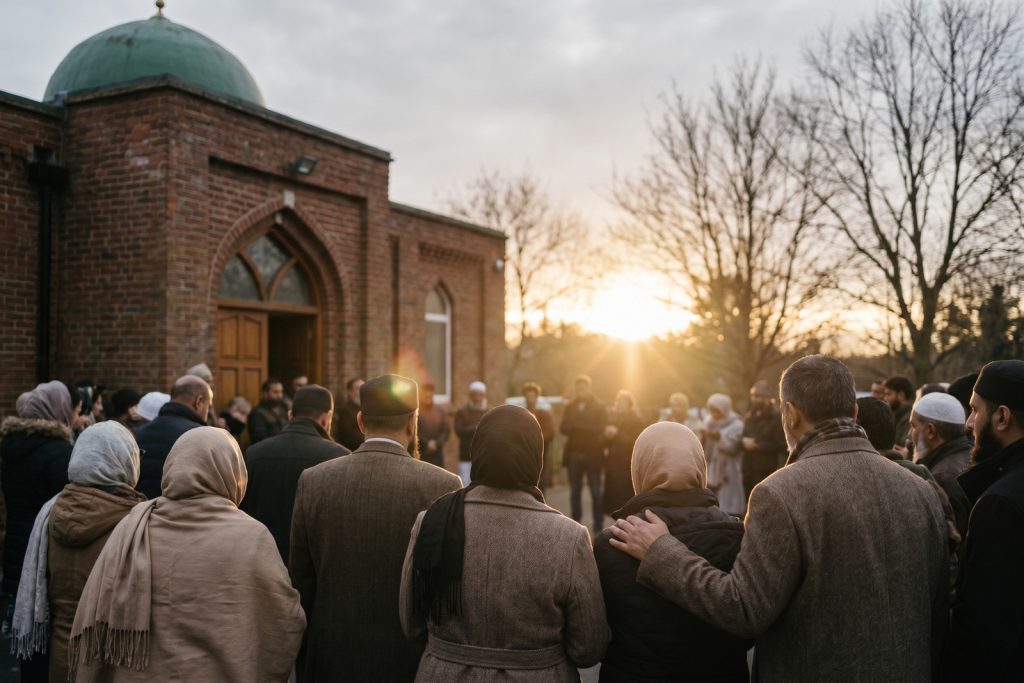
We then proceeded to the Oxford Mosque, praying maghrib together in a house of God that stands as a testament to the city’s scholarly heritage and its people’s piety. That prayer endowed our meeting with a spiritual dimension perceptible only to those whose hearts are attached to the houses of God. We returned to my home after the prayer, continuing our conversation along the way, exchanging opinions until the time came for farewell. The delegation departed for London, and I found myself repeating in my heart: had this gathering lasted longer, we would not have wearied; had this meeting been extended, we would not have tired. But such is the way of days—each meeting followed by a parting, with hope in a future reunion where conversations bloom anew, friendships are renewed, and the service of knowledge endures so long as hearts beat with life, minds with thought, and the ummah with men who bear the torch of knowledge, never dimming nor extinguished.
Original source: