Journey to Bosnia (13)
Wednesday, 10th of Dhul-Hijjah, 1447 AH
Sheikh Abu Talib, who had come from America, led us in the Eid prayer at six-thirty in the morning. His voice in the takbir resonated with a profound sense of tranquility and reverence, and his presence carried the dignity of scholars who blend knowledge with spiritual purity. He is among the renowned orators who captivate the hearts of listeners before their ears and is one of the esteemed teachers at the Institute of Peace, known for their dedication to knowledge and calling to the path of Allah.
He delivered an eloquent sermon reminding us of the history of the Kaaba’s construction, recounting the story of Ibrahim (peace be upon him) as he raised the foundations of the House, a labor intertwined with faith and a sacrifice not of one man alone, but of an entire family chosen by Allah for trials and certainty. He lingered on the story of Hajar and her patience, and Ismail and his obedience, making it seem as though these distant events were unfolding before our eyes, filled with tears of hope, trials of love, and sincere submission to Allah Almighty.
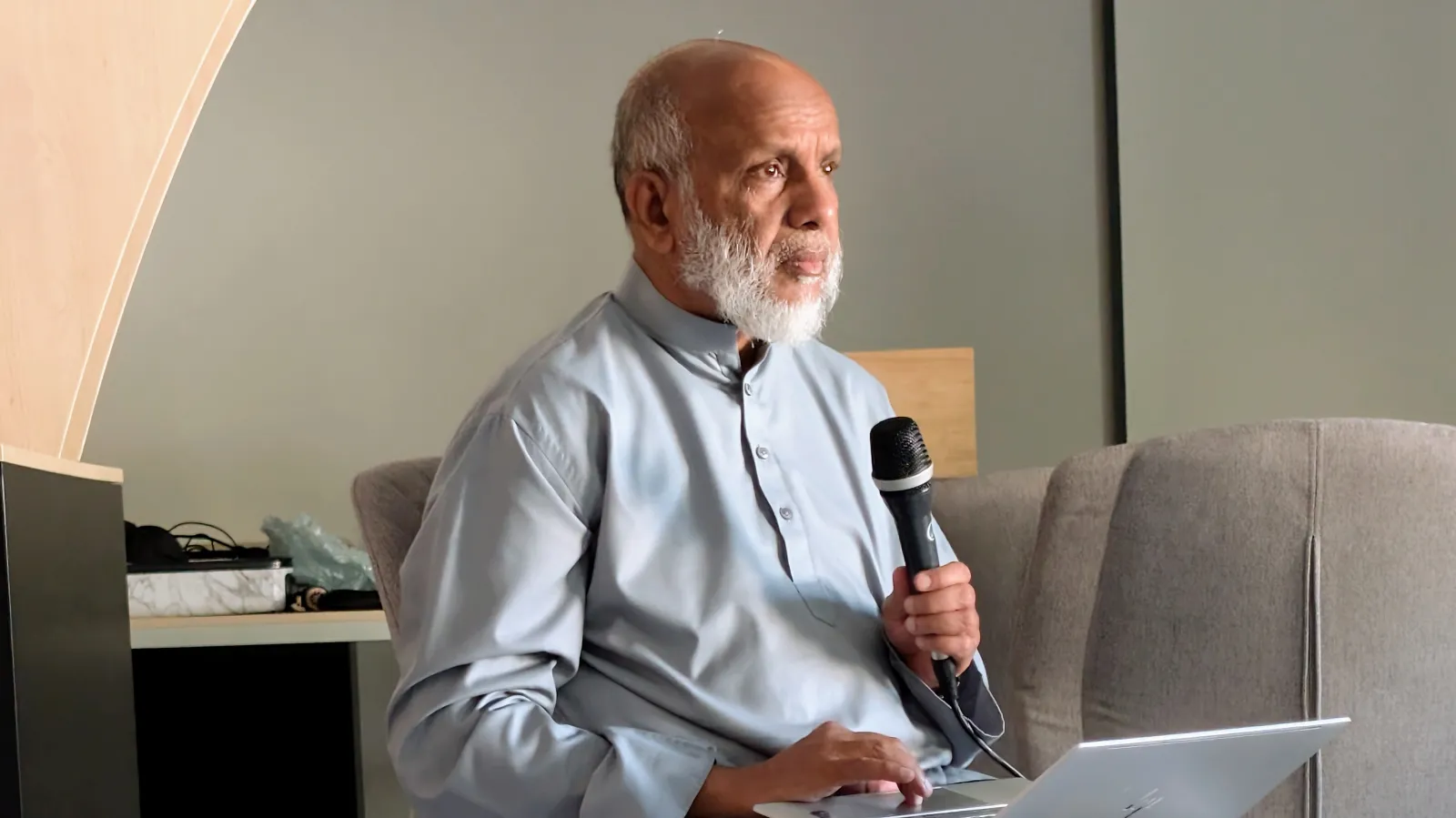
After the prayer, I delivered a brief talk about the meaning of the musalsal hadith and its uniqueness in the science of narration, illustrating how it carries in its words and form the impact of the chain of transmission and the spirit of reception, conveying not only the words but also the manner of delivery and the warmth of feeling. I narrated to the audience the musalsal with the first, a hadith traditionally taught first to students by their teachers, then the musalsal with love, for its uniting of souls and hearts in love for Allah, and then the musalsal with Eid, adding a special joy to the occasion, where the honor of narration met the joy of the occasion, blending knowledge with camaraderie, and remembrance with joy.
When we finished, we embraced and congratulated each other on the blessed Eid of Allah, with faces radiating pure joy, unforced and genuine, as if Eid had restored something of their original innocence. We then proceeded to the hotel restaurant at a quarter past seven, enjoying breakfast in an atmosphere of camaraderie and contentment, where conversations of knowledge, religion, and travel memories mingled with the laughter of friends and the clinking of coffee cups, while the morning sun began to cast its gentle rays over the place, heralding an unforgettable day of Eid.
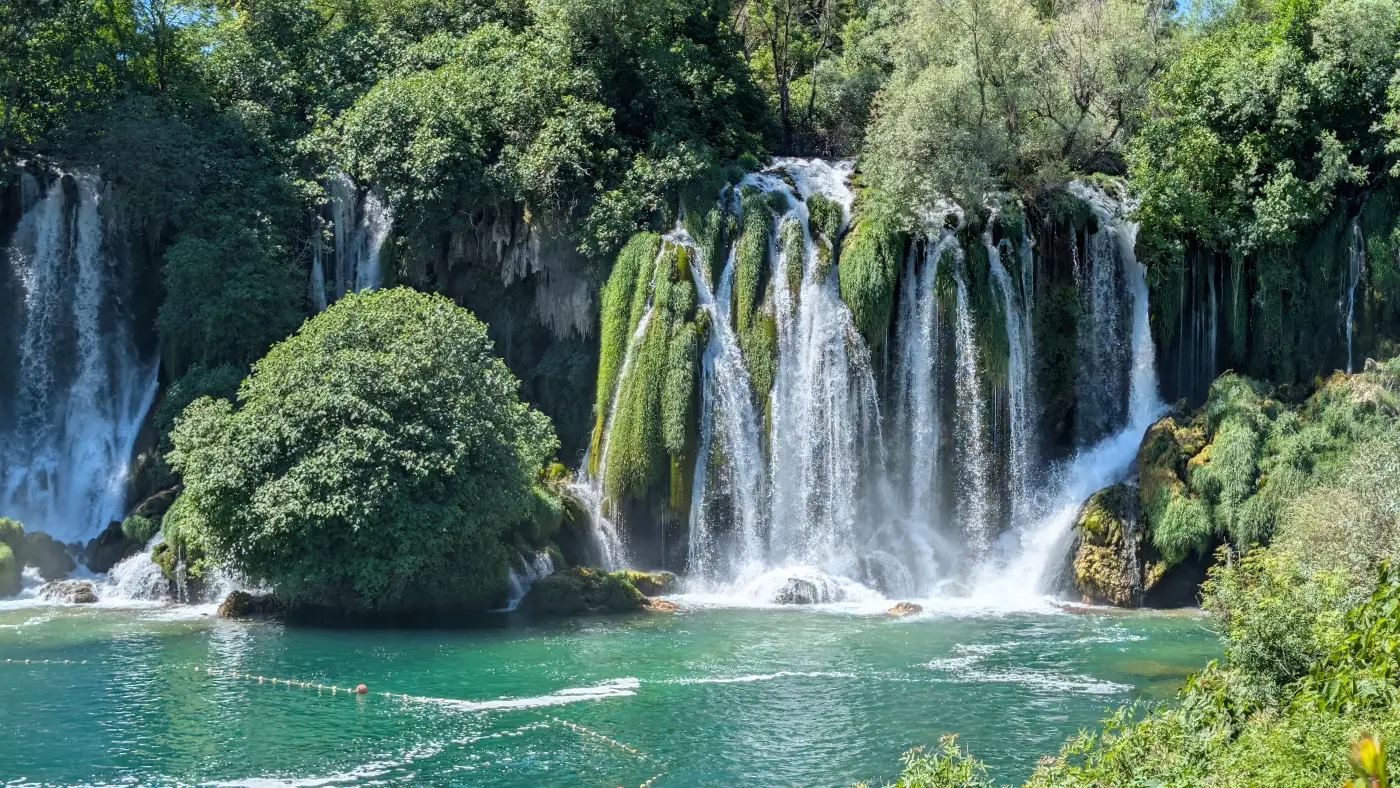
At nine-thirty, we set out for the Kravica Waterfalls, that natural gem nestled in the heart of Herzegovina, where the waters of the Trebižat River initially flow gently, only to cascade down in a delicate violence, as if nature itself had combined tranquility and rebellion, whisper and clamor. As we approached the site, it felt as though we had transitioned from the world of people to another realm governed solely by water, greenery, and pure air.
The path to the waterfalls wound between poplar and fig trees, and those wild trees that grow naturally, untouched by gardener’s hands or urban order. The greenery enveloped the area so completely that it seemed the earth had donned a green garment with nothing else visible. The limestone rocks over which the water flowed were covered with moss, lichen, and fine grasses, making the waterfall appear alive and pulsating, not a silent inanimate object.
I saw no evident traces of civilization’s artifice or urban clamor here; no towering buildings marred the natural scenery, nor did the noise of machines disturb the soul’s serenity. Instead, the water flowed in its primal freedom, and the trees stood in their ancient majesty, as if time had never touched this place.
The waterfall stood about twenty-five meters high, with its waters branching into twenty small cascades, all converging into a serene circular lake, surrounded by sand and trees on every side. Perhaps the relatively small size of the waterfall is what grants it this intimate closeness to people; it is not so immense as to inspire awe alone, but rather it is beautifully familiar, inviting visitors to draw near and linger in its company and contemplation.
I observed people scattered between swimming and sitting on the lake’s banks, some spreading out for meals and conversation, while others pitched their tents not far from the water. There was a small café where visitors sat quietly, speaking in whispers as if fearing to disrupt nature’s sacred silence. They told us about boating and rowing in the summer, and about spring when the greenery reaches its peak, and tables are laden with grilled fish and local dishes for which the region is famous. We enjoyed some ice cream and strawberries.
They then guided us to a nearby cave adorned with stalactites and stalagmites in strange beauty, and to an old mill and a small boat moored at the river’s edge, like a remnant of a bygone era refusing to pass. The place needed no embellishment; its beauty was pure and natural, without artifice or pretense.
Exploring the Beauty of Bosnia
Perhaps the most astonishing thing we heard there was their talk of a phenomenon occurring in late spring and the hot summer days. At noon, water vapors rise to form a delicate mist cloud over the lake, shading those seated and tempering the sun’s heat. Imagining this scene while gazing at the water, it seemed to me that nature here not only bestows beauty upon people but also mercy.
We lingered at the waterfalls for quite some time, listening to the roar of the water, which did not bring discomfort but rather awakened a deep sense of tranquility within. It was as if, in the presence of this silent beauty, one forgets the weariness of days and the clamor of cities, returning somewhat to their primal nature, closer to the earth, sky, and water. Eventually, we departed slowly, with the image of the waterfalls remaining etched in our minds, unerasable by haste or forgetfulness.
We arrived at one o’clock in the village of Počitelj, a small settlement perched on a mountainside overlooking the Neretva River valley, as if it were a piece of history taken from the Middle Ages and left there in its ancient stillness, indifferent to the noise of civilization and the rush of the modern age. The stone houses ascended the mountain in a remarkable order, climbing the slope gently until they reached the ancient fortress that overlooks the entire village like a venerable elder watching over his household.
This fortress, with its remaining walls and towers, transports the observer to distant times when empires rose and fell, and flags changed, yet the stone remained a witness to the fleeting power of man and the lasting impact of his legacy. The village possessed a profound tranquility absent in cities; there was no market clamor, no car noise, only the murmur of water, the sound of the wind passing through the trees, and the quiet, contented conversations of the people.
Most of the village’s inhabitants are Muslims, and there was something in their faces and way of life that exuded a noble simplicity, endearing them to others. I felt a particular affinity for those who live off their land, content with what their villages and fields produce; those who breathe the pure air of their homeland, eat bread made from their own wheat, barley, and corn, drink milk from their livestock, and water from springs flowing between rocks and trees. In their lives, there is an unpretentious honesty and independence that does not require the many slogans echoed by city dwellers.
As I looked at those small fields and modest homes, it occurred to me that true freedom is not achieved through speeches alone, nor preserved by politics alone, but is rooted in this self-sufficiency that makes a person less dependent on others and more capable of living with dignity and peace of mind. How often do nations speak of independence while relying on others for their sustenance and necessities! Yet these villagers, in the simplicity of their lives, embody a sense of freedom not written in constitutions but lived in bread, water, and air.
We then ascended to the village mosque to perform the combined and shortened Zuhr and Asr prayers. The mosque stood on a high hill, overlooking the valley and village, inspiring a sense of serenity and reverence. This mosque, named after Hajji Ali Jah, was built by Hajji Ali Jah bin Musa in the year 1563 AD. Its construction was simple and sturdy, devoid of eye-straining ornamentation, with its beauty lying in its tranquility, antiquity, and the silent nature surrounding it.
On the left of the entrance was a small ablution area where we performed our ablutions. I noticed that Bosnian mosques generally pay significant attention to ablution facilities, while bathrooms, common in some Muslim countries, are scarcely found. The water was cold and clear, gently descending from the mountain springs, making ablution there not just a physical purification but also a comfort for the soul.
We then departed from Počitelj as the sun began to tilt slightly westward, heading towards Blagaj. The road to Blagaj winds between mountains, rivers, and green plains, making the traveler feel as though they are moving through a painted scene rather than a land of people. From afar, small villages appeared scattered on the slopes, with light smoke rising from some, surrounded by orchards and fruit trees, calming the heart and giving the impression that this land was created for peace, not conflict, for construction, not destruction.
We arrived in Blagaj at three in the afternoon, finding it a tranquil village nestled at the foot of a great mountain, as if the mountain had bent over it to guard it from the ravages of time and the vicissitudes of days. There, we witnessed the Buna River emerging from the rock’s depths, a sight that filled us with awe and reverence; the water did not spring from a small eye or narrow stream but surged powerfully and purely from the mountain’s heart, making one think the earth had split open to reveal a hidden sea it had concealed for ages.
We dined at a restaurant overlooking the river, across from the tekke, in a location so beautiful that words fail to capture its essence. We sat on a terrace extending over the water, with the river flowing beneath us like crystal, revealing pebbles at its bottom as if placed by a meticulous jeweler. The reflections of trees and rocks on the water added to its beauty. A gentle, cool breeze passed by, bringing a sense of peace unknown to the inhabitants of noisy cities, a peace incomprehensible to those accustomed to asphalt, smoke, and car noise.
The food arrived quietly, as if the hosts themselves had absorbed the river’s calmness and gentleness. We lunched by the water’s edge, our conversation shifting from travel tales to the history of these lands and the wonders we had seen since arriving in Bosnia. Some companions would suddenly fall silent, not because they had nothing more to say, but because the scene itself demanded silence, overpowering the soul irresistibly. How often does speech become a veil between man and beauty!
Across from us stood the tekke, nestled at the mountain’s base, white and serene, as if part of the rock itself. Its reflection on the water was gentle, making it seem as though the river harbored another tekke within its depths. The visitors’ voices mingled with the water’s murmur, only to be absorbed by it, leaving only the continuous natural melody flowing through the place uninterrupted.
There, I felt a profound tranquility that defied explanation; some places are not merely seen with the eyes but penetrate the heart like an ancient memory, making one feel as if they have known it for a long time or awaited it unknowingly. Perhaps the secret lies in the harmonious gathering of water, rock, and trees, returning man to his primal nature before cities corrupted him, ambitions burdened him, and customs dominated him.
After finishing our meal, we proceeded to the famous Sufi tekke, a place I doubt I have seen in my travels that combines the allure of nature and the spirituality of the location as this tekke does. It stands at the source of the Buna River, where the water emerges from a towering mountain in a breathtaking manner, making one think the mountain itself bursts with life.
This site was sacred before the Ottomans arrived, and a tekke was established there, gaining renown throughout the Ottoman Empire. The traveler Evliya Çelebi wrote about it in the seventeenth century, noting that dhikr gatherings and scholarly discussions were held there. Dervishes inhabited it for a long time, filling it with prayer, solitude, and the recitation of litanies, offering shelter to strangers and wayfarers.
We entered the complex, composed of interconnected buildings: lecture halls, rooms for seclusion, a guesthouse, a kitchen, a bath, and a small mosque topped with a dome, along with a tomb housing some of the Sufi residents. The place exuded a quiet majesty, not from grandeur and ornamentation, but from the convergence of rock, water, and remembrance in one spot.
The mountain overlooking the tekke, the small waterfalls cascading around it, and the bridges spanning the river all enhanced the place’s beauty. When the sun’s rays struck the water, it appeared like scattered pearls and diamonds. We sat by the waterfall for a while, enjoying the water’s roar and observing the tourists crowding the area from all walks of life; some eagerly took photos, others sat silently absorbed in contemplation, while some simply gazed long at the water emerging from the rock’s heart, as if trying to grasp the secret of this endless, unfading beauty.
We returned to Mostar at six in the evening. I opted for rest at the hotel, having already explored the city on a previous trip, while my companions ventured into its neighborhoods and markets. Mostar is a captivating city, blessed with natural beauty, architectural splendor, and the sweetness of the river. It stands on both banks of the Neretva, connected by the famous bridge that has become a symbol of the city and its history.
That bridge was destroyed during the war when hatred consumed people, sparing neither stone nor human. It was later rebuilt, symbolizing the triumph of life over ruin. The city is home to ancient Ottoman mosques, narrow markets, historic buildings, and cafes and hotels bustling with visitors. It is a city divided between Muslims and Christians, separated by the river, yet hearts yearn for peace, while those who incite discord awaken animosities whenever they subside.
The devastation that befell Bosnia during the war is beyond description; the tragedy extended to the point where people believed the fire would never extinguish and corruption had taken root in the land. At that time, the power of arms overshadowed noble character, elevating the wicked and bringing down the honorable, as if human society were a turbulent sea where foam floats above while gold and pearls sink within.
At nine in the evening, I delivered a lecture to the students on the creed of Ibrahim (peace be upon him) as depicted in the Quran and as meticulously analyzed by the esteemed scholar Abdul Hamid al-Farahi in his writings, which combine precision of thought with clarity of faith. The discussion was not merely an interpretation nor a lesson that passes through minds and fades away, but rather an intellectual and spiritual journey with this great prophet whom God made an exemplar for humanity, and with that creed founded on pure monotheism and the liberation of the heart from the illusions of idolatry and the biases of tradition.
I spoke at length about the meaning of Hanifism and how al-Farahi, may God have mercy on him, understood it beyond the literal words to the truths and goals of religion. I then addressed the issue of the sacrificial son, which has long been debated among scholars, and referred to his invaluable book, “The Correct Opinion on Who the Sacrificial Son Is,” a work that does not merely recount opinions but delves into the roots of disagreement and establishes its argument with the calm confidence of a knowledgeable scholar, not the clamor of the fanatical. I asked the students to read this book with contemplation, not as casual readers, and to approach it with open minds and fair hearts.
The lesson lasted an hour, but it passed swiftly as if it were mere minutes; the students listened with remarkable stillness, their faces reflecting signs of thought, and their questions revealing a sincere desire for understanding, not argument.
When I concluded the lesson, questions poured in from all sides: one asked about the connection between the creed of Ibrahim and the Muhammadan Sharia, another inquired about al-Farahi’s method of reasoning, and yet another wanted to know how this scholar managed to combine the authenticity of tradition with the freedom of thought. I answered their questions as best I could, and we engaged in an extended conversation filled with youthful enthusiasm and a passion for knowledge, instilling a sense of hope and reassurance within me.
The gathering dispersed late at night, and the streets grew quiet, leaving a lasting impression from that calm, profound discussion, as if the spirit of Ibrahim (peace be upon him) hovered over the entire assembly, calling for faith free from fanaticism and reason unafraid of truth. I returned to my room, feeling somewhat fatigued, yet my soul was content and at peace, grateful to God for a day spent in learning, teaching, and dialogue, hoping that what was said and heard would benefit these young people who carry the nation’s hopes and dreams into the future.