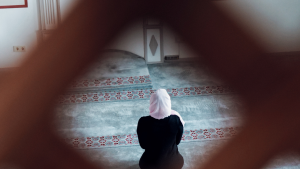
Prayer
From morning till evening, and from evening till morning, we are occupied with countless necessary and unnecessary tasks, worldly and otherworldly. Yet, if we compare among them, the truth will shine clearer than the sun: prayer is the most exalted of all. Prayer is the essence of life and the distillation of servitude. Every moment spent in prayer is far better than the whole world and all it contains. The one who prays is the proof of God upon the earth, speaking and acting only by His command.
With regard to some virtues, the Book of God declares emphatically that those who practise them will enjoy the company of God, for example: “Indeed, Allah is with the patient,” “Indeed, Allah is with the doers of good,” “Indeed, Allah is with the God-fearing.” But for prayer no such affirmation is found: nowhere does it say, “Indeed, Allah is with those who pray.” For the very meaning of prayer is the company of God. In one verse He commands: “Seek help in Allah and be patient.” Here, “in Allah” refers to prayer, as explained in other verses. Whoever separates prayer from God is blind to insight, deprived of reason, nearer to the essence of disbelief and farther from the essence of faith.
The whole form of prayer is testimony to the company of God. Its inward aspect is divine nearness and intimate conversation with the Lord; its outward aspect is purity, humility, and spirituality. In this world there is nothing whose inward and outward are alike—except prayer. Whichever angle one views it from, divine unity is manifest; the mercy of the Lord shines forth; the love of the Creator of all fills the air. The worshipper in prayer stands before his Lord, overcome with ecstasy; a radiant lamp shines within his heart; his mind is safeguarded from the deceit and trickery of Satan.
What is the rank of the one who prays? Every precious thing is beneath it. He is a neighbour securely placed beside the Throne on high, while everything else remains fixed upon the earth. Prayer elevates character and removes vice. The abandonment of mosques is unbearable to us, yet we squander our prayers without concern. We are deeply anxious for the restoration of mosques—if only a fraction of that anxiety were spent on safeguarding prayer itself! Were we to devote ourselves to prayer, other nations would offer us their temples, urging us to take them and populate them, saying: here are the houses of worship, fill them with your devotion. The greatest testimony to the truth of our religion is our prayer. Its outward and inward alike proclaim with loud clarity that this is the worship of truthful people.
We say: politically we are so weak that we cannot establish Islam. But think—whom shall we blame for our neglect of prayer? Is prayer not the greatest command of God? Can those who perform it ever be humiliated and abased? Did the struggles of the Prophets ever begin with anything other than prayer? Prayer lifted nations out of weakness, bestowed upon them social and political strength. The truth is that prayer is so great that such things do not add to its greatness. If, through prayer, kingdom and wealth were lost, let them be lost. For whoever attains prayer—what is he missing?
When I see someone praying, my love for him increases. My heart desires to kiss him, to place him upon my head. From the company of those who pray arises a fragrance beyond words. How beloved to me is the glorification and sanctification of God! And when this glorification and sanctification appear in prayer, the soul is stirred. If there is any state of the believer that has precedence over the angels, it is this state of prayer.
O my Muslim brothers! Reject heedlessness and intoxication; turn towards prayer—for the foundation of servitude is prayer. Whoever has prayed has not been deprived. In the Qurʾān, whenever Muslims are described, prayer is mentioned first. Wherever the people of Paradise are described, their foremost quality is prayer.
And wherever the people of Hell are mentioned, special reference is made to abandoning or neglecting prayer. When I was a child, I would often wander the lanes of my village softly singing Saʿdī’s verse:
روز محشر که جانگداز بود
اولین پرسش از نماز بود
(On the Day of Resurrection, that soul-searing day,
The very first question will be about prayer.)
Can one who does not pray even be called a Muslim? An Islam without prayer has no existence in the Book of God, nor in the practice of the Prophets, nor in the lives of the Companions and the pious predecessors. It was prayer that raised them high, and it is prayer that will raise us high. Human perfection lies hidden in prayer. All virtues and honours are dependent upon it: abstraction and detachment, independence and renunciation, chastity and contentment, forbearance and generosity, selflessness and humility, courage and heroism—all are the fruits of this blessed tree. All its fruits are pure. Every station of nearness in the Hereafter is a gift of prayer. The place where prayer is performed becomes the envy of the heavens—indeed, a likeness of the gardens of Paradise:
از برائے سجدۂ عشق آستانے يافتم
سر زمينے بود منظور آسمانے يافتم
(Through the prostration of love I found a threshold,
A piece of earth favoured by the heavens themselves.)
Let entire volumes turn black with ink, yet the description of prayer will remain unfinished. Who are we? What is our worth? If all the Prophets, their Companions, every saintly and righteous one, and even the hosts of angels close to God, were to describe the merits of prayer, still it would be far greater, far loftier than all they could ever say:
مجلس تمام گشت وبه پاياں رسيد عمر
ما ہمچناں در اول وصف تو مانده ايم
(The gathering is ended, life itself has drawn to a close,
Yet we remain still at the beginning of describing you.)
—
Disclaimer: This article was translated by AI. Original post: https://t.me/DrAkramNadwi/7088