Dhikr
The human being is the subtle secret of the world of creation—one that cannot be comprehended merely through the light of reason, nor reached by the lens of empirical experience and observation. His existence is not simply a structure of matter, but the centre of a meaningful cosmos. It is in this inner realm that the remembrance of Allah (dhikr) becomes a luminous spiritual lamp—one that brightens the darkness of the heart, enlightens the consciousness, and brings man into harmony with his true reality: ʿubūdiyyah (servitude).
This remembrance is not a formal act or mere verbal repetition, but a constant spiritual awareness that liberates the human being from the prison of the ego and leads him into the vast horizons of servitude. When man remembers Allah, he, in reality, comes to know himself; for it is only in the mirror of divine remembrance that one may gain a true understanding of one’s essence.
In the Noble Qurʾān, Allah says: “So remember Me, I will remember you” (2:152). This is not merely a promise, but a divine relationship and a declaration of covenant. When a person remembers their Creator in their states and deeds, this remembrance is not confined to the heart alone—it becomes a relationship that flows through every particle of one’s being. At this level, dhikr becomes an inner discipline that shapes the outward and polishes the inward.
The Qurʾān praises those who remember Allah in all conditions—standing, sitting, and lying down. Every moment of their lives, every action, every silence and every sound is suffused with the remembrance of Allah. Dhikr is a living bond, not confined to a moment, but a pervasive experience in every corner of life. Prayer (ṣalāh), the pillar of the religion, is in fact the physical embodiment of dhikr. Allah says: “Establish the prayer for My remembrance” (20:14). When the spirit of dhikr is present in prayer, it ceases to be mere bodily motion and becomes the ascension of the soul. But if that spirit is absent, the prayer becomes a ritual devoid of impact, void of transformation in the heart and character.
The true essence of all acts of worship lies in this living dhikr. If the heat of divine remembrance is absent from prayer, fasting, zakāh, or ḥajj, they become empty shells—outwardly beautiful perhaps, but inwardly barren. This is why the Qurʾān declares: “Surely, the prayer restrains from indecency and evil, and the remembrance of Allah is greater still” (29:45). Thus, dhikr is the soul of worship; and when the soul departs, the body becomes lifeless.
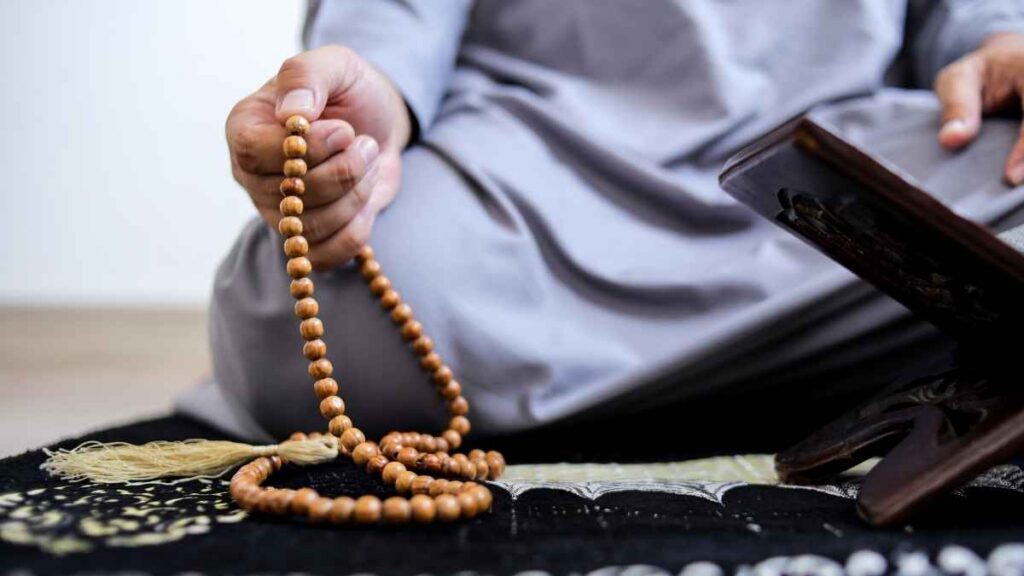
Dhikr is not the name of a specific time or fixed method—it is the name of a spiritual awakening that pervades every aspect of life. Whether it is comforting the sorrowful, helping the needy, seeking knowledge of the religion, or simply reciting a tasbīḥ—all are forms of divine remembrance. The Qurʾān describes the believers as: “Those men and women who remember Allah often” (33:35). Here, kathrah (abundance) is not only in quantity but in quality. A single moment spent with complete awareness can outweigh many heedless hours.
The Prophet ﷺ declared dhikr essential for the purification of the heart. The pollution of the world, the dust of desires, and the rust of heedlessness settle upon the heart in such a way that one becomes unable to recognise the truth. In such a state, dhikr is the polish that renders the heart into a mirror—one in which the truth becomes visible, falsehood is distinguished, and the veils of the nafs are lifted.
Dhikr is not only a means to divine nearness but also a fortress of protection from divine punishment. Sayyidunā Muʿādh ibn Jabal رضي الله عنه narrates that the Messenger of Allah ﷺ said: “There is no deed more protective against punishment than the remembrance of Allah.” It is not merely a spiritual excellence but a practical refuge—a fortress wherein man finds the safety of his existence.
Dhikr guards one from the whisperings of Shayṭān, delivers him from the deceits of the nafs, and saves him from the dazzling misguidance of the world, directing him instead towards the path of truth.
As for those who neglect this remembrance, the Qurʾān issues a stern warning: “And whoever turns away from the remembrance of the Most Merciful, We appoint for him a devil who becomes his companion” (43:36). This heedlessness is, in truth, a spiritual death. The Messenger of Allah ﷺ said: “The one who remembers Allah is alive, and the one who does not is dead.” Thus, dhikr is the sign of life, and neglect of it a prelude to spiritual demise.
Dhikr is that light which tears through the darkness of the heart and spreads the illumination of īmān. It is the bond that links the servant to his Lord, creating a connection so profound that the intellect cannot fathom its depth. In a ḥadīth qudsī, Allah says: “I am with My servant when he remembers Me, and his lips move with My remembrance.” This divine companionship is no metaphor—it is a reality whose taste is only known to the one immersed in sincere remembrance.
The remembrance of Allah is, in reality, the fountain of grace from which the believer quenches his inner thirst. It is the light by which his soul is illumined; it is the provision by which he journeys towards his true destination. It is not mere words, but a state; not merely an action, but a relationship; not merely a ritual, but a soul. And when this soul is alive, every breath, every sigh, every glance, and every step becomes dhikr. Such a person may appear ordinary in the eyes of the world, but in the sight of Allah, they are special—the truly successful, the truly honoured.
Original source: