The Book of Sībawayh
Our brilliant teacher, the historian of Islamic sciences, the eminent ʿAllāmah Abū al-ʿIrfān al-Nadwī, may Allah have mercy on him, used to say: “In the history of humanity, there are four unparalleled books, one of which is the Kitāb of Sībawayh on grammar.” Shaykh al-Islām Ibn Taymiyyah, may Allah have mercy on him, stated in Majmūʿ al-Fatāwā 9/46: “Likewise the grammarians, like Sībawayh, whose book has no equal in the world; it contains the wisdom of the tongue of the Arabs. He did not force himself into contrived definitions of ‘noun’ and ‘subject’ as others did.” Elsewhere he said: “The book of Sībawayh is something that most people cannot produce the like of, yet it is not miraculous, for such is not exclusive to prophets; it exists among others besides them.” And he further added: “The grammar of Sībawayh has no parallel; if someone produces what no one else can match, it is not exclusive to prophets, for it is well known that he learnt some of it from others and derived the rest through his own reasoning… for what such a person says is gained through hearing, experience, or analogy.”
I believe that no book in our Arabic heritage has received as much attention, study, and investigation as Sībawayh’s Kitāb — that immortal work, which still today stands as a pinnacle of linguistic thought in Islam. Were you to ask me about Sībawayh, I would say to you, without hesitation or exaggeration, that he was not merely an accomplished grammarian; rather, he was — and remains — an institution unto himself, a complete school of thought in understanding and analysing Arabic.
As for his origin, he was undoubtedly Persian; but his soul was purely, unquestionably Arab. He lived in an era when knowledge was sought for knowledge itself, not for status or ostentation. When men spoke of language, they spoke of it as if it were part of their very being — their culture, indeed their religion.
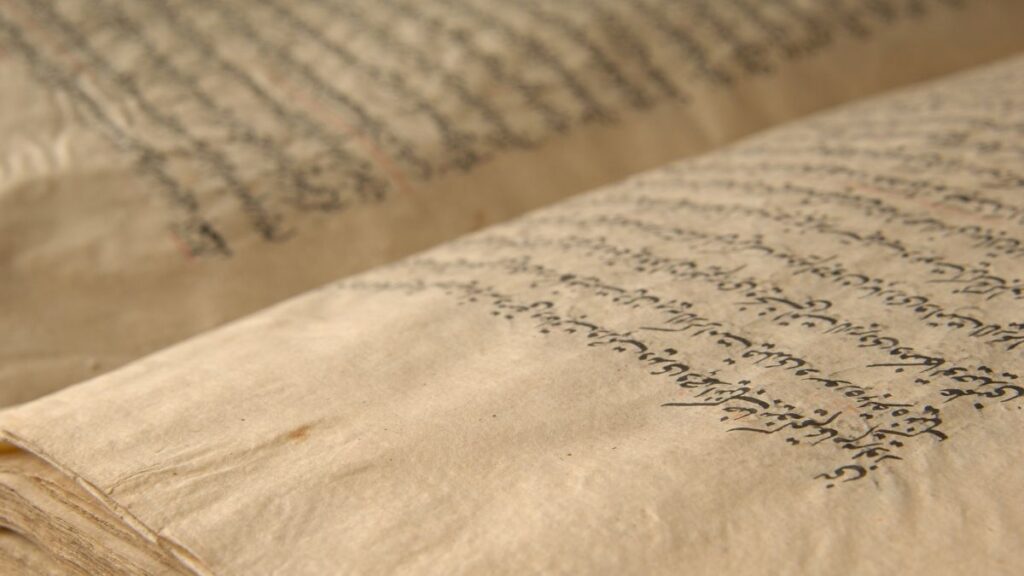
His book, which he himself did not title, was named by the people al-Kitāb — The Book — and that name alone suffices as a mark of its grandeur. It was the fruit of a long life dedicated to seeking Arabic: gathered from the mouths of Bedouins, the chests of poets, and the lamps of the Qurʾān. He composed it at a time when Arabic still breathed the air of the desert — pure, untainted by the dialects of non-Arabs or the tongues of city dwellers — so his book came as close as possible to the original spring: clear and pure, though hard to drink for those unaccustomed to such clarity.
Sībawayh lived in the second century of the Hijrah, an age when Islamic civilisation flourished — not only in architecture and warfare, but also in the pen and the intellect. He was a student of the brilliant Imām al-Khalīl ibn Aḥmad al-Farāhīdī — that unique man who founded the science of ʿarūḍ (prosody), laid the foundations of lexicography, and achieved what none before him had. Sībawayh was loyal to his teacher and followed his path, yet he soon disagreed with him on certain matters and surpassed him with deeper, sharper insight.
In those days, the Arabs revered their language as they revered their religion, convinced that the loss of Arabic meant the loss of Islam itself. Thus, the Kitāb became a guardian of Arabic, a sword in the hands of scholars, defending against errors and safeguarding the rules of syntax and morphology.
This book is astonishing to anyone who reads it without a guide: it begins without an introduction to pave the way, is not divided into clearly defined chapters, nor does it follow an easy logical order. Rather, it resembles a flowing river — issues interwoven, evidences overlapping, examples alternating — so that one might think it a maze navigable only to those granted knowledge and patience.
But whoever delves deep into it, sitting with it as a scholar sits with his companion, will find therein a magnificent method — unmistakable to the eye, impossible to elude the mind. Sībawayh begins with sound, with whispers and voiced sounds; then he proceeds to the word, dissecting and analysing it as noun, verb, and particle; then he examines its syntax, applying the governing factors, setting the rules, referring the anomalous to the standard, or leaving it with a justified exception.
Among Sībawayh’s most brilliant contributions was his introduction of the concept of ʿamal (governance) — that marvellous principle explaining how words affect one another — which testifies to his innate intelligence, analytical acumen, and boldness in establishing foundational theories. By this principle alone, he may have preceded many theories of comparative grammar unknown to Europe until centuries later.
In phonetics, he clarified points of articulation and qualities of sounds, distinguishing whispered from voiced, emphatic from plain — as if he possessed the tools of modern times, not the limited instruments of his distant era.
You also find in his Kitāb a leaning towards logic — not the abstract logic of Aristotle, but the inherent logic of the language itself: the logic of rule and analogy, of what is acceptable and what is rejected. He would distinguish between what is permissible and what is repugnant, what is elegant and what is weak, as though he possessed a grammatical taste akin to a literary taste in poetry criticism.
The Kitāb was neither neglected nor abandoned. Scholars across East and West embraced it: al-Sīrāfī explained it, al-Mubarrad completed it, Ibn Jinnī expanded upon it. They disagreed with Sībawayh, criticised him without hesitation, yet still engaged with his work and never dispensed with his knowledge.
In al-Andalus as in Baghdad, the Kitāb remained a fixture of scholarly gatherings for centuries — read, explained, and memorised — like a Qurʾān of grammar, from which not a letter was dropped without knowledge and precision.
As for modern scholars, they looked at the Kitāb differently from their predecessors. Some saw in it a grand achievement, but criticised its bias towards Bedouin speech and its exclusion of urban dialects, arguing that it enshrined an immutable ideal of eloquence that resisted linguistic evolution. Others found in it an early model of structural analysis, seeing in its divisions and progressions echoes of transformational-generative grammar.
Perhaps both sides were right: Sībawayh was a man of his time, with insights that outstripped his age, yet he did not completely transcend it. He remained bound to the highest texts: the Noble Qurʾān, the Prophetic ḥadīth, and pre-Islamic poetry. His science described what existed, rather than exploring what could be or might change.
Undoubtedly, the Kitāb has aspects open to criticism alongside those deserving praise: its style is difficult, its structure obscure, its language argumentative, burdensome for the untrained reader. His attachment to Bedouin speech — though understandable in his time — inevitably marginalised the living linguistic realities and the dynamic urban dialects that were generating a renewed, evolving Arabic.
Moreover, his treatment of meaning does not reach the level of modern linguistics, which considers semantics, pragmatics, and context in greater detail. He did not distinguish between grammatical meaning and logical or rhetorical meaning, confining his model largely to syntactic structure rather than extending it to communicative intent or situational context.
Yet if there is a science in our heritage that reached the heights, Sībawayh’s Kitāb is surely among them — a union of knowledge and reflection, taste and codification, concern for the language combined with meticulous analysis. In his Kitāb, Sībawayh was a founder of a discipline, not merely a transmitter of reports, an innovator of theories, not simply a compiler of examples.
If we read the Kitāb with the eye of a critic rather than that of a mere imitator, we shall find in it what enriches, inspires, and calls us to develop grammar, not abandon it; to understand language deeply, not freeze it in time. Whoever wishes to begin where Arabic grammar began will find no foundation more secure than this immortal work, written centuries ago, yet still teaching us today how to love Arabic and truly understand it.
Original source: