Reflections on Unity and Knowledge: A Meeting with Bangladeshs Minister
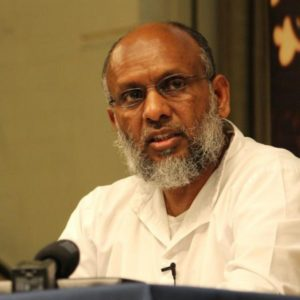
Shaykh Akram Nadwi
Muhaddith & Islamic Scholar

Disclaimer: This article was translated by AI.
Visit of the Bangladeshi Minister for Religious Affairs
By: Dr. Mohammad Akram Nadwi
Oxford
Today (Tuesday, 9 Jumada al-Akhirah 1446 AH), the Bangladeshi Minister for Religious Affairs, Maulana Dr. Abu Al-Fayz Sahib, along with a delegation, visited my humble abode in Oxford. During a gathering that lasted approximately an hour and a half, we exchanged thoughts on various academic, educational, and religious matters.
Mr. Abu Al-Fayz Muhammad Khalid Hussain Sahib (commonly known as Dr. A.F.M. Khalid Hussain), born on 2 February 1959, is a religious scholar who has also pursued education from modern universities. Since 8 August 2024, he has been serving as an Advisor for Religious Affairs in the interim government led by Nobel Laureate Dr. Muhammad Yunus. He is associated with various educational and religious organizations, and his activities in Bangladesh are quite extensive.
Maulana Abu Al-Fayz expressed his eagerness to meet me. He mentioned that he had studied my English book Al-Muhaddithat and praised it. Later, he visited my library, where he saw the 43 volumes of Al-Wafa Bi Asma’ Al-Nisa, the seven volumes of Al-Jami’ Al-Mu’in, and other works. My student, Mizanul Haque, presented one set of both mentioned books as a gift to the Minister, who expressed great joy upon receiving them. He also expressed his desire to see the Bengali translation of Al-Muhaddithat, but despite searching, the book could not be located in the library.
We had a discussion about the academic, educational, and religious conditions in Bangladesh. I mentioned that during my visit to Bangladesh two years ago, I observed an exceptional passion for seeking knowledge among the youth. Many students met me, and some of them are also my online students. Bangladesh possesses hidden potential that needs to be harnessed effectively.
When asked how Islamic unity can be maintained in Bangladesh, I remarked that sectarianism is a fatal poison for any nation. Here in England, Muslims from all sects live peacefully because there is no Muslim government. If any Muslim faction were in power here, all other sects would have been deprived of freedom. Each group would label the other as misguided, creating a toxic atmosphere.
Until the later Mughal period, all Muslims in the Indian subcontinent were united. At institutions like Madrasa Rahimiya and Farangi Mahal, people from diverse schools of thought studied together, even Shias and Sunnis. However, later on, narrow-minded individuals became dominant, considering the religion of others as doubtful. The widespread debates and issuance of fatwas deteriorated the environment, as is evident to all. Such individuals leave non-Muslims untouched but always target fellow believers.
There is a need to subordinate personal inclinations to the religion, to avoid using minor differences as a source of division, and to view Muslims as a single Ummah. Only through tolerance and broad-mindedness can we progress. In Pakistan, the environment of sectarianism poses a serious threat to the country’s integrity. The majority of scholars there work only for their respective sects, which naturally strengthens sectarianism and weakens the religion.
The honorable guest inquired about the number of my authored works and my daily routine. I briefly answered, stating that apart from reading and writing, I have no other occupation. I do not participate in social or cultural programs. When I leave the house, it is either to go to the mosque or to exercise. The saying, “A scholar’s world extends only to the mosque,” aptly applies to me. The Minister repeatedly prayed for me.
My conversation with Maulana Abu Al-Fayz was conducted in Urdu. He speaks and understands Urdu, along with other languages, but he preferred to converse in Urdu. This meeting increased my respect for the Minister. His humility and graciousness left a lasting impression on me. May Allah grant prosperity to Bangladesh and all Muslim nations and protect them from all harm.