In the name of Allah, the All-beneficent, the All-merciful
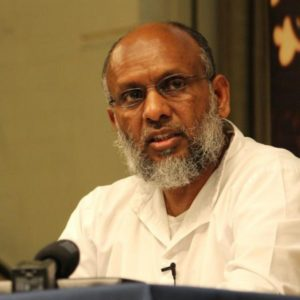
Shaykh Akram Nadwi
Muhaddith & Islamic Scholar

In the name of Allah, the All-beneficent, the All-merciful
When should the fast of Arafah be observed?
By Dr Mohammad Akram Nadwi, Oxford
Translated by Hala Akram and Aisha Akram.
Someone asked me that in India, the Islamic months usually begin a day or two after Saudi Arabia. The day in which the pilgrims stand at Arafah is the 8th day of Dhul Hijjah for us, and the 9th for us is when the pilgrims arrive in Mina to offer rami (stoning the Jamarat) and the sacrifice. My question is, if the virtue of the day of Arafah is connected to the waquf (standing), then on which day should we fast to attain its virtues?
My response:
Arafah is on the 9th day of Dhul Hijjah, a day of great virtue which is known to all pilgrims. For those who are not performing Hajj, Allah, through his grace, has given them a special opportunity to gain reward. One should recite the takbir and do dhikr, not only on that day, but during the entire first ten days of Dhul Hijjah.
There is a sahih narration in Sahih Muslim in which the Prophet, peace be upon him said, fasting on the day of Arafah expiates the sins of the previous and upcoming years, i.e. two years of sins will be forgiven. This is a very important virtue, for how many sins do we commit everyday? But fasting on this one day erases the sins of two years. Major sins are forgiven through asking for forgiveness and the like, and if one does not have any sins, he will be elevated accordingly. Hence we should not allow this precious opportunity to slip from our fingers.
After this introduction, let us now turn to the real question. In order to understand this, keep in mind that Allah has a definitive law concerning time: a person will adhere to the timings of wherever he may be. For example, if you are in Lucknow, you will offer the Fajr prayer after the dawn and before the sunrise of Lucknow. You will pray Dhuhr after the zenith in Lucknow and Maghrib after the sun has set in Lucknow. You don’t follow the timings of Makkah and Madinah for prayer times.
The qualities that Allah has related to a specific time are transferred from place to place along with that time. For example, in Japan when it is Tahajjud time there is great mercy. As time goes by, the mercy will move westward. By the time it is Tahajjud in India, the sun will have risen in Japan. This is something that everyone observes and experiences. A June afternoon in Lucknow will be very hot, yet at this exact time, it will be a pleasant morning in London. The beauty in the mornings of Banaras and evenings of Awadh are according to their times, not according to the timings of Japan or America. Similarly, the time for iftar in Lucknow will be after the sunset in Lucknow and the time of suhur will be according to the Lucknow calendar.
The same is true of the blessings of the day of Arafah. Wherever and whenever the 9th of Dhul Hijjah may be, its blessings will occur in that place, at that time. If the 9th of Dhul Hijjah in India is one day after Saudi Arabia, then the people of India will fast according to that date; even though the pilgrims will be in Mina, performing rami or the sacrifice. Likewise, the day of sacrifice in India will be according to the 10th day of Dhul Hijjah in India. The people of India will follow their own calendars and the people of other places will follow theirs.
Muslims of every community should follow their own Muslim leaders. Whatever they decide will be valid in the sight of Allah. A famous hadith found in Sunan al-Tirmidhi says: “The fast is the day the people fast, the breaking of the fast is the day the people break their fast, and the sacrifice is the day the people sacrifice”. This means that Ramadan, Eid al-Fitr and Eid al-Adha are communal acts. Mulsims of every place should celebrate this day with their scholars and leaders.
May Allah help us to do the utmost good deeds and avoid sins in these blessed days. Amin.