In the name of Allah, the All-beneficent, the All-merciful
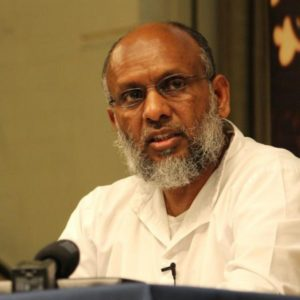
Shaykh Akram Nadwi
Muhaddith & Islamic Scholar

In the name of Allah, the All-beneficent, the All-merciful
My late father, May Allah have mercy on him
By Dr Mohammad Akram Nadwi
Oxford
Translated by Mohsina, Fatima and Aisha Akram
Yesterday (Friday 4th Ramadan 1442 / 16th April 2021) my father, Tajammul Hussain departed from this world. The hour that the heart dreaded at the mere thought of eventually came. After seven years of separation, my mother and father have reunited. May Allah forgive their sins, envelop them in His mercy and grant them a place in Jannat al-firdaws, amin.
I am far away from home. When I call my brothers and sisters, I can hear the cries and sorrow in their voices. Two nights have passed and I have not slept well. I am restless, I sometimes pray, and I sometimes think about the problems that my family are to face. This is such a grief that weakens even the stoic. I console myself that the people of knowledge and wisdom suffer a thousand sorrows in silence, and I claim to follow their sunnah.
If I try to write down my countless memories of Abba, it’ll be like a cluster of fireflies glowing and dimming. That small village comes to mind. The roads and streets were so familiar, I still yearn for them. The history of its people has been close to my heart. It’s people were familiar with each other. The people were less known by their names and more by their titles and nicknames given by relatives. Amongst them were Dada, Baba, Chachcha, Bhai, Laddu, Guddo, Achchan, Jumman. They shared each other’s pain, their mannerisms and words were so pure and simple. They were unfamiliar with the art of similes and metaphors . They never knew how to express themselves in poetic language. They were human beings and simplicity was a reflection of their nature. They would remember each other’s dates of birth with reference to a famous incident. Whenever I wanted to know Abba’s date of birth, the elders of the house would say that he was still a child at the time of Gandhi’s assasination (30th January 1948). According to this he was 75 years old or more when he passed away.
My paternal grandparents were not very educated, but they were simple, pious and soft-spoken. They lived a modest life and did not have many sorrows. They performed Hajj; their recollections about hajj were fascinating. My paternal grandmother was from Kichhauchha Sharif. Her brother was a devotee at the shrine of Ashraf Jahangir Semnani (may Allah have mercy on him). As a child I used to see him frequenting my house, in fact I was named by one of my grandmother’s brothers. At that time the Pakistani wrestler Akram Pahalwan was quite popular. My grandmother’s brother was a fan of wrestling and so he named me after Akram Pahalwan.
My grandparents wanted to teach their children religious education. My paternal aunt’s husband, Maulana Abdul Qayyum Sahib (may Allah have mercy on him) lived in Bakhra (Azamgarh District). He was a graduate of Deoband and a student of Mawlana Anwar Shah Kashmiri (may Allah have mercy on him). He had good character and was pious; I had the pleasure of accompanying him. He was a teacher at Baitul Uloom Saraimeer. My paternal uncle was inspired by him and went to that school to do hifz there. Hafiz Naseem Sahib (may Allah have mercy on him) also from Bakhra was a hifz teacher there. Abba started hifz under his tutelage.
Later, Hafiz Naseem Sahib moved to Madrasa Zia-ul-Uloom, Mani Kalan. My grandfather had a special attachment to Hafiz Ji, and this new madrasa was very close to our village, so Abba enrolled at Zia-ul-Uloom. After completing hifz, Abba studied introductory Persian and Arabic texts. It was during this time that he married and his studies remained incomplete. I think he studied Arabic and Persian from Hafiz Umar Sahib (may Allah have mercy on him). Abba always used to call them his teachers and would respect them as a student respects his teacher.
When I started going to Madrasa Zia-ul-Uloom, I used to hear stories about Abba. In fact some teachers were surprised as a few years earlier the father used to study here and now the son does. I studied Gulistan, Bostan, Meezan, Munsha’ib, Panjganj, and Nahw Mi and other texts using my father’s books. These books remained in my house for many days, but I no longer know of their whereabouts.
When I was very young and studying at the village school, Abba used to go to Madrasa Zia-ul-Uloom every Thursday to listen to Mawlana Abdul Halim Sahib’s lectures. Sometimes he would take me along. Once he asked Mawlana to make a special dua for me; he blew into a bottle of water and I continued to drink from it for a long time as a means of blessings. Abba wanted me to have a sharp mind and strong memory, for which he used to feed me Dimagheen. It tasted so good that I would have it with great keenness and the bottle would finish earlier than it should have.
Abba was fond of raising pigeons; there were around a hundred pigeons in our house. As children, their voices sounded as familiar to us as the voices of family members., We used to recognize them and they would recognise us. Abba was also keen on bird hunting. We had a Germain air gun which he used to hunt with. His aim was so accurate that he would place a five pence coin at a distance and would shoot right in the middle of the number five. As a child, I ate a lot of bird meat. Even if I try to forget its taste, I can not. As the verse says: “And flesh of fowls that they desire”. And what can I say about bird broth? There is nothing like it, the thought of it makes my mouth water! If Abu al-‘ala ma’ri who was a vegetarian was at my dining table having this food, he would repent from vegetarianism.
Abba used to enjoy reading Urdu books. As his Persian was good, he never had any difficulty with Urdu. He was at the forefront of religious and community work in the village, infact for a while he was the director of the village school. He was firm in faith and deeds, adorned with good morals, had good relations with the common people of the village and was respected by all. He was also friendly with non Muslims. Occasionally the Hindus who knew him used to come and visit him. The graveyard in our village is very big, a Hindu occupied a part of it. During that time, Abba used to come to Lucknow a lot to fight this case and would stay with me at Nadwa-sometimes the Hindu gentleman would be with him and would also stay with us. Despite fighting a lawsuit against each other there was no animosity between them. The Hindu gentleman lost the case but still retained control of the occupied land. Due to this issue, Hindu-Muslim riots took place in our village. Muslims in India are currently going through a severe test, may Allah have mercy on us.
Abba used to meet my teachers at Nadwatul Ulama and ask about me. He used to talk to Mawlana Shahbaz (may Allah have mercy on him) the most. He was very happy that he never heard a complaint against me. Once, my teacher Hazrat Mawlana Saeed al-Rahman Azmi (may Allah have mercy on him) was a little angry with me and Abba was unaware of this. At that time, he happened to come to Nadwa and asked him about me. My respected teacher replied that he is okay in his studies but he should take a teacher as a mentor, for how many intelligent people have perished as a result of no mentorship. May Allah help us to follow the words of the respected Mawlana (may Allah have mercy on him).
Abba used to advise me often. During my childhood, he used to live in Bhiwandi for business. Once I was with him and he took me to Bombay to meet a relative. There was a very tasty dish which I ate plenty of. He later told me that one should not eat too much in another’s house; this advice always remained with me.
Another piece of advice that I benefited from is the story Abba told me about an art student. He produced a nice painting and displayed it at the bazaar and said that if anyone sees any mistakes, he should mark them. When he went in the evening, he saw that there were marks on every part of the painting. He returned home and was very frustrated and anxious. His father asked, “What happened my son?” The son replied, “I wasted my life, there is nothing right with my painting”. His father reassured him and asked him to make another painting but this time write down that if there is something wrong with it, then make a painting without any mistakes. When he went to the bazaar that evening, there were no signs on the painting and no one had tried to make their own painting. He was very happy.
There is no shortage of critics in this world who do not value people’s knowledge or research, nor do they recognise a good poet or artist. Around twenty years ago I wrote ‘A students day at Nadwa’. A gentleman commented that the book does not detail the nights at Nadwa; he promised to write ‘A night at Nadwa’ which has yet to be written. Another gentleman said ‘A students day at Nadwa’ is too serious, so I asked him to write a light-hearted book. So far he has not been able to do so. Ten years ago, I wrote a book in English about women’s prayer in the mosque. A message came from a gentleman that he was going to write against my book, but he has not done so yet.
Abba performed Hajj twice with Amma, and on both occasions I accompanied them. He also travelled to perform Umrah alone once or twice. He used to do good deeds. He was friends with Haider Ali of the village; their friendship is about forty years old. They were together from morning to evening. This companionship is rarely seen. The two would support each other on every occasion of happiness and sorrow. When I spoke to Haider Uncle on the phone he said whenever the people of the village withdrew from me, Hafiz Ji always supported me.
He was a member of the Tablighi Jamaat, for a while he remained the preacher in the village. From time to time, he would go for forty days in Tablighi Jamaat and would attend gatherings. In 1977, there was a Tablighi Jamaat gathering in Nadwa, and I joined them. One year later, I was admitted into Nadwa. One of his most important virtues was that he gave his two sisters a share of his father’s inheritance. He wanted women to get their share of what is stated for them in the noble Qur’an.
There is a lot to say about Abba, however it is difficult to list them all in this short article. I am content with that. May Allah forgive our parents and guide us to the path of the righteous, Amin.